India’s Auto Makers Struggle With Sharp Shift in Economy
September 19, 2013, 7:11 a.m. ET

India’s Auto Makers Struggle With Sharp Shift in Economy

SEAN MCLAIN

AI-CD660_INDCAR_G_20130919064810

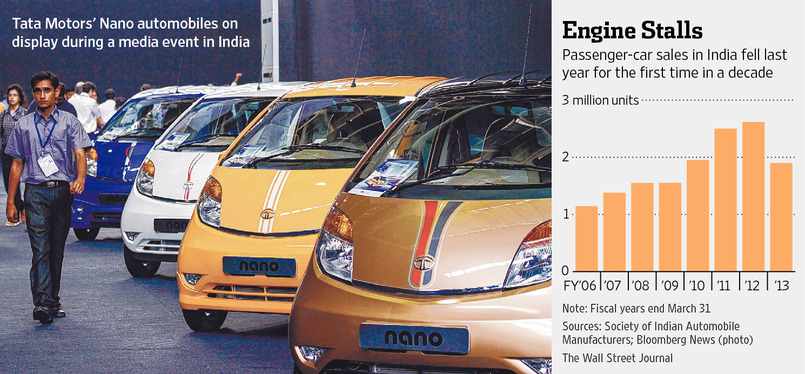
NEW DELHI— For years, Udayan Banerjee’s business making automobile exhaust systems was in high gear as middle-class Indians flocked to buy cars. This summer, that came to a screeching halt. “July and August were the worst months I’ve ever seen,” Mr. Banerjee said, predicting that his Sharda Motor Industries Ltd. 535602.BY +7.38% would post a loss for this year’s third quarter. Until recently, India was seen as a potential new Asian tiger, powered by its globalized information-technology industry, and auto makers were among the biggest beneficiaries of a boom in consumer-driven growth. Now they are reeling as investors pull back from emerging markets around the world, exposing the frailties of an Indian economy that was already decelerating sharply even before the global market turmoil. Read more of this post
Indonesian oil and gas: Crooked pipelines

Indonesian oil and gas: Crooked pipelines

Sep 6th 2013, 4:54 by N.O. | JAKARTA

GIVEN his industry’s woes, Lukman Mahfoedz is surprisingly upbeat. As Indonesia’s oil-and-gas sector reels from its most recent scandal, the president of the Indonesian Petroleum Association is relaxed when he greets your correspondent at his office atop a gleaming high-rise in Jakarta’s business district. On August 13th anti-corruption investigators arrested the chairman of the country’s upstream regulator, Rudi Rubiandini, on suspicion of accepting a $700,000 bribe. He had only been in the job eight months (last November the Constitutional Court dissolved the previous regulator, an independent watchdog, to install one under the control of the energy ministry). This new scandal strikes at an ailing industry. Indonesia’s oil production has been in decline for decades. Some predict that its proven reserves of about 4 billion barrels could be exhausted by the mid-2020s. Read more of this post

Indonesia Warned of Weak Human Capital

Indonesia Warned of Weak Human Capital

By Anushka Shahjahan on 9:11 am September 19, 2013.
The vision of an integrated regional economic community by 2015 is aimed at liberalizing trade among the 10-member Association of Southeast Asian Nations, but questions remain over whether the countries are ready for it and how Indonesia will benefit from the integration. A press statement released after the ninth Asean Economic Community council meeting said that 77.5 percent of the regulatory and economic measures under the blueprint had already been implemented. Read more of this post

Blue Bird Taps Taxi Know-How to Expand Logistics: Southeast Asia

Blue Bird Taps Taxi Know-How to Expand Logistics: Southeast Asia

The owner of Blue Bird, Indonesia’s biggest taxi operator, plans to boost revenue from logistics at least fivefold by delivering more sandwiches and electronics to a burgeoning middle class. The Djokosoetono family, whose Iron Bird unit transports dry and chilled goods to 7-Eleven convenience stores in Jakarta, plans to increase the share of logistics in group sales to more than 50 percent “ideally,” from about 10 percent now, said Noni Purnomo, a director at PT Pusaka Citra Djokosoetono, the parent company of Iron Bird and Blue Bird. Purnomo didn’t specify a timeframe for the target. Read more of this post

Mooncakes Go Unsold as Vietnam Slowdown Hurts Companies

Mooncakes Go Unsold as Vietnam Slowdown Hurts Companies

By noon on a recent weekday, Nguyen Thi Hanh hadn’t sold a single mooncake at her sidewalk kiosk set up for the Mid-Autumn Festival on a busy street in Hanoi. She squatted on the ground to tend to her embroidery, instead. “I’m very worried the slow sales will cut into my bonus this year,” said the 52-year-old vendor, who sells the sweet pastry stuffed with mung beans at 36,000 dong ($1.70) each for a local food chain. Sales are about half of last year’s, she said Sept. 3, about two weeks before the festival. “There’s no way I can meet the quota set by the company if this continues.” Read more of this post

Malaysian Kuan Kam Hon Proves Billionaire Making 45,000 Gloves an Hour in Hartalega

Malaysian Proves Billionaire Making 45,000 Gloves an Hour

Kuan Kam Hon saw the need for rubber gloves during the early years of the AIDs epidemic. At the time, health-care workers and others were increasingly using the gloves to protect themselves against the virus and other infectious diseases. So Kuan turned his stagnating woven-label and badge manufacturing plant into a maker of latex gloves. The decision has made Kuan, 66, a billionaire. His Kuala Lumpur-based company, Hartalega Holdings Bhd., has soared 56 percent this year, reaching an all-time high Wednesday. Kuan and his family own 55 percent of the company. He has never appeared on an international wealth ranking. Read more of this post

The Fed’s Commitment Issue; Surprise Decision to Hold Off on Scaling Back Bond Purchases Shows It Hadn’t Convinced Investors It Intends to Keep Short-Term Rates Low for Longer

Updated September 18, 2013, 7:12 p.m. ET

The Fed’s Commitment Issue

Surprise Decision to Hold Off on Scaling Back Bond Purchases Shows It Hadn’t Convinced Investors It Intends to Keep Short-Term Rates Low for Longer

JUSTIN LAHART

MI-BY547_FEDHER_G_20130918181804

On second thought, maybe not. The Federal Reserve’s decision not to reduce monthly bond purchases got a rousing cheer from investors Wednesday. Stocks rallied, sending the Dow Jones Industrial Average to a new record, as did Treasurys, pushing yields sharply lower. The response was good news for the Fed—higher stock prices and lower long-term interest rates offer more support to an economy that remains in a rut. But it also could make for some headaches down the road. Read more of this post

Giant state-owned firms have fallen back out of fashion. Good

Giant state-owned firms have fallen back out of fashion. Good

Sep 21st 2013 |From the print edition

BACK in 1987 the rock band Bon Jovi was top of the pops and the world’s third-largest firm by value was Tokyo Electric Power (TEPCO), a utility in Japan few outside that country had heard of. Today Bon Jovi is still churning out number-one albums but TEPCO’s value has fallen by 90% and it is teetering on bankruptcy. It is now known around the world for the disaster at its nuclear power plant at Fukushima. Like pop charts and Olympic medal rankings, corporate league tables are both silly and compelling. They reflect the ups and downs of firms, which investors amplify by buying or dumping their shares with less fealty than a teenage music fan. But they are also a crude test of economic virility. Read more of this post

SEC Thinks Disclosing Worker Pay Will Shame CEO’s?

SEC Thinks Disclosing Worker Pay Will Shame CEO’s?

There’s an obvious illogic in efforts to use disclosure to shareholders as a way to stop things that politicians dislike. Shareholders love things that politicians dislike. Conflict diamonds? Oh, sure. Giant executive paychecks? Why not. In fact, the last time regulators tried to shame companies out of paying their chief executive officers too much — by requiring them to disclose how their pay compared to that of their peers — they ended up driving up executive pay. Why would any company want an average CEO? Everyone has to get top-quartile pay. Read more of this post

One-Hundred-Year Bond Wiped Out by 21-Cent Plunge: Mexico Credit

One-Hundred-Year Bond Wiped Out by 21-Cent Plunge: Mexico Credit

Three years after Mexico took advantage of the Federal Reserve’s unprecedented stimulus effort to sell the world’s longest-dated government debt, the Latin America nation’s timing is proving to be prescient. Mexico’s bonds due 2110 have plunged 21.2 cents since Fed Chairman Ben S. Bernanke said on May 22 that policy makers may taper their asset purchases of $85 billion each month. On a total return basis, the 17.4 percent decline was the most among investment-grade sovereign notes maturing in 30 years or more, according to data compiled by Bloomberg. At 92.94 cents on the dollar, the 100-year bonds currently trades below their issue price of 94.276 cents and yield 6.19 percent. Read more of this post

Wealthy Borrowers Sacrifice Upside for Down Payment Aid

Wealthy Borrowers Sacrifice Upside for Down Payment Aid

Jeff Uter would have needed to sell stocks or pull cash out of his consulting business to afford the down payment on a $780,000 home in Orange County, California. Instead, he paid half of the 20 percent required and got the other $78,000 from San Francisco-based FirstRex. In exchange, the real estate investment firm will get 40 percent of any gains in the value of Uter’s 4-bedroom condo in a golf course community. “I have stocks and my own business,” said Uter. “I’d rather invest in that than put it in a personal residence.” Read more of this post