China said consumers will need to bear some of the costs of tighter fuel standards, opening the door to higher prices at fuel pumps
September 24, 2013 Leave a comment
September 23, 2013, 11:15 a.m. ET
China Says Consumers Need to Bear Some Costs of Tighter Fuel Standards
China said consumers will need to bear some of the costs of tighter fuel standards, opening the door to higher prices at fuel pumps.
WAYNE MA
BEIJING—China said Monday that consumers will need to bear some of the costs of tighter fuel standards, opening the door to higher prices at fuel pumps as the nation balances growing public concern over the environment with worries about inflation. The announcement comes after a number of episodes of severe air pollution in recent months in Beijing and several other places. The government also Monday mapped out plans to combat air pollution, including limiting the number of motor vehicles in Beijing to six million by 2017. In January, the official Xinhua news agency said Beijing had around 5.18 million vehicles.The National Development and Reform Commission, China’s top economic planning agency, said Monday that higher costs to improve nationwide fuel quality will be borne by both the refining industry and its consumers. It didn’t elaborate.
“Currently, the situation of the atmospheric environment in China is grim,” the NDRC said on its website.
Tiny particulate matter in the air has “harmed the health of the population and has had an impact on society and harmonious stability,” it said.
Chinese refiners have resisted costly upgrades to raise fuel standards because of Beijing’s strict control over fuel prices, which has made it difficult to pass on higher costs to consumers. However, the Chinese government unveiled an overhaul to its fuel-pricing system this year, which has improved bottom lines and made it easier for other changes.
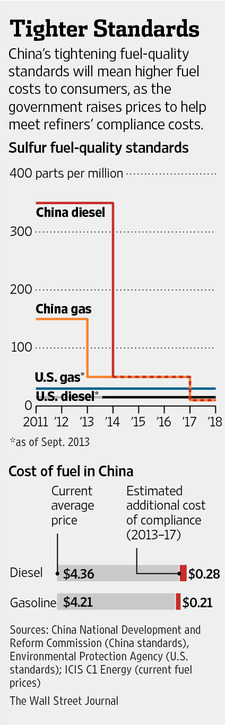
China, which has lagged behind Western countries in fuel standards, plans to improve fuel quality over time using a road map similar to that followed by the U.S. and Europe. For example, one target is to limit the concentration of sulfur in gasoline to 50 parts per million from 150 parts per million before the end of this year.
The NDRC said China’s two largest refining companies pegged the cost of doing that at 290 yuan a metric ton, or about 13 U.S. cents a gallon. It wasn’t known how much of that cost would be passed on to consumers. The average price of gasoline in China is about $4.21 a gallon, consultancy ICIS C1 Energy said.
The NDRC said that because of rapid growth in car ownership in China, vehicle emissions now account for between 20% and 30% of the country’s overall emissions of PM 2.5—tiny particulate matter harmful to human health.
Meanwhile, the NDRC said it wouldn’t raise fuel prices immediately but allow for a gradual transition over the next few years, which also will be determined by local governments. It also said it would temporarily subsidize grain farmers and the forestry, fishery and transportation sectors to ease the impact on consumers.
 About bambooinnovator
 Bamboo Innovator