How do you spot a real van Gogh? Van Gogh himself was characteristically gloomy in his own assessment of his efforts: it was “well below what I’d wished to do”
September 24, 2013 Leave a comment
The Economist explains
How do you spot a real van Gogh?
Sep 23rd 2013, 11:31 by T.W.
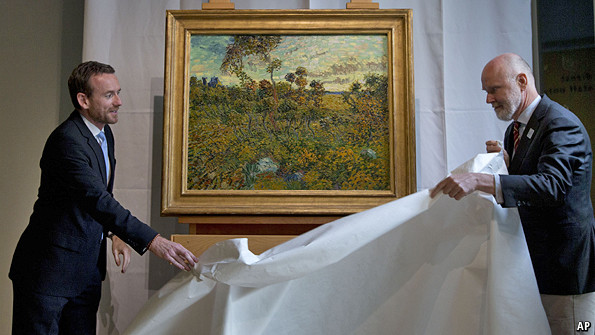
ON SEPTEMBER 24th a newly discovered painting by Vincent van Gogh is due to go on show in Amsterdam. “Sunset at Montmajour”, a dazzling depiction of a landscape near Arles, in southern France, was painted in 1888 but lay unloved in an attic for decades because it was believed to be a fake. But earlier this month experts at the Van Gogh Museum, where it will be on show, declared that it was the real thing after all, sending its value soaring. How do they know it is genuine? Van Gogh famously sold only one painting during his short life. “Sunset at Montmajour”, a 37-by-29-inch canvas, was bought in 1908, 18 years after his death, by a Norwegian businessman, Christian Nicolai Mustad. According to the AP news agency, Mustad had it on display until the French ambassador to Sweden told him (wrongly, it turns out) that it was a fake. The masterpiece was promptly hidden away in the attic. When Mustad died in 1970 the painting was bought by a collector. Experts at the time said they too thought that the unsigned canvas was a fake, or the work of a lesser painter.A piece of old-fashioned detective work changed their minds. A new collection of van Gogh’s letters was made available to researchers, who spotted a giveaway in a letter from van Gogh to his brother Theo, written on July 5th 1888. In it he described a landscape he had painted the previous day: “At sunset I was on a stony heath where very small, twisted oaks grow, in the background a ruin on the hill and wheat fields in the valley.” That rang a bell. “It was romantic…The sun was pouring its very yellow rays over the bushes and the ground, absolutely a shower of gold.” This description was enough to make the museum’s experts believe they might have a new van Gogh on their hands. Using modern scientific analysis they were able to confirm their suspicions: chemical tests found that the paint was the same as that used by van Gogh in other paintings from Arles, and an X-ray showed that the canvas was his usual type.
Van Gogh himself was characteristically gloomy in his own assessment of his efforts: it was “well below what I’d wished to do”, he said. Today’s collectors disagree: nowadays van Gogh’s works change hands for tens of millions of dollars. “Sunset at Montmajour” is the first full-sized canvas to be discovered since 1928. Tantalisingly, there could be more of them still to be discovered. Van Gogh completed more than 800 paintings in his short life. No one knows quite how many survive, partly because of the artist’s tendency to destroy the canvases that he wasn’t happy with. But the letters suggest there could be more missing van Goghs out there, unidentified, unloved and uninsured. Time to check the attic.
 About bambooinnovator
 Bamboo Innovator