Humble Chinese Village Basks in Legacy of Three Kingdoms Era; “The Three Kingdoms” is to China what “The Iliad” is to the West. But unlike “The Iliad,” “The Three Kingdoms” has wide appeal in modern times. Mao Zedong supposedly studied it for strategy lessons
September 24, 2013 Leave a comment
September 22, 2013
Humble Chinese Village Basks in Legacy of Three Kingdoms Era
By EDWARD WONG
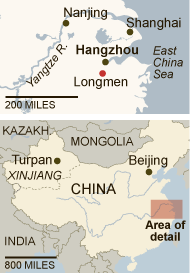
LONGMEN, China — In the shadow of a lush mountain and near a slow-moving river in southeast China sits this village, whose name means Dragon Gate. There are narrow alleys and whitewashed homes and the flesh of sliced bamboo drying on the ground. Its humble appearance, though, belies the fact that it played a role in the famous Three Kingdoms era, when kings leading rival states fought in the third century over the right to succeed the Han empire. The blood-drenched stories were immortalized in a 14th-century classic by Luo Guanzhong, “The Romance of the Three Kingdoms,” which in turn has spawned countless films, television shows and other adaptations. “This village is so important because the people are descended from Sun Quan,” said one resident, Sun Yaxiao, 25, as she walked with visitors one afternoon through the alleys. Sun Quan was one of the three major kings in the early period of the Three Kingdoms, a figure known to most Chinese.“People named Sun are rare; there just aren’t that many,” she said. “There aren’t as many as those named Huang, for example.”
The village has managed to capitalize on its association with Sun Quan, even though the king never actually lived here. It was his grandfather Sun Zhong, a melon farmer, who was said to be a resident, even though that is debated among scholars. Longmen charges a $13 entrance fee to outsiders, who usually make the 30-mile drive from the provincial capital of Hangzhou.
There are countless hamlets, towns and cities across China that boast of links to the four or five towering classics of Chinese literature and the historical events on which those works are based. Virtually all Chinese learn these tales, which mix history and myth, and so residents of otherwise obscure locales leap at the chance to latch on to the legends, sometimes for profit.
In the western region of Xinjiang, for instance, the desert town of Turpan has become a big tourist draw because of its proximity to the Flaming Mountains, the site of a well-known episode in “Journey to the West,” a 16th-century novel about the Monkey King’s pilgrimage to India that, like “The Romance of the Three Kingdoms,” is also based on history.
“The Three Kingdoms” is to China what “The Iliad” is to the West. Its tales of battlefield heroics and betrayal, palace intrigue and passions, stir the imagination here. It also resonates with the Chinese because its sweeping narrative encapsulates a historical rhythm that they see as an immutable fact, one expressed in the opening lines: “The empire, long divided, must unite; long united, must divide. Thus it has ever been.”
But unlike “The Iliad,” “The Three Kingdoms” has wide appeal in modern times. Mao Zedong supposedly studied it for strategy lessons. John Woo, the Hong Kong filmmaker, recently directed an epic, “Red Cliff,” based on a famous battle from the novel. The film was the top earner at the Chinese box office in 2008.
Places associated with heroes and villains from “The Three Kingdoms” — Liu Bei, Zhuge Liang, Guan Yu, Cao Cao and, of course, Sun Quan — are scattered across China.
“In China, there are simply too many places that have become famous because of the Three Kingdoms,” said Fang Beichen, a scholar of the Three Kingdoms at Sichuan University who has visited Longmen. “The number is over a hundred. It’s a very common phenomenon in China.”
Mr. Fang said Longmen’s ties to the Three Kingdoms were “at best mediocre.” South of the Yangtze River, where Sun Quan’s Kingdom of Wu once existed, there are places with more famous links to the ancient king. The area around Nanjing, where the kingdom’s capital once stood, has a mausoleum reputed to contain Mr. Sun’s remains and a stone citadel that Mr. Sun ordered built, Mr. Fang said.
That has not stopped residents of Longmen from claiming not just ties to the Three Kingdoms but to other famous figures — Sun Yat-sen, the 20th-century revolutionary intellectual from Guangdong Province, and Sun Tzu, the author of “The Art of War.”
Ordinary residents take obvious pride in the village’s ancient roots. Sun Yaxiao, the young woman showing visitors around, boasted that the village had 80 homes dating to the Ming dynasty (1368-1644) and 40 to the Qing dynasty (1644-1911). She said villagers began preserving the homes in 2002, when they realized there was tourism potential. About 10 of the 120 or so buildings are open to the public. Directors of a half-dozen minor films have shot scenes in the village.
There is an ancestral hall with dark wooden pillars, red lanterns and a cobblestone courtyard. On one wall is a drawing of a complicated family tree showing the dozens of generations of Suns.
“In all of China, this is the place with the most people named Sun,” said Ms. Sun, with perhaps a bit of exaggeration. “The Sun people have gone everywhere — Korea, Singapore and so on.”
Outside the hall, another villager, Sun Ruqi, 16, stood by a street stand selling stinky tofu and liquor made from fermented sorghum, two somewhat dubious local specialties. Badminton rackets are another local specialty — a factory in a nearby village makes them. She was among the Suns who might leave the village a few years from now. “Many young people go out to find work,” she said. “This is a small place.”
But Longmen plays a big role in local Three Kingdoms lore, according to one resident, Sun Wenxi, who wrote a book on Longmen folk tales. One legend, he wrote, says that Sun Quan attained his monarchical status because of the generosity of his grandfather, the melon farmer. When the grandfather came across three elders passed out in a field one day, he shared half a melon with them. They turned out to be immortals who promised Mr. Sun that within four generations, a king would arise within his family.
Sun Quan’s legacy is a mixed one, though, and his story in “The Three Kingdoms” is one of shifting loyalties. He met an ignominious end. Yet he remains “a very special figure” in Chinese history, Mr. Fang said.
“In the first half of his life, Sun Quan was modest and enterprising, readily following good advice,” he said. “But in the second half of his life, he became corrupt and depraved, purged loyal and faithful officials and became a loser in the competition for power. The Wu Kingdom’s prosperity came to an abrupt end. Decline and chaos followed. It’s very important to learn from his lesson, for an individual, a family and the state.”
 About bambooinnovator
 Bamboo Innovator