New Zealand’s Privatization Effort Propels IPO Market
September 24, 2013 Leave a comment
Sep 23, 2013
New Zealand’s Privatization Effort Propels IPO Market
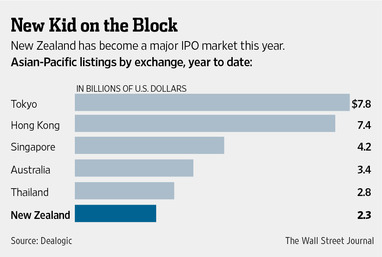
New Zealand has a reputation for punching above its weight in everything from dairy exports to the America’s Cup. Now it is doing that in the financial arena. Despite being home to only 4.5 million people, the South Pacific nation this year ranks among major global markets for initial public offerings, thanks to a government privatization drive that has put the stock exchange on pace for one of its best-ever years for IPOs by value. So far this year, NZX Ltd.NZX.NZ -0.78% has hosted a total of US$2.3 billion of IPOs, nearly double the $1.3 billion raised over the previous six years combined, according to data provider Dealogic. That has catapulted it into sixth place among the Asian-Pacific region’s top IPO markets—behind Japan, Hong Kong, Singapore, Australia and Thailand—and puts it in 14th place world-wide.Meanwhile, the benchmark NZX-50 share index hit an all-time high last week and is the second-best performer in the region this year, behind only Japan’s Nikkei Stock Average.
The banner year has also seen New Zealand’s economy stoked by billions of dollars of reconstruction in earthquake-hit Christchurch, the country’s second-largest city. The economy grew 2.5% in the three months through June from a year earlier, encouraging consumers to spend more on everything from new houses to big-screen TVs.
“New Zealand has growth fundamentals that a lot of countries would like to have,” said Martin Poulsen, Auckland-based head of wealth management at broker First NZ Capital.
The strong performance of the NZX-50, which has gained 16% this year, no doubt has further underpinned consumer confidence. The index includes the accumulative value of dividends, which inflates gains.
The privatization program driving the new listings is intended to help restore the government’s budget to a surplus in the fiscal year through June 2015, ending five years of deficits, by raising around five billion New Zealand dollars (NZ$4.2 billion). The government has already raised NZ$1.7 billion from the sale of a 49% stake in electricity generator Mighty River Power Ltd.MYT.AU -1.73%
And there’s more to come. On Friday, government officials revealed details of the biggest sale of a state-owned asset in the country’s history—the IPO of Meridian Energy Ltd. The government wants to sell 49% of the company, which supplies electricity to households and businesses, and estimates the stake to be worth at least US$1.6 billion. The targeted listing date is Oct. 29.
It also plans to sell 49% of Genesis Energy Ltd. and 23% of listed flag carrier Air New Zealand Ltd.AIR.NZ +0.70% The Air New Zealand stake is valued at about NZ$350 million and might be sold later this year. The Genesis Energy offering, likely to raise around NZ$1 billion, is expected early next year.
New Zealand’s best year for IPOs by deal value was 1997, when US$10.6 billion was raised. However, US$10 billion of that came from the listing of Telstra Corp.TLS.AU -0.30%
It hasn’t all gone smoothly this year. Shares in Mighty River Power have fallen nearly 10% since their debut in May from an offering price some analysts have said was too high. Also, the government needed an 11th-hour deal last month with Rio Tinto—a major Meridian customer—to keep the energy provider’s IPO on track. Rio Tinto, majority owner of New Zealand Aluminium Smelters Ltd., had threatened to shut the operation, which takes around 40% of Meridian’s energy output, unless Meridian lowered its power prices.
The new life in New Zealand’s IPO market is giving a helping hand to the Australian Securities Exchange, where listings of domestic companies have stagnated. Mighty River Power and New Zealand fuel retailer and refiner Z Energy Ltd., which raised US$677 million in an IPO last month, were also listed on the ASX. The New Zealand government also plans a secondary listing in Australia for Meridian.
Expectations that the New Zealand dollar will rise against the Australian dollar have kindled interest in the IPOs among Australian fund managers looking to place bets on swings in the currencies, Mr. Poulsen said.
Some foreign investors might be deterred by the New Zealand market’s size; the NZX-50 has a capitalization of NZ$79 billion, compared with around US$1.3 trillion for Australia’s S&P/ASX 200.
Still, the IPO outlook appears positive for the next 12 to 18 months, said Brian Gaynor, an executive director at Auckland-based Milford Asset Management. “There are a number of companies coming through the door—two or three a week—looking at listing,” he said.
 About bambooinnovator
 Bamboo Innovator