Growing logistics market in China struggles to contend with smuggling

Growing logistics market in China struggles to contend with smuggling

Xinhua

2013-09-22

China is struggling to combat illegal imports which smugglers conceal in mass freight as the country’s logistics industry booms. On Tuesday, police dumped a large batch of smuggled goods in a landfill in Nanning, capital of south China’s Guangxi Zhuang autonomous region. Around 200 tonnes of items were destroyed, including frozen chicken and beef. In the third quarter of this year, Nanning police have cracked a number of smuggling cases, featuring 2,700 kg of pork of questionable quality and 970 tonnes of other frozen goods. In recent years, smugglers have turned to disguising banned goods in large cargoes, which have become much more common as the logistics industry expands. Read more of this post

Brazil risks lost decade as it bungles infrastructure boost; Transport investment still lags far behind other large economies

September 22, 2013 2:22 pm

Brazil risks lost decade as it bungles infrastructure boost

By Joe Leahy in São Paulo

Transport investment still lags far behind other large economies

Officiating at a railway project last week in Rondonópolis in the Brazilian soya bean state of Mato Grosso, President Dilma Rousseff said the country was “two centuries” behind when it comes to building its rail network. A similar point, although to a lesser degree, could be made for the rest of the country’s transport and logistics networks. Brazil’s highway system lags behind probably by 50 to 60 years, the same for ports, urban transport and airports. The government is trying to fix this. But as shown by two landmark tender processes last week – one for highways and the other for oil exploration blocks – it needs to get moving or risk condemning Brazil to a lost decade in terms of higher potential economic growth. Who is responsible for this mess? Most countries, developing or developed, struggle with infrastructure construction and Brazil is no exception. Read more of this post

China’s internet firms find new battle pitch in smart TV

China’s internet firms find new battle pitch in smart TV

Staff Reporter

2013-09-23

Internet television is set to explode this year. In China, internet companies such as Alibaba Group, Tencent Holdings, and Xiaomi Technology, as well as online video portal LeTV.com, all have jumped on the internet TV industry, but which one can eventually stand out remains to be seen, China Entrepreneur Magazine reports.

Internet TV, or online TV, is the digital distribution of TV programs via the internet. Earlier this month, Xiaomi simultaneously introduced its Xiaomi 3 handset and the Xiaomi TV, but the backbone of the company — the smartphone — has yet to be tested by the market, the report said. Xiaomi described its TV product as “equipped with 47-inch 3D Smart TV, the first TV for young people.” In the eyes of Xiaomi chairman Lei Jun, a smartphone is the TV remote control, while the TV is the phone’s display. Larger phone screens are still not satisfying to the video-viewing crowd, Lei said. The best solution to resolve the small-screen problem is to link the phone to the TV, hence the creation of Xiaomi TV. Read more of this post

WeChat monetization takes a celebrity twist; For a membership fee, WeChat users can now have their favorite movie stars wake them up in the morning, see unretouched celebrity photos, and read books published by famous writers

WeChat monetization takes a celebrity twist

BEIJING, Sept. 22 (Xinhua) — China’s most popular instant-messaging service now offers a more intimate way for fans to interact with celebrities — and it comes with a price. For a membership fee, WeChat users can now have their favorite movie stars wake them up in the morning, see unretouched celebrity photos, and read books published by famous writers. The official WeChat account of Chinese actor Chen Kun now asks users to pay 18 yuan (2.92 U.S. dollars) a month for exclusive content. Given Chen’s massive popularity and WeChat’s 400 million-plus users, analysts say the account could generate a substantial amount of revenue. Read more of this post

Brooks Brothers, national retailers analyze ‘big data’ from sales to adjust marketing

Brooks Brothers, national retailers analyze ‘big data’ from sales to adjust marketing

By Mohana Ravindranath, Monday, September 23, 3:07 AM

Like a lot of retailers, Brooks Brothers collects rivers of data about the sales it makes at its more than 500 physical and online clothing outlets around the world. And for a lot of retailers, the deluge of analytics can be overwhelming. “We couldn’t get to the answers fast enough,” said Cindy Lincks, Brooks Brothers’ analytics director. Her team was mired in spreadsheets, she said, trying to make sense of data about how many people viewed the online store and why, sometimes, they didn’t buy anything. So last year, the menswear giant turned to a firm to help it analyze which marketing campaigns work, which products to promote and where to invest more. Read more of this post

Consumers from California to Switzerland are developing a taste for dark chocolate, taking a bite out of global cocoa supplies and driving up candy prices in both high-end boutiques and mass-market drugstores

September 22, 2013, 6:36 p.m. ET

Chocolate Prices Soar in Dark Turn

Consumer Shift to Dark Chocolate Further Squeezing Cocoa Supplies

LESLIE JOSEPHS And NEENA RAI

MI-BY613_COCOA_G_20130922180904

Consumers from California to Switzerland are developing a taste for dark chocolate, taking a bite out of global cocoa supplies and driving up candy prices in both high-end boutiques and mass-market drugstores. The cost of one kilogram of chocolate in the U.S. is expected to hit a record $12.25 this year, a 45% increase from 2007, according to market-research firm Euromonitor International. Prices are on the rise due to a shortage of cocoa beans, which are roasted and ground to make chocolate. Market experts estimate that supplies will fall short of demand this year for the first time since 2010 and dry weather is expected to hurt the next harvest in West Africa, where 70% of cocoa beans are produced. Read more of this post

Despite talk of farm bubble, Farmer Mac woos investors

Despite talk of farm bubble, Farmer Mac woos investors

1:27am EDT

By David Randall

NEW YORK (Reuters) – Farmer Mac – the farm loan equivalent of its cousins Freddie Mac and Fannie Mae – owes its existence to the last time a U.S. farm bubble burst. Now, the company is trying to convince investors it would survive another one. The market isn’t giving the company a vote of confidence yet. Just five years ago, Farmer Mac had to be rescued by its creditors after its large positions in Lehman Brothers and Fannie Mae went sour. Now, the revived company must prove to skeptical investors that it can withstand a sharp decline in the price of farmland that analysts expect to come in the next year. That open question – and the inability of Congress to pass an updated five-year farm bill, which provides crop insurance and other subsidies that farmers rely on – has been weighing on the company’s stock price. Read more of this post

India’s Rural Silent Revolution Spurs Spending in Boon for Singh

India’s Rural Silent Revolution Spurs Spending in Boon for Singh

Kamal Chand takes a break from watering his wheat field to sit under a banyan tree and flick through advertisements for motorbikes. Rising welfare payments have turned the Indian farmer’s dream of owning one into reality. “The government has really helped us,” said Chand, 35, eyeing a picture of a Hero Motocorp Ltd. bike. Higher guaranteed crop prices, wages from a government jobs program and grants have allowed him to renovate his home in the village of Challi in Rajasthan state, buy his wife gold ornaments and acquire his first Nokia Oyj mobile phone. He still has $600 for the bike. Read more of this post

Six Myths About Renewable Energy: So, you think renewables are a speck on the energy landscape? That they can create millions of green jobs? Think again.

September 22, 2013, 5:17 p.m. ET

Six Myths About Renewable Energy

The impact on jobs and other assumptions that don’t hold up anymore

KEITH JOHNSON

Old ideas die hard. The country has been debating renewable energy for decades—how much we should support it, what place it should have in our energy policy, how big an impact it actually has. Yet many of the things we think we know about renewable energy go back to the earliest arguments. Many of the debating points we hear today are based on outdated facts and assumptions that don’t hold up anymore. So, we set out to look at a few persistent myths or beliefs held by both supporters and critics of renewable energy. We’ve focused largely on wind and solar power, in part because they’ve shown explosive growth in recent years but also because they are at the center of political debates over energy. Read more of this post

Thai Farmers Hooked on Subsidies Test Yingluck: Southeast Asia

Thai Farmers Hooked on Subsidies Test Yingluck: Southeast Asia

Thailand’s decision to expand subsidies for rice and rubber farmers to quell protests is undermining efforts to control rising debt, even as governments in neighboring Malaysia and Indonesia cut back support programs. The government will pay 21.2 billion baht ($681 million) directly to rubber farmers’ bank accounts to offset falling prices, up from 10 billion baht agreed on earlier, after violent clashes between the police and growers demanding subsidies. The administration also promised to buy rice at above-market rates for another crop year, at a cost of 270 billion baht. Read more of this post

Twitter Pitches Itself to TV Networks

September 22, 2013, 5:55 p.m. ET

Twitter Pitches Itself to TV Networks

Ahead of IPO, Social-Media Site Rolls Out Wider Range of Ad Products

YOREE KOH And KEACH HAGEY

Ahead of its stock market debut, Twitter Inc. is hoping for a breakout role on TV this fall: moneymaker. As television networks crank up their marketing machines to promote new fall shows, Twitter wants to squeeze more dollars out of its ability to generate real-time online buzz. Twitter’s trend-tracking hashtags have already become common marketing tools on TV, but networks haven’t always paid for their benefits, often capitalizing on Twitter’s power as a free marketing tool. Read more of this post

Netflix Makes Some History With Showing at Emmys; Emmy win could boost Netflix’s prestige in Hollywood as an outlet for high-quality original series and further encourage writers, producers and actors to consider Netflix projects at a time when competition for talent among TV networks is as fierce as ever

Updated September 23, 2013, 12:18 a.m. ET

Netflix Makes Some History With Showing at Emmys

AMOL SHARMA And ALEXANDRA CHENEY

If Hollywood wasn’t already taking Netflix Inc. NFLX +2.73% seriously, it is now. The streaming video service scored a win at the TV industry’s Emmy Awards on Sunday night as David Fincher took the best director prize for political drama “House of Cards.” It marked the first victory in a major category for an online video distributor. The Emmy win could boost Netflix’s prestige in Hollywood as an outlet for high-quality original series and further encourage writers, producers and actors to consider Netflix projects at a time when competition for talent among TV networks is as fierce as ever. Read more of this post

Microsoft’s Ballmer Points to Its ‘Shoot-the-Moon’ Power; “I believe in the company as an investor. I’m Microsoft all over—it’s in my blood and in my heart.”

Updated September 19, 2013, 9:11 p.m. ET

Microsoft’s Ballmer Points to Its ‘Shoot-the-Moon’ Power

DON CLARK

Microsoft Corp. MSFT -2.52% Chief Executive Steve Ballmer, in what may be a final appeal to financial analysts, made an impassioned argument that the company is one of few that can shape technology in the years ahead. Noting that he will soon become just a shareholder in the company, Mr. Ballmer asserted that the company’s massive investments, financial resources and talent will allow Microsoft to anticipate and catch the next big wave in technology—whatever that may be. “I believe in the company as an investor,” said Mr. Ballmer, who holds about 4% of Microsoft’s shares. “I’m Microsoft all over—it’s in my blood and in my heart.” Read more of this post

Just as consumers are moving away from buying music and movies toward monthly subscriptions, corporate tech buyers are moving away from owning the technology outright and are instead asking others to do it for them in return for a monthly or annual fee

September 22, 2013

Cutting Through the Cloud

By QUENTIN HARDY

SAN FRANCISCO — Over the next few years, what happens to the several trillion dollars that businesses spend on technology will be decided by executives like Jeff Allen. As big business hitches its computer systems to the latest technology wave, Mr. Allen and others will have the tricky job of ensuring that old systems work with the many new systems finding their way into his company. “A lot of normal companies are struggling to stitch together lots of different software” from different technology providers, said Mr. Allen, a marketing vice president at Standard Register, a specialty publishing and communications company in Dayton, Ohio. Eventually, he said, he will have to choose from only three or four big suppliers. Read more of this post

DirecTV Upends Ad Model With Toyota Spots for Auto Geeks

DirecTV Upends Ad Model With Toyota Spots for Auto Geeks

To reach potential buyers of its all-electric RAV4, Toyota Motor Corp. is using an advertising strategy as experimental as the battery-powered crossover car it seeks to sell. The automaker is working with DirecTV to zero in on would-be customers identified as tech-savvy early adopters in Los Angeles, San Francisco and San Diego, where the $50,000 vehicle is sold. They’re using a new tool that combs satellite-TV subscriber data to help marketers like Toyota reach narrow slices of consumers, cutting wasted dollars and improving the effectiveness of ads. Read more of this post

Complex Media Raises $25 Million From The Powerhouse Behind Umbro And Rocawear, Iconix Brand Group; It used to be unusual for advertisers to invest in media companies. Sponsored content – even sponsored websites – are the new normal

Complex Media Raises $25 Million From The Powerhouse Behind Umbro And Rocawear, Iconix Brand Group

ALYSON SHONTELL SEP. 23, 2013, 9:01 AM 1,314

Complex Media, the style and entertainment network for men which owns Complex magazine, is more than a decade old. During that time, it has grown into a profitable web business with nearly 90 million monthly readers and 931 million monthly pageviews across its network of 100+ publishers. When traditional investors hear numbers like that, it’s not difficult to start funding conversations with them. But Complex Media just raised $25 million, and the money didn’t come from a venture capital firm, a hedge fund or a bank. Complex Media CEO Rich Antoniello says he only had top-level conversations with venture capitalists. Instead, Iconix Brand Group, the owner of Rocawear, Ecko Unlimited, Umbro and other brands, stepped up to the plate and offered to pay the entire amount Antoniello was seeking in full. Read more of this post

Acxiom, which tracks more than 700m consumers across the globe, to create ‘master profiles’ tying offline and online data

September 23, 2013 12:14 pm

Acxiom to create ‘master profiles’ tying offline and online data

By Emily Steel in New York

Marketers will soon have access to a system that will sweep up information on individuals to create profiles that link offline details such as income and political leanings to their online activities across multiple devices. The system, to be announced during the Advertising Week conference in New York on Monday by one of the largest data brokers, promises to suck in data about individuals from a wide range of sources, from in-store and online shopping habits to activities on websites and mobile apps. Read more of this post

Hon Hai in final leg of negotiations to expand in Indonesia; Hon Hai is reportedly in advanced negotiations with Erajaya Swasembada, Indonesia’s leading mobile phone distributor, and Jakarta-based tech company A2Z Technology

Hon Hai in final leg of negotiations to expand in Indonesia

Staff Reporter

2013-09-23

Taiwan’s Hon Hai Precision Industry — the world’s largest electronics contract manufacturer, better known by its trading name Foxconn — is entering the final stages of solidifying new alliances in Indonesia, reports our sister paper Commercial Times. Hon Hai is reportedly in advanced negotiations with Erajaya Swasembada, Indonesia’s leading mobile phone distributor, and Jakarta-based tech company A2Z Technology. The company has been building an investment plan in Indonesia for more than a year, though it was not until a recent cross-strait summit that chairman Terry Gou announced that Indonesia will be Hon Hai’s next target for development opportunities in Asia. According to sources, Hon Hai is still undergoing negotiations with local enterprises in the hope that it can secure an industrial park of a specified minimum size to house Hon Hai factories and mobile phone production facilities in the country. In return, Hon Hai will reportedly provide its technical knowledge and innovation to offer a boost to the local economy and tech industries. Potential partner Erajaya Swasembada has nearly 400 retail outlets and 25,000 distributors in Indonesia, accounting for 30% of the domestic market. In addition to Erajaya and A2Z Technology, Hon Hai is also said to be in discussions with telecommunications providers and industrial park developer Jababeka.

Long hours and low pay to become the norm in Taiwan: observer

Long hours and low pay to become the norm in Taiwan: observer

Monday, Sep 23, 2013

The China Post/Asia News Network

TAIPEI – Long working hours and low pay will become the norm in Taiwan’s labour market as a result of the fast growth in atypical employment, an observer said Saturday. The number of atypical workers, including those who have only temporary employment or work on assignments by dispatch agencies, has risen to 740,000 so far this year, said Lin Yu-min, chief executive of the Chinese Personnel Executive Association (CPEA). Read more of this post

Small Fry Feed Off Merger of Big Fish; Is big actually better or is small beautiful? Small is at least funnier, in the hands of rivals of the soon-to-merge Omnicom and Publicis

September 22, 2013

Small Fry Feed Off Merger of Big Fish

By STUART ELLIOTT

SOME people love collecting sayings that seemingly contradict each other, like “Many hands make light work” versus “Too many cooks spoil the broth.” In the advertising business, those who believe that “Bigger is better” find themselves at odds with those who believe that “Small is beautiful.” The debate has been intensifying as the bigger on Madison Avenue get bigger — most notably the planned merger, announced in July, of the Omnicom Group and the Publicis Groupe to form what would be the world’s largest agency holding group. Read more of this post

ESPN to Launch Ad Campaign for ‘SportsCenter’; Marketing Push Comes as ESPN Faces New Competition

Updated September 20, 2013, 7:40 p.m. ET

ESPN to Launch Ad Campaign for ‘SportsCenter’

Marketing Push Comes as ESPN Faces New Competition

SUZANNE VRANICA

Facing new competition in the sports-TV world, ESPN is about to go on a marketing offensive. The U.S. sports-TV juggernaut is expected to begin airing a new advertising campaign Saturday for its flagship program “SportsCenter.” ESPN, which is majority owned by Walt Disney Co., DIS -1.08% has long promoted the show on its own network, but this is the first time in about a decade it will pay for SportsCenter ads to air on other media outlets. Read more of this post

The Credit Bubble Is Not Only Back, It Is 94% Bigger Than In 2007

The Credit Bubble Is Not Only Back, It Is 94% Bigger Than In 2007

Tyler Durden on 09/23/2013 09:28 -0400

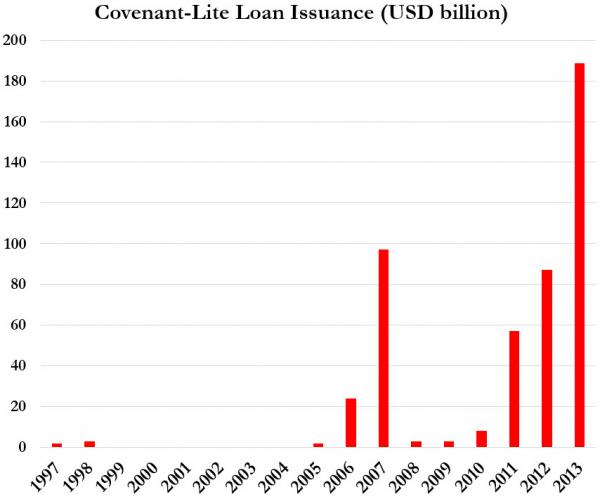
If the Fed was worried about ‘froth’ in the markets earlier in the year, then this chart should have them panicking. Of course, as Jim Bullard noted Friday, there is no bubble because everyone knows there is no bubble but judging by the massive surge in covenant-lite loan issuance, there is a bubble in forced demand for leveraged loans. At $188.7 billion, the 2013 issuance of these highly unsafe loans (which have seen huge inflows since the Fed started talking taper back in May) is almost double that of the peak of the last credit bubble in 2007 and is five times the size of 2012 YTD issuance at this time. As Reuters notes, Covenant-lite loans used to be reserved for stronger companies and credits, but are now so common in the U.S. leveraged loan market that investors are becoming wary of some credits with a full covenant package. With corporate leverage at all-time highs, what could go wrong? Demand for leveraged-loans is surging (as rate concerns rise)…

20130923_loans

And where there is demand, supply rises to meet it – as the least lender-protected notes surge in issuance…

20130923_loans1_0

(Data: Morgan Stanley S&P LCD) Read more of this post

Side-effects that should call time on the QE medicine

September 22, 2013 9:26 pm

Side-effects that should call time on the QE medicine

By John Authers

An incomplete list of how quantitative easing is damaging

Here is a Monday morning challenge. In how many ways is QE damaging? (For the uninitiated, QE stands for quantitative easing, the central bank policy of buying bonds in an attempt to stimulate the economy.) We now know, after last week’s surprise announcement from the Federal Reserve, that the US central bank has decided it must keep up with QE at full throttle. We also know, from its efforts to prepare the markets for a move away from QE, that it would like to end it if at all possible. Read more of this post

Relief to be temporary for EM investors in Asia; Corporate balance sheets in Asia are the most levered in the world.

September 23, 2013 9:21 am

Relief to be temporary for EM investors

By Henny Sender

After the Federal Reserve announced its decision not to begin selling securities, UBS sent a note to clients declaring “Hooray! Nothing Has Changed!”. Meanwhile, Deutsche Bank put out a piece of celebratory research citing the fact that “liquidity will be ample and cheap for longer”. Nowhere were the sighs of relief more audible than in the emerging markets of Asia. Indonesia, among the hardest hit by the prospect of less liquidity, rose 4.8 per cent, the Australian market over 1 per cent and the Philippine market over 3 per cent. Hong Kong, ever sensitive to developments across the border, has been up almost 20 per cent since the end of June when a combination of a sudden spike in Chinese rates and the Fed’s open mouth policy took their toll on confidence. But the sighs of relief will prove temporary for emerging market investors in Asia. Read more of this post

Shipping Lenders Toughen Oversight After Worst Rout in 23 Years

Shipping Lenders Toughen Oversight After Worst Rout in 23 Years

Shipping lenders are tightening rules on who their clients can trade with after the industry’s worst rout in at least 23 years. Banks are threatening to cancel loans if ship owners do business with customers they perceive to be at risk of failing to honor contracts, according to the Baltic and International Maritime Council, whose members control 65 percent of the global fleet. That means some shipping companies are being forced into shorter contracts from a smaller pool of clients, said Peter Sand, an analyst at the Bagsvaerd, Denmark-based group. Read more of this post

Railroads Look Past U.S. Oil-Move Costs Helping Pipelines

Railroads Look Past U.S. Oil-Move Costs Helping Pipelines

As 57,000 miles of U.S. crude pipelines threaten to lure business from railroads, Burlington Northern Santa Fe LLC and Union Pacific Corp. (UNP) are sticking to their bet on the nation’s energy boom. Domestic oil that was significantly cheaper than imported crude for the last two years allowed refiners to pay rail service’s higher transportation costs rather than use slower, less expensive pipelines. With the oil price difference now narrowing, the share of crude shipped by rail from Williston Basin region in and around North Dakota has decreased for three consecutive months, the longest string of declines since 2011. Read more of this post

Fed’s underlying message a bad signal for U.S. profit growth

Fed’s underlying message a bad signal for U.S. profit growth

1:10am EDT

By Caroline Valetkevitch

NEW YORK (Reuters) – The euphoria with which investors in the U.S. stock market greeted the Federal Reserve’s decision to stick with its easy-money policy has begun to evaporate, as the message the Fed was sending about a less-than-stellar economy sinks in. An economy still in need of a safety net may be too weak to produce robust earnings growth, meaning that the Standard & Poor’s 500 valuation, now at its most expensive on a price-to-earnings basis since 2010, becomes harder to justify. Read more of this post

Not All S&P 500 Index Funds Are Created Equal; An ETF’s structure is an oft-ignored data point that can affect performance

Not All S&P 500 Index Funds Are Created Equal

Superlatives surround the SPDR S&P 500 Trust (SPY). It is the oldest exchange-traded fund, launched in 1993. It is the largest, at $148 billion. And it is the most-traded ETF, with average volume of 100 million shares, or 20 times that of Wal-Mart Stores Inc. (WMT). What SPY is not: the best-performing ETF tracking the S&P 500. In fact, it’s the worst-performing of the three ETFs that track all 500 stocks and have 10-year records. Read more of this post

Europe’s banks slog to exit bailouts

September 20, 2013 10:44 pm

Europe’s banks slog to exit bailouts

By FT Reporters

In all the euphoria around the UK government’s first move this week to reprivatise Lloyds Banking Group, it is easy to forget just how long – and painful – the turnround in Britain’s banks has been, following the multiple collapses of 2007-8 and the subsequent bailouts, write Sharlene Goff and Patrick Jenkins.

The process of returning Lloyds and Royal Bank of Scotland to private ownership has been severely hampered by a deeper and more prolonged economic downturn than many envisaged five years ago. So it was unsurprising that George Osborne, chancellor, grasped the opportunity to hail the sale of £3.2bn of Lloyds shares as a clear sign that the UK banks – and with them the broader economy – were finally healing. Read more of this post