Noted Chinese Real Estate Tycoon, Vanke’s Wang Shi, Warns About Danger in China’s Housing Market

Noted Chinese Real Estate Tycoon Warns About Danger in China’s Housing Market

09-25 10:33 Caijing

“Rises of housing prices in first-tier and second-tier Chinese cities bear striking similarities to those in the bubble economy of Japan at the end of 1980s’, ” said Wang, chairman of China Vanke The red-hot housing market in China’s big cities are much like the situation in Japan’s bubble economy two decades ago, said Wang Shi, a prominent real estate tycoon in a dire warning over unrelenting housing market in the world’s second largest economy. “Rises of housing prices in first-tier and second-tier Chinese cities bear striking similarities to those in the bubble economy of Japan at the end of 1980s’, ” said Wang, chairman of China Vanke, the country’s largest real estate developer by market value, Tuesday on his weibo. “The bubbles in Japan burst. Take a lesson from that,” Wang said. Read more of this post
Executive’s Arrest Is Latest Sign of Trouble for China’s State-Owned Shipper COSCO

09.24.2013 18:28

Executive’s Arrest Is Latest Sign of Trouble for State-Owned Shipper

Former GM of COSCO subsidiary detained over questionable leasing deals, just the most recent bad news for the embattled company

By staff reporter Liu Ran

(Beijing) – The recent arrest of an executive of a subsidiary of China Ocean Shipping (Group) Co. (COSCO Group) has spelled more trouble for the state-owned shipping firm, which has been grappling for years with the heavy losses incurred by another member of the corporate family. Meng Qinglin, former general manager of COSCO Dalian Ocean Shipping Co. (COSCO Dalian), was taken away for questioning by the Communist Party’s discipline watchdog over alleged corruption related to vessel-leasing deals, COSCO Dalian said on August 27. Read more of this post

Chinese Cities Hooked on Land Revenue Fuel Housing Costs

Chinese Cities Hooked on Land Revenue Fuel Housing Costs

Chinese cities, addicted to the money they raise by selling land to developers, are undermining the government’s multiyear campaign to contain housing costs. Municipal residential land deals, measured by area, rose 26 percent in the first eight months of the year from the same period in 2012, according to China Investment Securities Co. The average price per square meter jumped 43 percent, pushing proceeds up 80 percent to 816.5 billion yuan ($133 billion). Local officials rely on revenue from the sales to repay debt, especially as economic growth slows. Developers bid up prices because demand from homebuyers remains strong. The cycle is driving property costs higher, complicating Premier Li Keqiang’s task of preventing social unrest over the lack of affordable housing amid a massive urbanization program. Read more of this post

China’s younger migrants eye more than money

China’s younger migrants eye more than money

Wednesday, September 25, 2013 – 03:00

Esther Teo

The Straits Times

BEIJING – Unlike her father, who did not venture out of central Henan province to work in Beijing until he was in his 30s, florist Su Ya left her home for the bright lights of the capital three years ago – when she was only 20. Ms Su makes new friends through floral arrangement classes and keeps in touch with them through social media, such as the Twitter-like Weibo microblogs. Her parents mix mostly with colleagues and fellow Henan natives. Read more of this post

China’s Industrial-Sized Debt; Beijing continues to fuel economic growth with more credit

Updated September 24, 2013, 9:17 p.m. ET

China’s Industrial-Sized Debt

Beijing continues to fuel economic growth with more credit.

The economic news from China this week is nominally positive, as HSBC’s Purchasing Managers’ Index shows industrial production picking up. This seems to confirm reports that Beijing decided in July that growth had slowed too much. The state-owned banking system pushed out some new loans to finance investment by state-owned companies. This has China bulls smiling, because they believe that rebalancing toward greater consumption will happen eventually and without serious dislocation. China bears, by contrast, see it as adding to a debt reckoning that is on the horizon. Read more of this post

China to Audit Army Officials Before Promotions or Retirement

China to Audit Army Officials Before Promotions or Retirement

China will audit military officials’ real estate holdings and use of official cars before deciding whether to promote them, as the Communist Party seeks to purge wasteful spending and power abuse within its ranks. Military officers recommended as candidates for regimental commander-level posts or above, personnel due to retire, and those who will be transferred to civilian posts will undergo the audit, the official Xinhua News Agency reported yesterday, citing guidelines issued by the Central Military Commission. Read more of this post

Amway Embraces China Using Harvard Guanxi

Amway Embraces China Using Harvard Guanxi

On a sweltering July evening in the inland Chinese city of Hefei, 1,000 people whistle and clap as Cao Yuchao tells them about Amway Corp., the household-products giant named after the American Way. Against a rainbow backdrop and the Chinese characters for glory and dreams, Cao, Amway’s local chief, paints a glowing portrait: China has been the company’s top market for nine years, with booming sales of Artistry cosmetics and Nutrilite dietary supplements. Amway also was a sponsor of China’s team at the 2012 Olympics, Bloomberg Markets will report in its November issue. Read more of this post

Tongyang to sell core unit Tongyang Power to repay debt for survival

2013-09-24 17:45

Tongyang to sell core unit for survival

FSS monitors ‘fund run’ out of securities arm

By Na Jeong-ju
Tongyang Group said Tuesday that it is willing to sell one of its core affiliates, Tongyang Power, in order to secure funds for debt repayment.
On the same day, the wife of the late Tongyang founder, Lee Yang-ku, said she will transfer her stake in Orion Group, an offshoot of Tongyang, to Tongyang Networks, to help relieve its cash shortage problem. The stake is worth about 150 billion won, according to the group.
These plans, if implemented successfully, could help the country’s 47th conglomerate avoid immediate bankruptcy, analysts said. Read more of this post

Pantech founder, vice chairman submits resignation over the worsening performance of the company while competing with major players like Samsung Electronics and Apple in the smartphone market

Pantech founder, vice chairman submits resignation

Sept 25,2013

Park Byeong-yeop, vice chairman of Korea’s mobile phone manufacturer Pantech, turned in his resignation yesterday. It is believed Park has been under immense pressure over the worsening performance of the company while competing with major players like Samsung Electronics and Apple in the smartphone market. Pantech, which had enjoyed surpluses every quarter since 2007, recorded its first loss in the third quarter of 2012.Since then, it has posted an operating loss every quarter. Read more of this post

Kim Sung-joo, one of Korea’s most successful businesswomen, is in trouble as sluggish local demand is taking its toll on her MCM brand-bag business

2013-09-24 17:18

MCM suffers major setback

By Choi Kyong-ae

Kim Sung-joo, one of Korea’s most successful businesswomen, is in trouble as sluggish local demand is taking its toll on her brand-bag business. Her Business is being pressured to withdraw or downsize from The Country’s major Department store chains, People familiar with The MATTER said Tuesday.  Read more of this post

Foreigners hunt small Japanese shares as big caps no longer cheap

Foreigners hunt small Japanese shares as big caps no longer cheap

10:13pm EDT

By Ayai Tomisawa

TOKYO (Reuters) – Long-term foreign investors are looking into small cap Japanese shares as the Tokyo market’s bellwethers such as Toyota Motor Corp (7203.T: QuoteProfileResearchStock Buzz) and Sony Corp (6758.T: QuoteProfileResearchStock Buzz) no longer look cheap even after considering the effect of the weak yen. Some fund managers have been dabbling in subcontractors of big Japanese exporters while others look at companies whose coverage by analysts is low and have been neglected by international investors. “Many export-oriented companies have become a little expensive to us,” said Drew Edwards, portfolio manager at Advisory Research Investment Management based in Chicago, who has $800 million under management. Read more of this post

Stronger is better: brewers tap India thirst for potent beer

Stronger is better: brewers tap India thirst for potent beer

Tue, Sep 24 2013

By Aradhana Aravindan and Nandita Bose

MUMBAI (Reuters) – With up to 8 percent alcohol, Carlsberg’s Tuborg Booster Strong packs a heavier punch than the Danish original and is sold only in India, where consumers in the world’s third-fastest growing beer market prefer an extra kick. Billed as the world’s first fruit-flavoured strong beer in its May launch, Tuborg Booster Strong is one of several potent brews that Carlsberg and rivals SABMiller, Anheuser-Busch Inbev and United Breweries are rolling out to make inroads in a market dominated by whisky. Read more of this post

Premier Foods had a spectacular fall from grace. The company expanded rapidly by borrowing and by buying household names such as Oxo, Hovis and Bisto, making it a stock market darling

Premier Foods could face a cash crunch next year

The revolving boardroom door at Premier Foods should be a red flag to any investor, says Questor

By John Ficenec, Questor editor

6:00AM BST 25 Sep 2013

Premier Foods
143¼p -4¼
Questor says SELL

Premier Foods

PREMIER Foods has lost another senior board member after Mark Moran, the finance director, said he was leaving the company in an announcement yesterday. Boardroom departures are always a major red flag for shareholders and Premier is no exception. On closer inspection, the company is heading towards a cash crunch in 2014 that could mean any value in the equity is toast. Premier had a spectacular fall from grace. The company expanded rapidly by borrowing and by buying household names such as Oxo, Hovis and Bisto, making it a stock market darling, delivering rapid sales and dividend growth. Then the credit crisis struck and, with it, disaster. Shares in Premier were worth £30 in 2007, but have slumped after a painful restructure and an axing of the dividend. Read more of this post

Singapore plans to almost double its container port capacity after Shanghai overtook the nation to become the world’s busiest harbor, part of Prime Minister Lee Hsien Loong’s push for an economic and popular revival

Lee Seen Spending $8 Billion on Ports as Support Falls: Freight

Singapore plans to almost double its container port capacity after Shanghai overtook the nation to become the world’s busiest harbor, part of Prime Minister Lee Hsien Loong’s push for an economic and popular revival. The government is spending at least S$8.8 million ($7 million) this fiscal year on the project, which involves moving terminals to free 1,000 hectares for development and building a larger facility at Tuas in the southwest. The plan may spur yearly growth of 5 percent and port building costs could top S$10 billion, said Vishnu Varathan, an economist at Mizuho Bank Ltd. in Singapore. Read more of this post

NZ’s Fonterra sees own-brand milk formula in 70 Chinese cities in three yrs

NZ’s Fonterra sees own-brand milk formula in 70 Chinese cities in three yrs

Tue, Sep 24 2013

WELLINGTON (Reuters) – Fonterra, the world’s biggest dairy exporter, is accelerating its expansion strategy in China and plans to sell its own branded infant milk formula in 70 cities there within three years, its chief executive officer said on Wednesday. Chief Executive Officer Theo Spierings said in an interview with Reuters the company was undeterred by a recent botulism scare and would push ahead with plans to enter the lucrative branded infant formula market in the world’s second-largest economy. Read more of this post

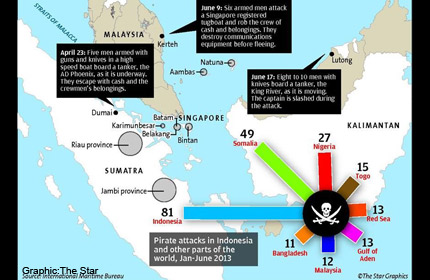
Waters near Johor and Malacca now world’s top piracy hotbed

Waters near Johor and Malacca now world’s top piracy hotbed

Tuesday, September 24, 2013 – 09:08

The Star/Asia News Network

main_abv_2409_PiratesmapPDF

PETALING JAYA – The treacherous waters off Somalia used to be the world’s most dangerous marine passageway. That dubious distinction has moved a lot closer to home, with the waters near Johor and Malacca now surpassing Somalia as the top piracy hotbed, according to the Inter­na­tional Maritime Bureau. It attributed this to the rise in piracy off Indonesia’s Tanjung Priok, Dumai, Belawan, Taboneo and Muara Jawa – where the waters have been marked as hot spots. Read more of this post

Mr Fix-It’s big job: Malaysia’s economy

Mr Fix-It’s big job: Malaysia’s economy

Wahid

Wednesday, September 25, 2013 – 04:10

Yong Yen Nie

Malaysia Correspondent In Putrajaya

The Straits Times

MALAYSIA – FOR over two decades, Senator Abdul Wahid Omar has been known as “Mr Fix-It”, turning Malaysian giants such as Maybank and Telekom Malaysia into regional players. On May 15, just 10 days after the Barisan Nasional coalition led by Prime Minister Najib Razak won the general election, Mr Wahid was summoned to Mr Najib’s office to take on what could be his biggest repair job – fix the economy. The challenges are daunting. For 15 years, the government has spent more than it has taken in, and public debt has ballooned to 53.5 per cent of gross domestic product, the highest in the region. Exports are dwindling due to the weak demand from Europe, the United States and China. Its current account surplus, at RM2.6 billion (S$1 billion) in the second quarter of this year, is the narrowest since 1997. Read more of this post

The prospect of foreign takeovers of debt-burdened Italian companies trigger backlash

September 24, 2013 5:41 pm

Sales of Italian groups trigger backlash

By Guy Dinmore in Rome

The prospect of foreign takeovers of debt-burdened Italian companies, includingTelecom Italia, Alitalia and units ofFinmeccanica, could be seen as a boost for prime minister Enrico Letta as he tries to attract foreign investment on Wall Street this week. Instead, back in Rome the usual storm is brewing, as politicians and trade unions raise an outcry over what they see as a threat to jobs and national control over strategic industries that have blocked similar takeover attempts in the past. Read more of this post

Rattlesnake Frontier Answering Brazil’s Land Shortage

Rattlesnake Frontier Answering Brazil’s Land Shortage

Atop a mountain plateau in Brazil’s northeastern Piaui state, Luciano Curioni inspects shriveled corn cobs as dust whirls across his rattlesnake-infested farm that has no water, power or a phone. Farmers like Curioni are testing the limits of climate and technology, pushing the country’s agricultural frontier into increasingly inhospitable regions, as the world’s fourth-largest farm exporter runs out of arable land. Companies providing solutions, such as Deere & Co., Monsanto Co. (MON), and Bayer AG, stand to gain. Read more of this post

Morgan Stanley: ‘The Fragile Five’ — The Most Troubled Currencies In Emerging Markets

MORGAN STANLEY PRESENTS: ‘The Fragile Five’ — The Most Troubled Currencies In Emerging Markets

MAMTA BADKAR SEP. 24, 2013, 3:46 PM 6,824 1

Ten years ago, Goldman Sachs declared Brazil, Russia, India and China (BRIC) as the emerging markets with the brightest economic growth prospects. This year, Morgan Stanley declared the Brazilian real, the Indonesian rupiah, the South African rand, the Indian rupee, and the Turkish lira as the “Fragile Five,” or the troubled emerging market currencies under the most pressure against the U.S. dollar. “High inflation, weakening growth, large external deficits, and in some cases exposure to the China slowdown, and high dependence on fixed income inflows leave these currencies vulnerable,” wrote Morgan Stanley analysts in an August research note. We’ve highlighted Morgan Stanley’s greatest concerns for each of the “Fragile Five,” and include their year-to-date performance against the greenback. Read more of this post

‘Massive fraud’ at centre of trial against BofA over U.S. mortgages

Updated: Wednesday September 25, 2013 MYT 9:28:34 AM

‘Massive fraud’ at centre of trial against BofA over U.S. mortgages

NEW YORK: Bank of America Corp’s Countrywide unit placed profits over quality in a “massive fraud” selling shoddy mortgages to Fannie Mae and Freddie Mac, a U.S. government lawyer said on Tuesday. The claim came at the start of the first case by the government to go to trial against a major bank over defective mortgage practices leading up to the 2008 financial crisis. Pierre Armand, a lawyer in the civil division of the U.S. Attorney’s Office in Manhattan, said Countrywide made $165 million selling loans that it promised were investment quality to Fannie and Freddie. Read more of this post

Lax Rules Give U.S. Upper Hand in Tussle Over Alibaba I.P.O.

SEPTEMBER 24, 2013, 6:07 PM

Lax Rules Give U.S. Upper Hand in Tussle Over Alibaba I.P.O.

By STEVEN M. DAVIDOFF

Never mind Twitter; the biggest initial public offering on the horizon is Alibaba. The company, a Chinese Internet behemoth, appears to be playing a game of global regulatory arbitrage, with suggestions that it may go public in New York if it can’t get its way in Hong Kong. A core group of 28 Alibaba executives known at the company as partners and led by Jack Ma want a corporate structure — as GoogleFacebook and other United States companies have — that would allow them to keep control of the company after the I.P.O. The Hong Kong Stock Exchange, however, doesn’t allow dual classes of stock and other types of mechanisms to preserve corporate control. Despite persistent complaints that Washington regulations hamstring companies that want to go public — witness the push for last year’s the Jump-Start Our Business Startups Act, or JOBS Act — in this case, the United States has become the place to avoid more stringent regulation. Read more of this post

Growers Dump Tobacco for Stevia See $58 Billion Market

Growers Dump Tobacco for Stevia See $58 Billion Market

The once-idled leaf-processing machines at a former tobacco trading house in Alma, Georgia, are coming back to life. Except now the warehouse, which still smells like tobacco leaves and cigarette smoke, is becoming a hub for a sweeter crop: stevia. Approved for commercial use in the U.S. five years ago, stevia extracts are fast becoming the sugar substitute of choice for a population trying to slim down and avoid artificial options. The no-calorie, natural sweetener, grown mostly in China and South America, is creating an opportunity for U.S. farmers and processors looking to make up for dwindling tobacco demand and win business from Cargill Inc. and Coca-Cola Co. Read more of this post

Germany’s strange parallel universe; A huge structural current account surplus exports products – and bankruptcy

September 24, 2013 6:58 pm

Germany’s strange parallel universe

By Martin Wolf

A huge structural current account surplus exports products – and bankruptcy

Angela Merkel’s remarkable election result confirms her position as the dominant politician in Germany and so also in Europe. It is assumed she will get the eurozone she wants: Germany writ large. That may prove right. Alas, if she does, it is going to be a deeply depressing spectacle. Wolfgang Schäuble, Germany’s finance minister, laid out the view on which Berlin’s current policy is based, with sobering clarity, in the Financial Times last week. The doomsayers, he argued were wrong. Instead, “the world should rejoice at the positive economic signals the eurozone is sending almost continuously these days”. If depressions and mass unemployment are a success, then adjustment in the eurozone is indeed a triumph. Mr Schäuble accuses his critics of living in a “parallel universe”. I am happy to do so rather than live in his. Read more of this post

AQR’s Asness Says Pensions Will Struggle to Return 7 Percent

AQR’s Asness Says Pensions Will Struggle to Return 7 Percent

AQR Capital Management co-founder Cliff Asness said the average public pension fund will have a “very hard time” achieving average annual returns of 7 percent to 7.5 percent. A portfolio constructed of 60 percent stocks and 40 percent bonds will probably return 2.5 percent above inflation, compared with 5 percent historically, Assness said today at the Bloomberg Markets 50 Summit in New York. Most public pensions assume rates of return between 7 percent and 8 percent. “It’s still going to be hard in a world where markets give you 5 percent to make 7,” said Asness. “For the next 10 through 20 years, I think the average pension fund is going to have a very hard time hitting that bogey.” Read more of this post

America’s Toilet Turnaround Is a Microcosm of US Manufacturing Trends; After Years of Moving Work Overseas, Remaining Factories Ramp Up U.S. Output

Updated September 24, 2013, 7:30 p.m. ET

America’s Toilet Turnaround

After Years of Moving Work Overseas, Remaining Factories Ramp Up U.S. Output

JAMES R. HAGERTY

PERRYSVILLE, Ohio—In previous management jobs, Jim Morando watched Chinese imports engulf the U.S. market for vinyl tiles, wood flooring and window blinds. Now, as president of Mansfield Plumbing Products, a toilet manufacturer here, Mr. Morando says he has decided to “stand and fight.” After decades of losing out to foreign rivals, U.S. manufacturing of toilets is making a surprising, if modest, comeback—mostly under foreign ownership. Mansfield Plumbing, owned since 2004 by Organizacion Corona of Colombia, is spending $9 million to expand the capacity of its Perrysville plant by nearly 50%. Another toilet maker, Toto Ltd. 5332.TO -0.51% of Japan, is installing new casting machinery to raise capacity at its Morrow, Ga., plant about 5%. American Standard Brands, bought earlier this year by Lixil Corp.5938.TO -1.62% of Japan, is installing a new kiln and refurbishing other parts of its Nevada, Mo., plant, boosting capacity 5% to 10%. The toilet turnaround is a microcosm of U.S. manufacturing trends. Read more of this post

SocGen: “The world might be on the brink of a sixth merger wave since the 1880s – the previous being the 1990s wave in information technology. This time, the underlying reason is globalisation”

September 24, 2013 4:48 pm

Charge into M&A deals jolts ‘animal spirits’ to life

By Ralph Atkins in London

Have animal spirits returned to global markets? A pick-up this month in merger and acquisition activity, share listings and corporate bond issuance – especially in the US – has signalled a surge in the most precious commodity in finance: confidence. The latest exuberance was Tuesday’s acquisition by Applied Materials, the US semiconductor equipment company, of rival Tokyo Electron to create a $29bn electronics group. Identified in the 1930s by John Maynard Keynes as an important economic driver, an eruption of “animal spirits” could start a virtuous circle of entrepreneurial risk-taking and investment – and further lift equities. Any benefits would wane quickly, however, if deal activity were merely the result of aggressive central bank policy action or structural changes forced by regulators. Read more of this post