India’s Emu Ranching Bubble Bursts, With a Grim Aftermath; The collapse of India’s emu business has reduced the size of the country’s flock from 2 million to 800,000
September 27, 2013 Leave a comment
India’s Emu Ranching Bubble Bursts, With a Grim Aftermath
By Bruce Einhorn and Ganesh Nagarajan September 26, 2013
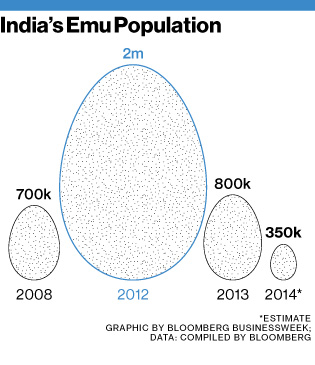
In India’s countryside, where poor farmers must cope with droughts, floods, and other disasters, there’s a new scourge: the collapse of emu ranching. Native to Australia, the emu is a large, flightless bird that somewhat resembles its African cousin, the ostrich, and tastes (fans say) like beef. Farmers in Australia, the U.S., and other countries raise emus for their meat, eggs, and oil (rendered from their fat). About five years ago, Indian farmers started seeing these Australian fowl as their ticket to riches. The fad quickly spread across the country, as farmers “just did whatever the neighbors said,” says Vinay Sharma, a former banker in New Jersey with Merrill Lynch who now raises emus in Gujarat. Overcapacity—the bird population peaked at about 2 million in 2012—has led some to abandon their emus in the wild. “People are feeling this business is not doing well,” he says.Farmers are giving up because the economics quickly stopped making sense. In 2008, 1 kilogram of feed cost 9 rupees. With so many farmers rushing into the business, feed costs had nearly tripled by 2011. As the emu population mushroomed, the price of emu meat fell about 25 percent to between 250 rupees and 350 rupees per kilo. “There was a sudden explosion in the number of people entering this business, and there was an oversupply in the market,” says Purshotam Rao, a farmer in the southern state of Andhra Pradesh who is vice president of the Emu Farmers Welfare Association. For many hard-pressed farmers, killing the birds is the only option, he adds. “I have six emus,” Rao says, “and no one wants to purchase them.”
The emu bubble burst in part because of a highly publicized scandal in the southern state of Tamil Nadu. A local entrepreneur accepted deposits from thousands of investors to bankroll emu farming, promising returns as high as 76 percent. Early investors did get paid, but as the emu glut worsened and investors’ suspicions mounted, the payments stopped.
The state government arrested about 70 people and seized more than 12,000 birds. In January, Tamil Nadu auctioned off the confiscated emus at fire-sale prices, further depressing the market nationwide. A bird that would have fetched 12,000 rupees at the peak of the market sold for just 700 rupees. “People were lured into the emu business with schemes and promises that their investments would double in three to six months,” says Sami Tambatkar, a farmer in Maharashtra, near Mumbai, who had 1,700 birds but started pulling out of the business in 2011. “There is no business because of a few greedy men.”
Half of India’s 5,000 emu farmers have left the business. Only 800,000 birds are left in India, and even that population “will not be sustainable now,” says Surinder Kumar Maini, joint secretary of the farmers association. By January, he says, the number will be down to 350,000.
The picture isn’t completely grim. Sharma, the former banker, says his company, TallBird Emu and Agriculture, is doing well. TallBird has 20 employees, and Sharma expects sales to increase by 50 percent this year, to almost $1 million, and grow to $1.5 million in 2014. In October he plans on opening a plant to process emu oil, which is popular as a moisturizer and treatment for allergies and migraines.
Sharma says a shakeout that leaves emu ranching dominated by larger farms that are better able to invest is what the industry needs. “India should have around 100 farms with at least 1,000 birds in each,” he says.
The bottom line: The collapse of India’s emu business has reduced the size of the country’s flock from 2 million to 800,000.
 About bambooinnovator
 Bamboo Innovator