Man Controls Artificial Leg Using Only His Brain, Researchers Say
September 27, 2013 Leave a comment
Updated September 25, 2013, 7:16 p.m. ET
Man Controls Artificial Leg Using Only His Brain, Researchers Say
RON WINSLOW
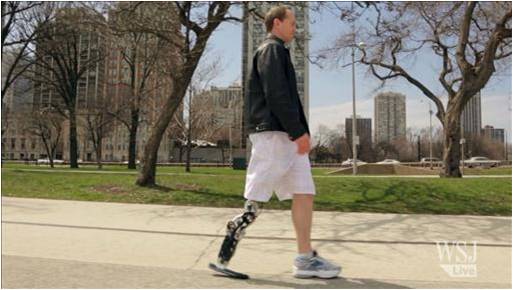
Researchers say that 32-year-old Zac Vawter successfully controlled movements of a motorized artificial leg using only his own thoughts. Video: Rehab Institute of Chicago.
In an advance that could eventually improve the mobility of thousands of people living with amputations, researchers said a 32-year-old man successfully controlled movements of a motorized artificial leg using only his own thoughts. Aided by sensors receiving impulses from nerves and muscles that once carried signals to his missing knee and ankle, the patient was able to climb and descend stairs and walk up and down inclines much as he could with a natural leg, based on directions that came from his brain. Importantly, he was able to flex the device’s ankle, enabling a near-normal gait, something not possible with current prosthetics. “It’s night and day” between the experimental bionic leg and the mechanical prosthetic limb he uses every day, said Zac Vawter, a software engineer from Yelm, Wash., who lost his right leg in a motorcycle accident four years ago. “Going upstairs with my normal prosthetic, my sound leg goes up first for every step,” he added. “With this I go foot-over-foot up the stairs and down the stairs.”Researchers said Mr. Vawter is the first person to have been able to control such a prosthetic by brain signals alone. Current state-of-the-art devices involving both the knee and the ankle require pressing a remote-control button at, say, the bottom of a flight of stairs to rock and kick the leg back to make the step up, said Levi J. Hargrove, a researcher at the Center for Bionic Medicine, Rehabilitation Institute of Chicago.
For Mr. Vawter, Dr. Hargrove said, “it’s all intuitive. He can walk up or descend stairs in stride.”
Dr. Hargrove is lead author of a report on the technology, published Wednesday by the New England Journal of Medicine.
More than a million Americans are living with amputations, including some 1,600 soldiers who returned from wars in Iraq and Afghanistan during the past decade having lost at least one limb. The current project is supported by an $8 million grant from the U.S. Army as part of an effort to address life-limiting injuries in soldiers, said Col. John Scherer, head of clinical and rehabilitative medicine research at the army’s Medical Research and Materiel Command in Fort Detrick, Md. A goal of the bionic-leg project is to enable young soldiers to “participate in life” and even return to active duty.
Researchers call the device bionic because of its ability to interact intelligently with a human. Despite associations of “bionic” technology with superhuman strength, the prosthetics “don’t necessarily need to be strong,” Dr. Hargrove said. “They need to be smart.”
Dr. Hargrove and his colleagues developed the electronics for the device, including a software algorithm that receives signals from electrodes attached to skin on what remains of the amputated leg and converts those signals to knee and ankle movement on the prosthetic. The electrodes get the signals from muscles attached to nerves in the residual leg, including nerves that before the amputation carried brain signals to the ankle. Those nerves were implanted in Mr. Vawter’s hamstring muscle shortly after the accident.
“When Zac wants to try to move,” Dr. Hargrove said, the brain sends signals down the spinal cord to muscle that hasn’t been damaged. “We have electrodes that are listening to those signals. The algorithm decodes patterns “to figure out what he was thinking,” translating the results into movement such as straightening the knee while sitting or flexing the ankle.
In experiments typically involving 700 to 1,000 steps, Dr. Hargrove said, minor errors such as scuffing the foot occurred in about 2% of steps with the signals coming from the brain. Mr. Vawter didn’t experience any more-serious errors that could have resulted in a fall, he said.
The accomplishment “takes us closer to the point where we’re going to have robust commercial products that use signals from a person’s brain to let them walk,” said Daniel Ferris, a professor in the school of kinesiology and department of biomedical engineering at the University of Michigan, who wasn’t involved in the current research.
Mr. Vawter said one drawback is that the device isn’t fit for running, which he can do with his regular prosthetic. Other needed improvements, Dr. Hargrove said, are making the 10-pound device quieter and smaller.
 About bambooinnovator
 Bamboo Innovator