Blame negative gearing for property bubble, not us: SMSF lobby

Michael Bailey Deputy editor

Blame negative gearing for property bubble, not us: SMSF lobby

Published 26 September 2013 11:28, Updated 26 September 2013 12:03

Self-managed super funds hold just 3.4 per cent of their $495 billion assets in residential property, and are being unfairly blamed for stoking a new bubble, claims the chief lobby group for the sector. Gearing within SMSFs is also not the problem that critics of the sector allege, says the director of technical and professional standards at the SMSF Professionals’ Association of Australia (SPAA), Graeme Colley. Read more of this post

Australian government faces housing bubble challenge

Australian government faces housing bubble challenge

Bubble risk, limits on home loans mulled

Banking regulator shows signs of concern over lenders’ increasing exposure to property

Xinhua | Agencies
Published on September 26, 2013 13:32

The Australian Prudential Regulation Authority (APRA), which regulates banks, has hinted it is concerned about the industry’s rising exposure to property. APRA has opened the door to imposing limits for the first time in a decade on how much can be lent to home buyers. Australian central bank (RBA) board members are likely to have mixed feelings about property industry. They are probably glad that a housing upswing is under way, supporting growth, but may get nervous about overinflating housing prices. Read more of this post

With Tastes Growing Healthier, McDonald’s Aims to Adapt Its Menu; fast-food chain said it would increase its offerings of fruits and vegetables and promote more nutritional options to children

September 26, 2013

With Tastes Growing Healthier, McDonald’s Aims to Adapt Its Menu

By STEPHANIE STROM

27mcdonalds-span-articleLarge

The company is working with its supply chains to ensure access to enough produce. The chain said it would use its arsenal of marketing tools to help customers understand the nutritional choices available. Under pressure to provide healthier meals, McDonald’s announced on Thursday that it would no longer market some of its less nutritional options to children and said it also planned to include offerings of fruits and vegetables in many of its adult menu combinations. Read more of this post

Don’t Even Think About Returning That Dress: Return fraud costs America’s merchants almost $9 billion annually. Now they’re fighting back

Don’t Even Think About Returning That Dress

By Cotten Timberlake September 26, 2013

BW40_comp_customer_315

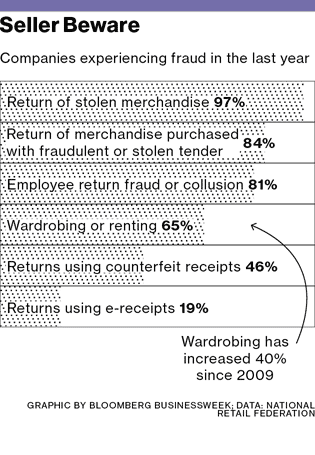
High-end retailers such as Bloomingdale’s are always happy to sell a glitzy party or bridesmaid dress that can cost hundreds of dollars. The return of a pricey frock after it’s been worn is a less jubilant event. If a garment comes back obviously used—sweat-stained, for example—a retailer can refuse to refund it, but that conversation can be “awkward,” says Richard Mellor, vice president of loss prevention at the National Retail Federation. So some retailers simply look the other way. Read more of this post

An Ugly Dilemma for Beauty Companies: China, whose cosmetics market is forecast to grow to $34.8 billion this year, requires animal testing for new products

An Ugly Dilemma for Beauty Companies

By Liza Lin September 26, 2013

Executives of Western cosmetics makers are ecstatic about the prospect of continued growth in China’s $32 billion beauty market. Animal rights activists, not so much. That’s because hundreds of thousands of animals are believed killed each year in tests mandated for all new cosmetics and personal-care products to win approval on the mainland. China is the only major market where companies must test their mascaras and lotions on animals. Rabbits, for instance, have ingredients dripped into their eyes or are killed after skin irritation tests, according to animal-rights group Cruelty Free International. That’s created a dilemma for companies like L’Oréal (OR:FP) and Procter & Gamble(PG) that want to sell in the giant market without alienating consumers in countries where public sentiment frowns on such animal treatment. U.S. regulators discourage, but don’t bar, animal tests. India in June banned animal testing for beauty products. And the European Union, which has long barred such trials within its borders, in March tightened regulations to also prohibit the sale of newly developed products tested on animals elsewhere. (Existing products that previously underwent testing in China are exempt.) Unless companies can get Chinese regulators to ease their mandate, they may need to devise separate formulations for China and Europe or produce China-only items. Read more of this post

India’s Street Vendors Come Out of the Shadows

India’s Street Vendors Come Out of the Shadows

What Indian economic phenomenon is at once marginal, even illegal, and enormously independent and entrepreneurial? That would be the street vendor, the small capitalist of the poor, and reservoir of off-the-books penalties that grease the machine of every municipal authority and police station in urban India. There are an estimated 10 million street vendors (another term is the more pejorative “hawkers”) in the cities of India, functioning mostly in breach of a host of urban laws governing licensing, selling and zoning — and challenging bourgeois ideas of what a metropolis should look like. Street vendors have long battled to be recognized as a professional guild, not a shadowy underclass. Earlier this month, after more than a decade of agitation, the National Association of Street Vendors won a significant victory when the Lok Sabha, the lower house of parliament, recognized the rights of street vendors by passing the Street Vendors Bill, 2012. Read more of this post

Google Alters Search to Handle More Complex Queries

SEPTEMBER 26, 2013, 5:29 PM

Google Alters Search to Handle More Complex Queries

By CLAIRE CAIN MILLER

Google on Thursday announced one of the biggest changes to its search engine, a rewriting of its algorithm to handle more complex queries that affects 90 percent of all searches. The change, which represents a new approach to search for Google, required the biggest changes to the company’s search algorithm since 2000. Now, Google, the world’s most popular search engine, will focus more on trying to understand the meanings of and relationships among things, as opposed to its original strategy of matching keywords. Read more of this post

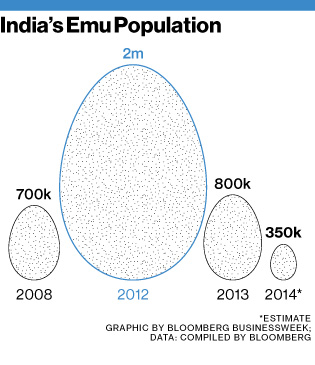
India’s Emu Ranching Bubble Bursts, With a Grim Aftermath; The collapse of India’s emu business has reduced the size of the country’s flock from 2 million to 800,000

India’s Emu Ranching Bubble Bursts, With a Grim Aftermath

By Bruce Einhorn and Ganesh Nagarajan September 26, 2013

econ_emu40chart_315

In India’s countryside, where poor farmers must cope with droughts, floods, and other disasters, there’s a new scourge: the collapse of emu ranching. Native to Australia, the emu is a large, flightless bird that somewhat resembles its African cousin, the ostrich, and tastes (fans say) like beef. Farmers in Australia, the U.S., and other countries raise emus for their meat, eggs, and oil (rendered from their fat). About five years ago, Indian farmers started seeing these Australian fowl as their ticket to riches. The fad quickly spread across the country, as farmers “just did whatever the neighbors said,” says Vinay Sharma, a former banker in New Jersey with Merrill Lynch who now raises emus in Gujarat. Overcapacity—the bird population peaked at about 2 million in 2012—has led some to abandon their emus in the wild. “People are feeling this business is not doing well,” he says. Read more of this post

India woos offshore currency players as rupee hits hard times

Updated: Thursday September 26, 2013 MYT 5:23:20 PM

India woos offshore currency players as rupee hits hard times

MUMBAI: Stung by the rupee’s recent collapse, India’s central bank is taking a carrot-and-stick approach to curb trade in the offshore forwards market that is seen as a key source of wrenching currency volatility. However, with no viable alternative to trading in non-deliverable forwards (NDF) involving the rupee, the strategy is likely to have only a limited impact. The Reserve Bank of India recently met with a handful of foreign banks and asked them to stop acting as market-makers for rupee NDFs, according to three bankers involved in the discussions. Read more of this post

Age Limits Among Car Ownership Limits Urged for Jakarta

Age Limits Among Car Ownership Limits Urged for Jakarta

By Hotman Siregar on 9:40 pm September 26, 2013.
A transportation analyst has urged the Jakarta authorities to impose a limit on the age of vehicles allowed on the streets, in a bid to both reduce exhaust emissions and cut back on car use. Yoga Adiwinarto, the director of the Institute for Transportation and Development Policy, said on Wednesday that the idea had long been discussed by city officials but never implemented. Read more of this post

EBay to Buy Braintree for $800 Million; Deal Could Accelerate PayPal’s Goal to Draw More Revenue From Smartphone and Tablet Users

Updated September 26, 2013, 7:08 p.m. ET

EBay to Buy Braintree for $800 Million

Deal Could Accelerate PayPal’s Goal to Draw More Revenue From Smartphone and Tablet Users

GREG BENSINGER

EBay Inc. will buy payments service Braintree Payments Solutions LLC for $800 million in cash, making a big bet to secure the pole position in the race to get consumers to pay for goods and services on smartphones, The deal will give eBay’s PayPal unit more extensive customer data as well as the lucrative transaction fees from Braintree’s expanding network, which currently processes more than $12 billion in payments annually, a third of which is on mobile devices. Braintree charges 2.9% plus 30 cents per transaction. Read more of this post

Singapore App Maker MyHero Raises $10M Series A For Its Stock Market Trading Gamification App, TradeHero

Singapore App Maker MyHero Raises $10M Series A For Its Stock Market Trading Gamification App, TradeHero

NATASHA LOMAS

posted 6 hours ago

An app that lets people play the stock market without the risk of losing any real money has turned its virtual cash game into a pile of actual Benjamins, by closing out a $10 million funding round — one of the largest Series A rounds for a consumer startup in the region, it claims. The app in question, TradeHero, is made by a Singapore-based developer MyHero. Investors in the round are Kleiner Perkins Caufield Byers China fund (KPCB China) and IPV Capital. Read more of this post

South Korea’s financial regulator is seeking to lower the heavy corporate debtor threshold to include more firms on the watch list for default risks. If the threshold is lowered, Hyundai Group and Tong Yang Group will likely be added

More corporate debtors likely to be on watch list

2013.09.26 16:55:21

South Korea’s financial regulator is seeking to lower the heavy corporate debtor threshold to include more firms on the watch list for default risks.

According to sources on Thursday, the Financial Supervisory Service (FSS) recently drew up a measure that lowers the debt threshold of large companies so that more firms can be included in the FSS list of so-called primary corporate debtors, FSS officials with knowledge of the matter said.
More liabilities regarding financial improvement will be requested for large companies when signs of mismanagement are detected. A primary corporate debtor’s role will also be expanded.
Under the envisioned plan, the FSS will lower the 0.1 percent rule so that more smaller conglomerates with liquidity risks can be added.
The regulator has also proposed including their short-term borrowings like commercial papers or corporate bonds since a lot of big firms rely on such types of debt instruments to raise money.
If the threshold is lowered, Hyundai Group and Tong Yang Group will likely be added to the list.

Diageo Goes Gangnam With Johnnie Walker for Korea Whisky Revival

Diageo Goes Gangnam With Johnnie Walker for Korea Whisky Revival

Diageo Plc (DGE), the world’s biggest distiller, is trusting Gangnam to do the same for whisky as the song named after it did for dance moves. Seoul’s luxury retail district, known internationally for the music video that became a global phenomenon, is the location for today’s opening by Diageo of a Johnnie Walker House as the liquor maker goes after high-net worth consumers seeking a bespoke bottle of its biggest whisky brand to take home. Read more of this post

Debt owed by 41 major South Korean public organizations would snowball from 520 trillion won ($483.7 billion) this year to 600 trillion won in 2017

41 public agencies’ debt to balloon to $558bn in 2017

Lee Sang-duk

2013.09.27 15:52:37

Debt owed by 41 major South Korean public organizations would snowball from 520 trillion won ($483.7 billion) this year to 600 trillion won in 2017, according to a report. This estimate is based on the assumption that the public companies do not seek to cut back on debt, and suggests they will need to tighten the belt to pay back much of the debt.
As such, the government will set up an intra-governmental task force dedicated to tackling the public debt and undertake intensive restructuring, such as asset disposal, to bring down the public debt to around 573 trillion won by 2017.  Read more of this post

Nine Japanese automotive suppliers admit they fixed prices of car parts in United States and abroad; to pay more than $740 million in criminal fines

September 26, 2013

Companies Admit They Fixed Prices of Car Parts

By JACLYN TROP

In an expanding global antitrust investigation, nine Japanese automotive suppliers, along with two former executives, have agreed to plead guilty to conspiracy and pay more than $740 million in criminal fines for fixing the price of auto parts sold in the United States and abroad, the Justice Department said Thursday. The pleas were the latest in what the Justice Department said was its largest criminal antitrust investigation, one that has involved the authorities from Asia to North America to Europe and has now resulted in $1.6 billion in fines since 2011. Read more of this post

Corporate Japan strives to beat power crunch

Updated: Friday September 27, 2013 MYT 11:52:28 AM

Corporate Japan strives to beat power crunch

TOKYO: Automatic doors are blocked at offices, subway escalators are disabled and much of the headquarters of Japan’s biggest utility sits in semi-darkness – all evidence of how a 2½-year power crunch has forced companies to re-think energy use. As expensive imported fuel has sent corporate electricity prices surging by more than a third since the Fukushima nuclear disaster, firms have scrimped and employees have grown used to sweaters in the winter and open collars in the summer. Read more of this post

Indonesian Funds Dump Stocks Tumbling Most Amid Global Rally

Indonesian Funds Dump Stocks Tumbling Most Amid Global Rally

Indonesia’s biggest mutual funds are liquidating stocks traded in Jakarta as local interest rates rise and growth slows, sending the nation’s benchmark equity index to the biggest drop among major markets this quarter. Equity funds managed by local units of Schroders Plc (SDR), Manulife Asset Management and PT Bank Mandiri raised their average cash holdings to 12.8 percent at the end of August from 10.3 percent in June and 6.9 percent in March, data compiled by Bloomberg show. The Jakarta Composite Index’s (JCI) 8.6 percent drop this quarter left it valued at 18 times reported earnings, a 54 percent premium over the MSCI Emerging Markets Index. Read more of this post

Singapore Casinos Lose Luster Among Locals

September 26, 2013, 3:42 PM

Singapore Casinos Lose Luster Among Locals

CHUN HAN WONG

Three years after Singapore launched its bold bet on casinos, local residents have become less inclined to try their hands on the glitzy gambling floors in this Southeast Asian financial center. Daily average visits by Singaporean citizens and permanent residents to Singapore’s two casinos have fallen to about 17,000, compared to 20,000 in 2010 when the resorts opened, the city-state’s casino regulator said in its annual report published Wednesday. Read more of this post

Rising debt, overheated housing market threaten New Zealand’s economic stability

Rising debt, overheated housing market threaten New Zealand’s economic stability

English.news.cn   2013-09-27

WELLINGTON, Sept. 27 (Xinhua) — New Zealand’s overvalued housing market and high household debt levels risk derailing the country’s fragile economic recovery, two leading economic institutions warned Friday. Reserve Bank of New Zealand (RBNZ) governor Graeme Wheeler said in the RBNZ’s latest annual report that the two most significant challenges facing the bank were the overvalued New Zealand dollar and the overvalued housing market. Read more of this post

“We are already using 45% of Petronas money to pay for salaries and to take care of expenditure – there is only so much money Petronas can give without severely damaging its own viability”

Updated: Friday September 27, 2013 MYT 6:53:03 AM

When popularity is a bane

ALL KINDS OF EVERYTHING BY DATUK ZAID IBRAHIM

Sometimes tough measures must be taken, even if they prove unpopular.

A POLITICIAN needs to be popular at all times, for his “legitimacy” comes from being elected as president of the party that commands the largest number of seats in Parliament. There are other ways of being president of course – a former Umno president was in power for 22 years and in that time, only one election for president was ever held. He was able to convince Supreme Council members that an election for the top posts would destroy the party. Persuasion is an option for those who find democracy too difficult to manage. Read more of this post

New guidelines for Malaysia’s SPACs

Updated: Friday September 27, 2013 MYT 7:56:58 AM

New guidelines for Malaysia’s SPACs

BY RISEN JAYASEELAN
RISEN@THESTAR.COM.MY

PETALING JAYA: The Securities Commission (SC) will soon issue new guidance notes relating to the listing of special-purpose acquisition companies (SPACs), a move that is aimed at ensuring new submissions are of a certain high quality, sources said. “There have been some concerns about the quality of submissions. The SC feels that it needs to elaborate on the original spirit of the SPAC guidelines,” said the source. Read more of this post

It was another eye-opening day for Prime Minister Datuk Seri Najib Tun Razak in Silicon Valley with a meeting with Facebook CEO Mark Zuckerberg and a visit to Google.

Updated: Thursday September 26, 2013 MYT 8:25:13 AM

Innovation the keyword in trip to Silicon Valley

MERGAWATI ZULFAKAR IN SILICON VALLEY, USA

IT was another eye-opening day for Prime Minister Datuk Seri Najib Tun Razak in Silicon Valley with a meeting with Facebook CEO Mark Zuckerberg and a visit to Google. Najib, who is on a three-day working visit to Silicon Valley, was at Facebook’s head office in Menlo Park besides making a trip to Google’s headquarters in Mountain View. “The experience is very, very interesting, an eye-opener on not only products but also the lifestyle, especially the culture of innovation. Read more of this post

The Slow, Profitable Death of GM’s Big SUVs; GM has 61 percent of the market for large SUVs, which can be up to 10 times more profitable than a midsized car

The Slow, Profitable Death of GM’s Big SUVs

By Tim Higgins September 26, 2013

BW40_comp_SUV_630

In a time when gasoline is $4 a gallon and hybrid cars are all the rage, it would be easy to conclude that the large SUV has gone the way of your grandfather’s Oldsmobile. But reports of the death of the gas guzzlers that grew popular in the late 1990s are greatly exaggerated. Instead, huge SUVs have slipped into a slow-but-profitable decline—andGeneral Motors (GM) is thankful for their delayed interment. Read more of this post

The First Cracks Appear In The Insane LBO Craze

The First Cracks Appear In The Insane LBO Craze

WOLF RICHTERTESTOSTERONE PIT SEP. 26, 2013, 6:20 PM 2,381

It could be an aberration. Or it could be the first visible crack in the insane leveraged buyout craze that has spread across the country: JPMorgan, Bank of America, and Goldman Sachs could get hit with a combined loss of up to $156 million on the $780 million in junk debt they pledged to sell to fund the buyout of teen-fashion retailer rue21. With consequences for investors. Read more of this post

Swaps Rules Worry Industry; Coming Regulations Have Market Players Concerned About Possible Disruption

Updated September 26, 2013, 7:55 p.m. ET

Swaps Rules Worry Industry

Coming Regulations Have Market Players Concerned About Possible Disruption

KATY BURNE and GEOFFREY T. SMITH

MI-BY730A_SWAPS_NS_20130926184804

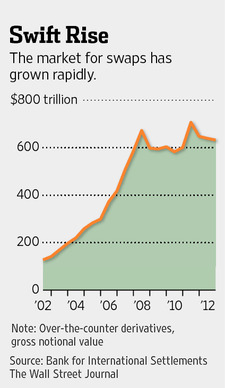
Banks, brokers and investors are warning of potential turmoil in a major part of the derivatives market on Oct. 2, when new U.S. rules kick in governing how instruments known as swaps are traded. Swaps are derivatives, traditionally not traded on exchanges, which corporations and financial institutions use to protect against or speculate on changes in everything from fuel costs to interest rates. The Bank for International Settlements estimates that there are $633 trillion of swaps outstanding. Read more of this post

SEC Aims to Get Tougher on Fraud; Chairman White, Fleshing Out Goals, Touts Settlements That ‘Have Teeth’ and Deter Wrongdoing

Updated September 26, 2013, 5:50 p.m. ET

SEC Aims to Get Tougher on Fraud

Chairman White, Fleshing Out Goals, Touts Settlements That ‘Have Teeth’ and Deter Wrongdoing

ANDREW ACKERMAN

CHICAGO—Wall Street’s main cop, under the new leadership of a former prosecutor, plans to ramp up its policing of financial fraud. Securities and Exchange Commission Chairman Mary Jo White, laying out a broad enforcement agenda for the first time since taking the helm at the agency five months ago, said the agency will seek charges against more individuals and pursue larger fines against companies that commit wrongdoing. Read more of this post

Is Nasdaq and NYSE Neglect Breaking the Humble Stock Ticker?

Is Nasdaq and NYSE Neglect Breaking the Humble Stock Ticker?

By Dave MichaelsSam Mamudi, and Matthew Philips September 26, 2013

On the morning of Sept. 12, executives of the nation’s major stock and options exchanges traveled to Washington to meet with Securities and Exchange Commission Chairman Mary Jo White. The summons was prompted by a rash of technical glitches on the exchanges, the most glaring of which hit on Aug. 22, when a software failure forced theNasdaq (NDAQ) to halt trading for three hours. White told the executives to come back in two months with a “comprehensive action plan” for making the markets more resilient. “Our homework assignments are clear,” NYSE Euronext (NYX) Chief Executive Officer Duncan Niederauer said to reporters afterward. “They require collaboration, and we’ve got 60 days.” Four days later, a glitch at an NYSE subsidiary helped bring the entire U.S. options market to a halt for 20 minutes. Read more of this post

Help a Ponzi Scheme? It’s No Big Deal for a Bank

Help a Ponzi Scheme? It’s No Big Deal for a Bank

Even by the lamentable standards of U.S. banking and securities regulators, the settlements unveiled this week with Toronto-Dominion Bank (TD) for its role in a $1.2 billion Florida Ponzi scheme were incredibly lacking. Three federal agencies on Sept. 23 said they had struck deals with TD Bank, the Toronto-based lender’s U.S. unit. The penalties amounted to $52.5 million: $37.5 million to settle allegations by the Office of the Comptroller of the Currency and $15 million to the Securities and Exchange Commission. Per the usual niceties, TD Bank neither admitted nor denied the agencies’ claims, which ranged from negligence to violations of anti-money-laundering laws. It also settled with the Financial Crimes Enforcement Network, a unit of the Treasury Department, but that won’t result in additional payments. Read more of this post

Global wealth management: banks’ panacea or failing dream?

Global wealth management: banks’ panacea or failing dream?

By Simone Foxman @simonefoxman September 26, 2013

If there’s one kind of banking that’s been repeatedly touted since the financial crisis, it has to be wealth management. Banking, we’re told, needs to become more boring. And in wealth management, the incentives of money managers are more directly aligned with those of their customers. But the wealth-management love story may be hitting a rough patch. Today, Barclays announced that it’s cutting its wealth management practice in 130 countries. On September 24, Credit Suisse said it too was scaling back on its emerging markets business (paywall), pulling out of approximately 50 countries, because it doesn’t have the scale to profit from customers there who are just moderately wealthy. HSBC, traditionally an emerging markets powerhouse, has also dialed back from practices in Latin America and Asia, though presumably to prevent itself from getting caught up in yet another damning and expensive money-laundering scandal. Read more of this post