Swaps Rules Worry Industry; Coming Regulations Have Market Players Concerned About Possible Disruption
September 27, 2013 Leave a comment
Updated September 26, 2013, 7:55 p.m. ET
Swaps Rules Worry Industry
Coming Regulations Have Market Players Concerned About Possible Disruption
KATY BURNE and GEOFFREY T. SMITH
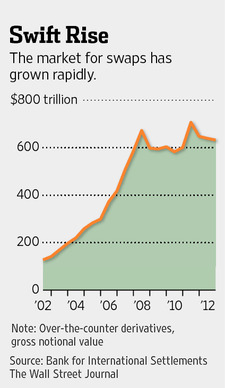
Banks, brokers and investors are warning of potential turmoil in a major part of the derivatives market on Oct. 2, when new U.S. rules kick in governing how instruments known as swaps are traded. Swaps are derivatives, traditionally not traded on exchanges, which corporations and financial institutions use to protect against or speculate on changes in everything from fuel costs to interest rates. The Bank for International Settlements estimates that there are $633 trillion of swaps outstanding.The new rules, which were mandated as part of the Dodd-Frank financial regulation law and are being implemented by U.S. regulators, are meant to make the swaps market more transparent and prevent a repeat of the 2008 financial crisis when the market was thrown into upheaval. Under the new rules, most swaps must be transacted through registered venues, routed through central clearing houses and reported to data warehouses known as trade repositories.
Industry officials are waging a vigorous last-ditch lobbying campaign aimed at persuading the Commodity Futures Trading Commission to delay the rules. They argue that the new standards have been applied too quickly and could throw the market into disarray.
“There is potential that trading is temporarily disrupted,” said Matt Nevins, managing director in the asset management group of the Securities Industry and Financial Markets Association, which asked to delay the deadline until at least April.
Others complain that the time frame for trading platforms to comply with the rules, and for traders to test new systems, is so tight it could propel trading to lightly regulated jurisdictions and venues that aren’t subject to the rules—potentially including those in the European Union, which is lagging behind the U.S. in drafting rules for derivatives.
Many market participants plan to eschew electronic trading platforms altogether in favor of clunky transactions over the telephone—a permitted detour around the new regulations, but the antithesis of the competitive, streamlined markets regulators wanted.
“We may have to revert back to voice trading for a while,” said Supurna VedBrat, co-head of market structure and electronic trading at BlackRock Inc. BLK +0.90%
For decades, trading in swaps has been conducted privately, away from transparent exchanges. But after the financial crisis, global regulators, backed by the world’s 20 economically largest countries, ordered most of the trades onto open platforms and routed to clearinghouses that take fees to guarantee trades. A key goal is to provide regulators with a better view of potential risks to the financial system.
In the U.S., that has led to the introduction of new systems called swap execution facilities, or SEFs, that need to be provisionally approved by the CFTC by Oct. 2. Even if the SEFs are registered by that deadline, many of their customers may not be operationally ready to trade on them.
A big reason for industry grumbling about the new SEF rules is that while they have been in the works for three years, some platform owners and investors say last-minute changes to the requirements have left them working around the clock to meet the Oct. 2 deadline.
“There is a general concern on the part of all market participants about readiness around Oct. 2,” said Michael Yarian, head of agency derivatives services at BarclaysPLC. BARC.LN -1.39% “There is uncertainty, which is driving the nervousness.”
The effects of any disruption could be felt far beyond the U.S. market. John Grout, policy and technical director with the London-based Association of Corporate Treasurers, said his members worry the new regulations will lead some key U.S. banks to reduce their activities in swaps. That could make it harder—and more expensive—for foreign companies to buy protection against their business risks.
The Wholesale Markets Brokers’ Association Americas recently asked the CFTC to delay until April a requirement to report certain swaps from SEFs to trade repositories. The group also requested a delay until February for SEFs to get their customers comfortable with the new systems. The International Swaps and Derivatives Association also is seeking temporary waivers on behalf of its members.
CFTC officials say they could in some circumstances grant waivers for owners of swaps platforms who aren’t ready. “There may be some very limited, targeted relief around the go-live date for SEFs,” a CFTC spokesman said.
“Market participants would benefit from getting a time-limited extension to allow for a smooth transition to these new execution venues,” said Scott O’Malia, one of five CFTC commissioners, in a speech Thursday.
The drift toward more regulated trading venues has been a priority for regulators since the crisis. But many market players held off on making costly investments in new infrastructure or switching their trading systems until they saw the final version of the CFTC rules.
When they were published in May, they contained a bombshell, buried in Footnote 88. The footnote—which has become a lightning rod for brokers’ grievances—expanded the types of contracts that SEFs had to accommodate from a few dozen products to hundreds.
Industry officials have been complaining to regulators—including CFTC Chairman Gary Gensler on a trip to London this month—that the necessary technological, legal and administrative work simply can’t be done by Oct. 2. Most are confident of being ready to trade routine products with their biggest clients, but say rolling out the full suite including unique products will take far longer.
Other logistical hurdles abound. And there have been heated industry debates over who is responsible if trades are rejected before clearing and how to ensure that customers have sufficient credit before trading.
“It’s complete chaos,” said Sunil Hirani, chief executive of trueEX Group, which has a pair of approved swaps-trading platforms.
 About bambooinnovator
 Bamboo Innovator