Investors are pouring money into nontraded real-estate investment trusts, despite repeated warnings from regulators
September 28, 2013 Leave a comment
September 27, 2013, 6:48 p.m. ET
A REIT That Could Bite Back
A target of regulators, nontraded REITs are drawing record assets.
LIZ MOYER
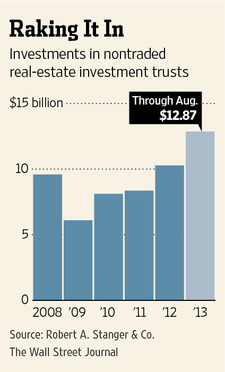
Investors are pouring money into nontraded real-estate investment trusts, despite repeated warnings from regulators. The products, which often sport yields of more than 6%, have proved popular among income-hungry investors looking to diversify beyond bonds. Like their exchange-listed cousins, nontraded REITs pool investor money into income-generating properties, such as office buildings, hotels or shopping malls, and pay dividends. As their name implies, they aren’t publicly traded and can lock up investor money for a number of years. Critics contend that the products are hard to understand and that investors aren’t being adequately warned about the risks.Total investments in nontraded REITs reached $12.9 billion as of Aug. 31 and are projected to surpass $18 billion by year-end, well more than the record $11.5 billion in 2007, according to a study released this month by the Investment Program Association, a trade group, and Robert A. Stanger & Co., an investment bank in Shrewsbury, N.J., that specializes in real-estate securities.
In August alone, $2.2 billion flowed into the products, the highest monthly total on record and an 83% increase over the same month a year ago.
Critics say the high costs associated with nontraded REITs—which have fees as high as 15%, much of that in commissions—has raised potential conflicts of interest between advisers who sell the investments and their clients.
The products have drawn criticism for other issues. They offer limited information on daily pricing and can make it difficult for investors to redeem their money. Cliff Caplan, an independent adviser at Neponset Valley Financial Partners in Norwood, Mass., who has recently sold nontraded REITs to some of his clients, says investors have to be comfortable with a time commitment of at least six years.
“If there’s any doubt, just don’t do it,” he says.
The Financial Industry Regulatory Authority has posted a warning on its website about the risks of nontraded REITs, while the Securities and Exchange Commission has said it wants nontraded REITs to provide more information about how shares are valued.
Massachusetts Secretary of the Commonwealth William Galvin, the state’s securities regulator, earlier this year subpoenaed 15 large brokerage firms about their sales of nontraditional products, including nontraded REITs.
Typically sold by financial advisers, the target audience is usually people close to retirement who are worried about their nest eggs, say lawyers who represent investors in securities arbitrations.
“I think they are legitimate products for people who want 2% to 4% of their portfolio in them,” says Andrew Stoltmann, a Chicago lawyer. “But as a sector bet, it’s very narrow. It’s impossible to justify 10% to 30%.”
Some Massachusetts advisory firms violated the state’s 10% limit on REIT-investment portfolio concentrations, Mr. Galvin said, after investigating their sales of nontraded REITs. In six separate settlements this year, the firms collectively returned $21.7 million to investors.
After filing a complaint in 2011, Finra last year ordered David Lerner Associates in Syosset, N.Y., to pay $12 million in restitution to customers who bought $2 billion in nontraded REITs. Finra alleged the firm used “unfair practices” to sell the securities, which were invested mostly in extended-stay hotels.
Finra accused the firm of targeting unsophisticated investors and the elderly, selling $442 million of nontraded REITs without performing adequate suitability reviews.
“The regulatory issues we faced in 2011 have been settled and are behind us,” Lerner said in a statement.
None of this has seems to have damped investor appetite. Some of the new investment is coming from investors in older nontraded REITs that have listed on an exchange or merged with another entity and returned investors’ initial stake. Many investors are taking their proceeds and plowing it back into new nontraded REITs, says Kevin Gannon, a managing director at Stanger.
There have been five nontraded REITs so far this year that returned $12 billion to investors and another three representing $8 billion are slated to close by the end of the year, according to the report by IPA and Stanger.
American Realty Capital Properties ARCP -0.32% in New York raised $5.8 billion through August in new and existing deals, according to the report. Cole Real Estate Investments COLE +0.08% in Phoenix raised $1.8 billion, and Griffin Capital in El Segundo, Calif., raised $1.4 billion.
While LPL Financial and rival Ameriprise Financial AMP -0.17% have been big sellers of nontraded REITs, other firms are jumping in.
Earlier this year, Bank of America BAC -1.28% Merrill Lynch began offering brokerage clients a nontraded REIT called Jones Lang LaSalle Income Property Trust, making it the first big brokerage to enter the sector. Offered exclusively through Merrill, the REIT sold $124 million through August. Other firms are being signed on to sell the product starting later this year. A Bank of America spokesman declined to comment.
Some of the new nontraded REITs offer more disclosure on daily pricing and offer more redemption opportunities and lower costs but the industry is still evolving, says Adam Markman, a managing director at real-estate-research firm Green Street Advisors in Newport Beach, Calif. “This is an inferior vehicle when you compare it to publicly traded REITs,” he says.
 About bambooinnovator
 Bamboo Innovator