Making 1 1=1: The Central Role of Identity in Merger Math

Making 1 1=1: The Central Role of Identity in Merger Math

Hamid Bouchikhi ESSEC Business School

John Kimberly University of Pennsylvania – Management Department

June 13, 2012
ESSEC Working Paper 1204

Abstract: 
When trying to pull off a successful deal many senior executives focus their attention on economic synergies (1 1>2) and ignore that psychological synergies (1 1=1) are required to reap the financial benefits of mergers and acquisitions. The authors discuss common mistakes firms make in the management of identity issues and offer four approaches that managers can follow to achieve identity integration.

How Your Brand Can Beat Goliath

How Your Brand Can Beat Goliath

by Ron Faris  |   8:00 AM September 23, 2013

There was once a running joke at Virgin Mobile when it came to our marketing spend: What Virgin Mobile would spend in one year, AT&T would spend on one episode of “American Idol.” Many disruptive brands struggle with how to best manage their marketing budgets while they strategize around how to dethrone their incumbent Goliaths. Smaller companies, of course, don’t have the advertising spends to compete with their competitors on traditional vehicles, and they’re far more susceptible to shifts in the competitive landscape. A simple budget cut can render them “dark” during peak months on TV, causing their consideration levels — a key metric for brand directors trying to compete — to dwindle.  Marketing execs then end up “re-launching” their own brands to new audiences on a loop in a struggle to make up for lost time. This is exhausting and, more importantly, it isn’t working. If ever a David were to save his strength to fight Goliath, the first step would be to eliminate needless spending on changing campaigns for re-brands, and focus more time on changing the conversation. Literally. Social conversation is the only way small brands can get an edge on the big guys. Read more of this post

Why you should spend your mornings in a cave: People are most creative when they work without distraction. But what does that mean for the team? Welcome to the cave-dwelling future of collaboration

WHY YOU SHOULD SPEND YOUR MORNINGS IN A CAVE

PEOPLE ARE MOST CREATIVE WHEN THEY WORK WITHOUT DISTRACTION. BUT WHAT DOES THAT MEAN FOR THE TEAM? WELCOME TO THE CAVE-DWELLING FUTURE OF COLLABORATION.

BY: DRAKE BAER

If you want to be your most creative self, research suggests that you should start your day in a cave–and find a way to make it an expected thing with your team. Why? Because as Kellogg School of Management professor Leigh Thompson tells Fast Company, people have work styles that range from an independent to an interdependent orientation, sort of like how people are introverts or extroverts, with ambiverts in the middle. The independent worker will kindly ask that you leave her alone while she gets her work done–while the interdependent worker can’t function without being around others. Read more of this post

“We can now produce more than half a million dumplings a day with our fully automated factory”; Who would think that the founder of Master Siomai was mixing their signature siomai recipe by hand just a few years ago

From ‘mano-mano’ to ‘matic: Shifting to success with Meralco

(philstar.com) | Updated September 23, 2013 – 10:46am

a39p

Master Siomai founder and SME Luminary Ernilito Chan

We can now produce more than half a million dumplings a day with our fully automated factory,” Ernilito Chan, president of MC Master Siomai Hut, Inc. proudly says. Who would think that the founder of Master Siomai, the country’s well-loved dumpling brand, was mixing their signature siomai recipe by hand just a few years ago? Today, Master Siomai is not just one of Malabon’s most successful home grown businesses in the small to medium enterprises (SMEs) category, it was also recently lauded as the most outstanding SME in the 2013 Meralco Luminaries — a customer appreciation program which recognizes top customers from the private and public sectors that share the utility’s vision of a brighter Philippines. Read more of this post

Why $100,000 Salary May Yield Retirement Flipping Burgers

Why $100,000 Salary May Yield Retirement Flipping Burgers

It seems like another life. At the height of his corporate career, Tom Palome was pulling in a salary in the low six-figures and flying first class on business trips to Europe. Today, the 77-year-old former vice president of marketing for Oral-B juggles two part-time jobs: one as a $10-an-hour food demonstrator at Sam’s Club, the other flipping burgers and serving drinks at a golf club grill for slightly more than minimum wage. While Palome worked hard his entire career, paid off his mortgage and put his kids through college, like most Americans he didn’t save enough for retirement. Even many affluent baby boomers who are approaching the end of their careers haven’t come close to saving the 10 to 20 times their annual working income that investment experts say they’ll need to maintain their standard of living in old age. For middle class households, with incomes ranging from the mid five to low six figures, it’s especially grim. When the 2008 financial crisis hit, what little Palome had saved — $90,000 — took a beating and he suddenly found himself in need of cash to maintain his lifestyle. With years if not decades of life ahead of him, Palome took the jobs he could find. The youthful and perennially optimistic grandfather considers himself lucky. He’s blessed with good health, he said. He’s able to work, live independently and maintain his dignity, even if he has to mop the floors at the club grill before going home at 8 p.m. and finally getting off his feet. “That’s part of the job,” he said. “You have to respect the job you’re doing and not be negative — or don’t do it.” Read more of this post

Humble Chinese Village Basks in Legacy of Three Kingdoms Era; “The Three Kingdoms” is to China what “The Iliad” is to the West. But unlike “The Iliad,” “The Three Kingdoms” has wide appeal in modern times. Mao Zedong supposedly studied it for strategy lessons

September 22, 2013

Humble Chinese Village Basks in Legacy of Three Kingdoms Era

By EDWARD WONG

23longmen-map-articleInline

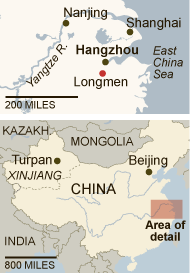
LONGMEN, China — In the shadow of a lush mountain and near a slow-moving river in southeast China sits this village, whose name means Dragon Gate. There are narrow alleys and whitewashed homes and the flesh of sliced bamboo drying on the ground. Its humble appearance, though, belies the fact that it played a role in the famous Three Kingdoms era, when kings leading rival states fought in the third century over the right to succeed the Han empire. The blood-drenched stories were immortalized in a 14th-century classic by Luo Guanzhong, “The Romance of the Three Kingdoms,” which in turn has spawned countless films, television shows and other adaptations. “This village is so important because the people are descended from Sun Quan,” said one resident, Sun Yaxiao, 25, as she walked with visitors one afternoon through the alleys. Sun Quan was one of the three major kings in the early period of the Three Kingdoms, a figure known to most Chinese. Read more of this post

Only Known Iraq Billionaire Hires Women Defying Hussein

Only Known Iraq Billionaire Hires Women Defying Hussein

Faruk Mustafa Rasool first saw a mobile phone in 1998 while he was lying in a London hospital bed recovering from quadruple heart bypass surgery. Ignoring his doctors’ advice to rest, he started figuring out how to bring the device to his native Iraq. Faruk was soon smuggling phones and transmitters over the Turkish border into his hometown of Sulaymaniyah, in Iraq’s semi-autonomous Kurdish region, according to his friend Shwan Taha. He built one of the country’s first wireless networks, something that once could have gotten him thrown in prison. Saddam Hussein banned mobile phones to isolate and better control the citizens of his totalitarian state. Read more of this post

Keeping the family fortune relatively intact; Third and fourth generations are revitalising companies

Last updated: September 22, 2013 3:32 pm

Keeping the family fortune relatively intact

By Jeremy Grant

Family-controlled companies loom large in Asia, many tracing their origins to the 19th-century migration of mercantilist entrepreneurs from China. They account for about half of all publicly listed companies and 32 per cent of total market capitalisation across 10 Asian countries, according to Credit Suisse. Some have come under the spotlight in recent years as they have grappled with awkward and sometimes bruising succession issues. The very public family squabble in 2011 over the assets of Stanley Ho, the 91 year-old Hong Kong-based casino billionaire, was a vivid example. But for each tale of family dysfunction there are others of transition under way to a professionalised younger generation, which is helping run businesses that are among the most profitable in the region. In many cases those younger family members – the third and fourth generation from the founding patriarch – have been educated abroad, at top business schools in the US and Europe. Many also have gained work experience elsewhere before joining the family business. Read more of this post

In praise of art forgery: Fakes say some interesting things about the economics of art

In praise of art forgery: Fakes say some interesting things about the economics of art

Sep 21st 2013 |From the print edition

20130921_LDD001_0

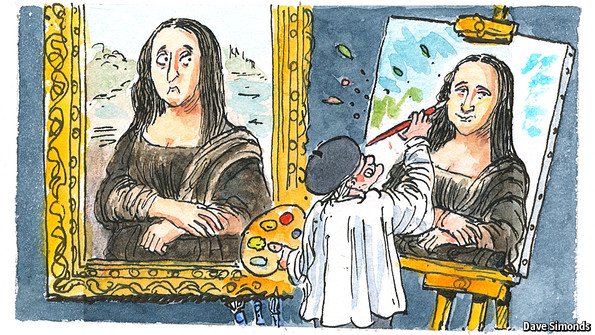
WHAT makes an artist great? Brilliant composition, no doubt. Superb draughtsmanship, certainly. Originality of subject or of concept, sometimes. But surely true greatness means that the creator of a painting has brought a certain je ne sais quoi to the work as well. There is, however, a type of person who seems to sait perfectly well what that quoi is, and can turn it out on demand. In 1945, for example, a Dutchman named Han van Meegeren faced execution for selling a national art treasure, in the form of a painting by Vermeer, to Hermann Göring, Hitler’s deputy. His defence was that it was a forgery he had painted himself. When asked to prove it by copying a Vermeer he scorned the offer. Instead he turned out a completely new painting, “Jesus Among the Doctors”, in the style of the master, before the eyes of his incredulous inquisitors. Read more of this post

Moncler, the purveyor of €1,000 down jackets, to list after sales climbed from less than €50m in 2003 to €489m in 2012; “China is very dangerous. I don’t trust that it will be like this for the next 20 years . . . there will be a crash.”

September 23, 2013 11:46 am

Moncler in second attempt to wrap up IPO

By Rachel Sanderson in Milan

Moncler Grenoble Fall 2013 Presentation

My dream is that you collect three, four, five of my jackets in your wardrobe and you choose one for different days, but they last for life – Remo Ruffini, chairman and creative director, Moncler

Moncler, the purveyor of €1,000 down jackets, has a stock market listing in its sights. Remo Ruffini, chairman and creative director of Moncler, said in an interview with the Financial Times that he and the brand’s private equity backers were looking at a winter listing of the Franco-Italian brand in Milan. A successful listing would be second time lucky for Moncler. Private equity group Carlyle pulled a stock market listing in Milan in June 2011. Jittery about volatile markets, Carlyle instead sold 45 per cent of Moncler to French private equity group Eurazeo for €418m. Read more of this post

Druckemiller: “My first mentor and boss used to tell me it takes hundreds of millions of dollars to manipulate a stock up, but the minute this phony buying stop, it can go down on no volume and it can just reprice immediatedly”

Three Investing Billionaires Have Recently Come Out With Cautious Statements On The Stock Market

JOE WEISENTHAL SEP. 22, 2013, 8:59 PM 9,196 10

Here’s an interesting observation from Mike O’Rourke of JonesTrading. In unusual timing, we’ve recently heard from three investing billionaires (Warren Buffett, Carl Icahn, and Stanley Druckenmiller) suggesting that the stock market is getting rich and fully valued. From O’Rourke:

[Buffett]  noted that the equity market was fairly valued and stocks were not overvalued.  Specifically, Buffett said “They were very cheap five years ago, ridiculously cheap,” and “That’s been corrected.”  He also noted, “We’re having a hard time finding things to buy.” One has to take note when the world’s most high profile investor (a long investor), cannot find stocks to buy although he reports his business is improving.  Buffett was not the only Billionaire to weigh in last week.  Carl Icahn responded candidly when asked his view on the market.  “Right now, the market is giving you a false picture.

The market tells you that you are doing well, but I don’t think a lot of companies are doing that well.  They are taking advantage of very low interest rates.  So, obviously, you don’t have to be a financial genius to understand if I can borrow at 3% or 4% and buy assets maybe my own stock that is yielding 9%, 10% or 11%, I am going to make a lot of money. In one sense or another that is what is going on….I do think at 17x that you have to be pretty well hedged.”  These comments come a little more than a week after Stanley Druckenmiller opined that, “But if you tell me QE is going to be removed over nine or 12 months, that’s a big deal because when it’s my belief that QE has subsidized all asset prices.  And you remove that subsidization, the market will go down.

Druckemiller elaborated “My first mentor and boss, Dr. Ellis in Pittsburgh, used to tell me it takes hundreds of millions of dollars to manipulate a stock up, but the minute you have this phony buying stop, it can go down on no volume and it can just reprice immediately. I personally think as long as this game goes on, assets will stay elevated. But when you remove that prop – and let’s face it, the Fed has said they’re targeting those asset prices – those prices can adjust immediately.”

Shadow Boxing With Risk at Chinese Banks

September 22, 2013, 2:51 p.m. ET

Heard on the Street: Shadow Boxing With Risk at Chinese Banks

AARON BACK

MI-BY611_CBANKH_NS_20130922165105

Chinese banks are bringing some holdings out of the shadows. But they might not be shining a harsh enough light on them. For some time, Chinese banks have used off-balance-sheet vehicles to lend to trusts, which are lightly regulated finance intermediaries. Now, new regulations are forcing them to take some of those instruments back onto their books as Chinese authorities look to rein in the “shadow-banking” sector. That led in the first half of this year to a surge on some bank balance sheets of credit extended to these trusts. Yet banks, especially smaller ones, may not be adequately reflecting, or preparing for, the risk that could be embedded in these holdings. The tangled web starts with wealth-management products, a kind of high-interest deposit banks offer clients. These were created to sidestep caps on rates for traditional deposits. Sometimes, banks guarantee the client’s principal in these products; when they don’t, the products don’t appear on bank balance sheets. Read more of this post

Wuhan has to repay about 100 million yuan every day in 2013 and 2014 as its debts soared on huge expenditures on infrastructure projects in the past years, the latest example showing the seriousness of China’s local government debt

Local debt levels raising alarm 
Monday, September 23, 2013
Wuhan has to repay about 100 million yuan (HK$126.7 million) every day in 2013 and 2014 as its debts soared on huge expenditures on infrastructure projects in the past years, the latest example showing the seriousness of China’s local government debt issue. Debts of the capital city of Hubei province reached 203.71 billion yuan as at June 30, 2012, China Business said, citing an investigation report by an official from the Ministry of Finance. Read more of this post

Hangzhou Bay Bridge provides lower returns than expected after five years; bridge’s operator is facing a huge capital shortfall of 850 million yuan (US$138.2 million)

Hangzhou Bay Bridge provides lower returns than expected

Staff Reporter

2013-09-23

C502X0020H_2008資料照片_N71_copy1

The opening ceremony of the Hangzhou Bay Bridge held on May 1, 2008. (Photo/Xinhua)

After putting the 36 km Hangzhou Bay Bridge in east China’s Zhejiang province into service in 2008, the bridge’s operator is facing a huge capital shortfall of 850 million yuan (US$138.2 million), given that only 643 million yuan (US$104.5 million) in tolls was collected during the first half of this year, Guangzhou’s 21st Century Economic Report reports. Read more of this post

Investors Vs. Asset Managers: A Dysfunction at the Heart of China Private Equity

Investors Vs. Asset Managers: A Dysfunction at the Heart of China Private Equity

2013-09-23 17:47:35

Peter Fuhrman, Chairman and CEO China First Capital

Assuming the same level of risk, would you rather make $100 from investing $10 or from investing $50? Easy, right? Who wouldn’t choose to make ten times your money, rather than just double it? There is one group I know. Private equity firms active in China. At least some of them. They care more about the amount they can invest in a deal than the profits they stand to make. The illogic at work here is the direct result of some particular, not very appealing characteristics, of the PE industry in China. PE firms lately have more confidence in their ability to raise money than to invest it profitably by achieving a timely exit. To raise money, though, a PE firm needs first to spend most of what it already has. Result: a rush to get money out the door and parked in deals. Read more of this post

Lotte heirs in ‘mini’ power struggle; Shin Kyuk-ho sent the elder Shin to Japan and the younger Shin to stay in Korea but the Korean ops have grown ten times bigger than the Jap ops in the past decades

2013-09-23 21:00

Lotte heirs in ‘mini’ power struggle

02-21

Shin Kyuk-ho                 Shin Dong-joo              Shin Dong-bin
Founder of             Japan Lotte Holdings             Lotte Group
Lotte Group                  vice chairman                     chairman

By Choi Kyong-ae
The brothers who run Lotte operations in Korea and Japan have been on a hunt for stakes in affiliates, triggering suspicion that they are competing for control of the Korean retail giant.  Their father is 91 but still engaged in managing the group. Last week, Japan Lotte Holdings Vice Chairman Shin Dong-joo acquired 1 billion won ($930,000) worth of stocks, representing a 0.05 percent stake, in Lotte Confectionery. Lotte Group Chairman Shin Dong-bin continued to buy stakes in Lotte Chemical, Lotte Confectionery, Lotte Chilsung and Lotte Insurance since May through Sept. 13. Read more of this post

Reality check for ‘salaried man myth’: STX Group chairman’s troubles tarnish image of a business legend; In every country, there are legends in the business world who start their career from the bottom as salaried workers, and after decades of hard work become heads of conglomerate

Reality check for ‘salaried man myth’

STX Group chairman’s troubles tarnish image of a business legend

Sept 23,2013

Korea Salaried

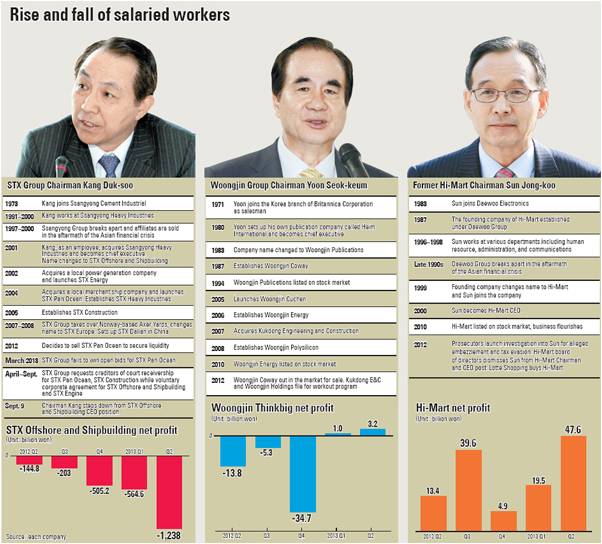
In every country, there are legends in the business world who start their career from the bottom as salaried workers, and after decades of hard work become heads of conglomerates. Korea, too, has such legendary figures to share, although in most cases they don’t seem to have a happy ending. STX Group Chairman Kang Duk-soo, who has long been considered a successful entrepreneur who started out with nothing but achieved much, is about to lose his title as chief executive officer of the conglomerate’s flagship STX Offshore and Shipbuilding, which he has been steering for more than a decade.  Read more of this post

Tongyang Group is expected to face the biggest-ever liquidity crisis as Orion Group has refused to offer emergency liquidity to the cash-strapped group; Orion’s Tam and wife Lee Hwa-kyung and Hyun Jae-hyun reportedly paid visit to graveyard of Lee Yang-gu, late founder of Tongyang Group, on Sep 14, which had raised the expectation that Orion Group would assist Tongyang Group repay debt

2013-09-23 16:37

Tongyang may go under court control

By Kim Rahn

TYCement

Tongyang Group is expected to face the biggest-ever liquidity crisis as Orion Group has refused to offer emergency liquidity to the cash-strapped group. Following Orion’s decision, Tongyang’s creditors have expressed their reluctance to provide fresh funds, which many believe will likely drive the ill-fated group into court receivership. Orion Group officially said Monday that it and its major shareholders do not and will not want to help the Tongyang Group, saying foreign investors and the main shareholders of Orion have expressed concerns over Orion’s involvement in the financial mess. Read more of this post

Yang Hyun-suk, who heads South Korean talent agency YG Entertainment maintained his top stance on the list of stock-rich celebrities this month

2013-09-23 10:16

YG Entertainment head remains richest celebrity in stocks

Yang Hyun-suk, who heads South Korean talent agency YG Entertainment Inc., maintained his top stance on the list of stock-rich celebrities this month, data showed Monday.
According to the data compiled by market researcher Chaebul.com, Yang saw the value of his shares reach 197.3 billion won (US$182.1 million) as of Sept. 16, becoming the richest shareholder among local celebrities. YG Entertainment has South Korean rapper Psy under its wing, who released the global-hit “Gangnam Style,” which has been viewed more than 1.77 billion times since it was uploaded on YouTube on July 15, 2012. Lee Soo-man, the chairman of SM Entertainment Co., ranked second with the value of his shares reaching 157.6 billion won, trailed by Bae Yong-joon, an actor widely known from the popular drama “Winter Sonata,” with 30.6 billion won. JYP Entertainment chief Park Jin-young saw the value of his shares reach 7.2 billion won, followed by actor Jang Dong-gun with 3.7 billion won. YG Entertainment, meanwhile, saw its operating profit jump 56.8 percent in the first half of 2013 from a year earlier, while that of SM Entertainment plunged 62.9 percent over the cited period. KeyEast Co., an entertainment agency founded by Bae, switched to a shortfall of 2.6 billion won over the cited period, compared to an operating profit of 1.5 billion won a year earlier. (Yonhap)

What K-pop needs to go global

What K-pop needs to go global

Korean companies should have faith in their singers that their music can stand up in any locale.

Sept 24,2013

To call Korean K-pop “Hallyu” (or “the Korean Wave”) might be a misnomer. A wave comes and goes; it comes in and goes out. That might be a metaphor for the many Korean singers that have gone to the United States in search of global stardom (a little about Psy later), crashed on the shore and returned home to Korea, somewhat less but humbler for at least trying.  Read more of this post

Korea’s total debt to GDP ratio hit a record high to 289.2% in 2Q, with debt growing much faster than economic output

2013-09-23 16:11

Debt-to-GDP ratio hits record high

By Kim Rahn
The nation’s total debt to gross domestic product (GDP) ratio hit a record high in the second quarters of this year, with debt growing much faster than economic output.
Data from the Bank of Korea showed Sunday that combined debt held by households, companies and the government was 3.74 quadrillion won ($3.45 trillion) as of the end of June. This is 289.8 percent of GDP for the last one year, larger than the previous record during the height of the global financial crisis of 285.2 percent in the second quarter of 2009.
The debt to GDP ratio was around 220 percent in 2003. But it rose to 236.5 percent at the end of 2006, to 245.9 percent in 2007 and 273.7 percent in 2008. Read more of this post

Amid skepticism about “hallyu” or the Korean wave, a 2003 Korean drama “Jewel in the Palace” continues on the airwaves a decade after its first airing in 2003

013-09-23 20:34

Hallyu drama celebrates 10 years

By Kim Ji-soo

Amid skepticism about “hallyu” or the Korean wave, a 2003 Korean drama “Jewel in the Palace” continues on the airwaves a decade after its first airing in 2003.

The broadcaster MBC has announced that it will put out special programs to mark the 10th anniversary of the epic drama about a female royal chef of the Joseon Kingdom (1392-1910). Starring actors Lee Young-ae and Ji Jin-hee, the drama was produced for $15 million. Since its first airing, it has achieved 57 percent viewer ratings in Korea, and has pulled in $40 million worldwide, becoming the definitive K-drama that catapulted Lee and Ji into global hallyu stars. It has also been made into a musical. Read more of this post

AmorePacific, Korea’s leading cosmetics firm, aims to join the league of the world’s top 10 global cosmetics firms by 2020, CEO Suh Kyung-bae said

2013-09-23 19:06

Amore aims to join global top 10

By Park Ji-won

AmorePacific, the nation’s leading cosmetics firm, aims to join the league of the world’s top 10 global cosmetics firms by 2020, CEO Suh Kyung-bae said. To that end, Suh plans to expand overseas sales by competing with global brands and develop it into a “Great Global Brand Company,” he added. “We expect that more than half of our products will be sold overseas in the near future. Our products are growing in popularity among Asian customers,” Suh said on the 68th anniversary of the company on Sept. 5. “If we keep providing what our customers want in beauty products, we expect the company will earn more than half of our revenue from the overseas market,” Suh said. Read more of this post

Treasury Wine CEO to Leave After A$160 Million Inventory Writedown; The company “needs a leader with a stronger operational focus to deliver the company’s growth ambitions”

Treasury Wine CEO Quits After A$160 Million Writedown

Treasury Wine Estates Ltd. (TWE), the world’s second-largest publicly traded wine maker, said Chief Executive Officer David Dearie will leave the company immediately after writedowns to destroy out-of-date inventory. The company “needs a leader with a stronger operational focus to deliver the company’s growth ambitions,” Chairman Paul Rayner said in a regulatory statement today. Warwick Every-Burns, a director of Treasury Wine Estates, will become interim CEO. Dearie’s departure follows chief financial officer Mark Fleming, who quit about six weeks before the company announced the U.S. writedown. Treasury, whose brands include Penfolds and Beringer, said July 15 it would take A$160 million ($150 million) of writedowns to destroy stock, discount older bottles, and take charges for onerous grape-buying contracts. The company held an an excess of low-valued bulk wine, as a result of expected lower sales to the U.S., which will reduce earnings in the 2014 financial year by about A$30 million, it said previously.

To contact the reporter on this story: David Fickling in Sydney at dfickling@bloomberg.net

How IT creates a wealthy Australia

How IT creates a wealthy Australia

PUBLISHED: 23 SEP 2013 18:46:21 | UPDATED: 23 SEP 2013 20:12:34

HUGH DURRANT-WHYTE

Last week was a fairly typical week at National ICT Australia (NICTA). On Monday morning we hosted a parliamentary delegation on transport safety and in the afternoon welcomed a senior leadership group from the NSW Police. On Tuesday morning we scoped a data analytics project with a major telco and a large logistics company. That same afternoon we started an exciting new health informatics project with the Garvan Institute. On Wednesday we held an industry forum in Melbourne on environmental analytics. Read more of this post

Zong Qinghou should rethink Wahaha management style; Hangzhou Wahaha Group — China’s leading beverage maker — operates like a “one-person company” and has never had a deputy CEO, with Zong Qinghou, the company’s founder, chairman and CEO handling every decision

Zong Qinghou should rethink Wahaha management style: insider

Staff Reporter

2013-09-23

Hangzhou Wahaha Group — China’s leading beverage maker — operates like a “one-person company” and has never had a deputy CEO, with Zong Qinghou, the company’s founder, chairman and CEO handling every decision. However, following reports that Zong was a victim of a knife attack, observers have begun to question whether the group would be able to continue operating smoothly if Zong were to stepped down, reports the Guangzhou-based Southern Metropolis Daily. The Chinese tycoon — the country’s second-richest man — was attacked near his home in Hangzhou in eastern China’s Zhejiang province on Sept. 13, sustaining minor wounds to his left hands. Local police later confirmed that Zong was attacked by a migrant worker surnamed Yang who was angry when Zong declined to offer him a job at his company. Read more of this post

Non-residents face hard and costly road to get around the hukou barrier in China

Non-residents face hard and costly road to get around the hukou barrier

Monday, 23 September, 2013, 12:00am

Zhang Hong hong.zhang@scmp.com

After working in Beijing for 10 years, Gao Feng, 36, a senior manager at a private technology company, nearly has it all: three flats, two luxury cars, a good job and a happy family. What could be missing? A Beijing hukouHukou refers to permanent residency status, and an urban hukou often affords its bearers a slew of benefits. For instance, in an effort to control property prices, the Beijing municipal government has set a rule that allows only permanent Beijing residents to buy a second home. To buy a first home, those without ahukou would need to show tax documents going back five years and proof of social security payments. Read more of this post

Growing logistics market in China struggles to contend with smuggling

Growing logistics market in China struggles to contend with smuggling

Xinhua

2013-09-22

China is struggling to combat illegal imports which smugglers conceal in mass freight as the country’s logistics industry booms. On Tuesday, police dumped a large batch of smuggled goods in a landfill in Nanning, capital of south China’s Guangxi Zhuang autonomous region. Around 200 tonnes of items were destroyed, including frozen chicken and beef. In the third quarter of this year, Nanning police have cracked a number of smuggling cases, featuring 2,700 kg of pork of questionable quality and 970 tonnes of other frozen goods. In recent years, smugglers have turned to disguising banned goods in large cargoes, which have become much more common as the logistics industry expands. Read more of this post

Brazil risks lost decade as it bungles infrastructure boost; Transport investment still lags far behind other large economies

September 22, 2013 2:22 pm

Brazil risks lost decade as it bungles infrastructure boost

By Joe Leahy in São Paulo

Transport investment still lags far behind other large economies

Officiating at a railway project last week in Rondonópolis in the Brazilian soya bean state of Mato Grosso, President Dilma Rousseff said the country was “two centuries” behind when it comes to building its rail network. A similar point, although to a lesser degree, could be made for the rest of the country’s transport and logistics networks. Brazil’s highway system lags behind probably by 50 to 60 years, the same for ports, urban transport and airports. The government is trying to fix this. But as shown by two landmark tender processes last week – one for highways and the other for oil exploration blocks – it needs to get moving or risk condemning Brazil to a lost decade in terms of higher potential economic growth. Who is responsible for this mess? Most countries, developing or developed, struggle with infrastructure construction and Brazil is no exception. Read more of this post

China’s internet firms find new battle pitch in smart TV

China’s internet firms find new battle pitch in smart TV

Staff Reporter

2013-09-23

Internet television is set to explode this year. In China, internet companies such as Alibaba Group, Tencent Holdings, and Xiaomi Technology, as well as online video portal LeTV.com, all have jumped on the internet TV industry, but which one can eventually stand out remains to be seen, China Entrepreneur Magazine reports.

Internet TV, or online TV, is the digital distribution of TV programs via the internet. Earlier this month, Xiaomi simultaneously introduced its Xiaomi 3 handset and the Xiaomi TV, but the backbone of the company — the smartphone — has yet to be tested by the market, the report said. Xiaomi described its TV product as “equipped with 47-inch 3D Smart TV, the first TV for young people.” In the eyes of Xiaomi chairman Lei Jun, a smartphone is the TV remote control, while the TV is the phone’s display. Larger phone screens are still not satisfying to the video-viewing crowd, Lei said. The best solution to resolve the small-screen problem is to link the phone to the TV, hence the creation of Xiaomi TV. Read more of this post