Malaysians Brace for Shift to Austerity as Najib Cools Spending

Malaysians Brace for Shift to Austerity as Najib Cools Spending

Malaysian Prime Minister Najib Razak returned to power this year with the help of a spending spree that boosted consumption. Now voters could feel the pinch as he tries to appease a different group: rating companies. Najib’s government raised subsidized fuel prices for the first time since 2010 this month and has said it will delay some infrastructure projects, seeking to contain the budget gap and shore up the current account after Fitch Ratings cut Malaysia’s credit outlook to negative in July. It is also considering a goods and services tax in the 2014 fiscal plan due Oct. 25. Read more of this post

Singapore’s Home Sales Rebound to Be Short-Lived; “Supply is a very real thing, so seeing spanking new buildings coming up with no real demand will see some price correction and some pain for developers as well.”

Singapore’s Home Sales Rebound to Be Short-Lived: Southeast Asia

Singapore’s jump in private home sales last month was only a temporary reprieve for developers as the government’s cooling measures take root and mortgage rates begin to rise. The city’s housing sales climbed 54 percent to 742 in August from July, when they fell to 482, the lowest in almost four years, according to government data. With nine rounds of cooling measures since mid-2009, the increase will be short-lived, according to Mizuho Bank Ltd. and UOB Kay Hian Pte. Monthly sales averaged about 1,700 units in the first six months of the year. Read more of this post

The battle to secure German shipping lender HSH

The battle to secure German shipping lender HSH

1:13am EDT

By Laura Noonan

HAMBURG (Reuters) – Once the beacon of a brave new future for Germany’s publicly-owned regional banks, HSH Nordbank is now a focal point of concern over the sector. The Hamburg and Kiel-based bank earned its trail-blazer status by attracting 1.25 billion euros from US investor J.C. Flowers in 2006 and touting plans to list a significant minority of its equity on the stock market. Now it is blazing a very different trail – the first Landesbanken to return to the European Commission for approval after it regretted a 2011 decision to hand back some of its original post-crisis bailout and asked for it to be re-instated. Read more of this post

Secluded heirs to the founder of Siemen called for a return to calm at the top of the German engineering giant, amid a continuing dispute over the leadership of the company’s supervisory board

September 15, 2013, 4:18 p.m. ET

Siemens Heirs Ask for Calm

Leadership Dispute Roils German Firm’s Supervisory Board

WILLIAM BOSTON

BERLIN—Heirs to the founder of Siemens AG SIE.XE +1.21% called for a return to calm at the top of the German engineering giant, amid a continuing dispute over the leadership of the company’s supervisory board. The intervention this weekend by the usually secluded heirs of Werner von Siemens, who founded the company in 1847, is a rare move and could indicate that a younger generation of successors is keen to play a more active—and public—role in Siemens, one of Germany’s biggest manufacturers. The continued jockeying for position among Siemens’s various stakeholders also could be a signal that more far-reaching change at the upper echelons of the 166-year-old company is coming soon. “It is important to the family that calm is restored,” said Nathalie von Siemens, a great-great granddaughter of the founder, in comments published by the weekly Frankfurter Allgemeine Sonntagszeitung on Sunday. “As a family, we have a close emotional connection to the company. We try to keep the traditions of the founding fathers alive.” Ms. von Siemens declined to comment further. Read more of this post

Regulators Should Draw a Line Between Finance and Commerce

Sep 16, 2013

Regulators Should Draw a Line Between Finance and Commerce

FRANCESCO GUERRERA

To be or not to be a bank?

The Federal Reserve, Congress and some of the world’s largest financial institutions are about to tackle the existential issue of what a bank is. The narrow version of the debate is whether J.P. Morgan ChaseJPM +1.05% & Co., Goldman Sachs Group Inc.GS +1.85% and Morgan StanleyMS +2.13% should continue to own, store and transport commodities such as oil, copper and electricity. But its ramifications reach into a cornerstone of modern U.S. financial architecture: the separation of finance and commerce. Read more of this post

TIPS Extend Record Loss to Almost 10% Before Consumer Prices

TIPS Extend Record Loss to Almost 10% Before Consumer Prices

Treasury Inflation Protected Securities are extending this year’s record loss to almost 10 percent before a government report economists said will show the annual increase in the cost of living slowed in August. TIPS have declined 9.5 percent in 2013, the most since they were first sold in 1997, based on Bank of America Merrill Lynch data. The Federal Reserve will probably reduce its monthly bond purchases to $75 billion from $85 billion after a two-day meeting concludes tomorrow, according to a Bloomberg News survey of economists on Sept. 6. Read more of this post

Refinancings Plummet After Worst Losses in 14 Years: Muni Credit

Refinancings Plummet After Worst Losses in 14 Years: Muni Credit

U.S. localities are scaling back refinancing by the most since 2006 as the worst municipal bond losses in 14 years push up borrowing costs. With yields near a 29-month high, refinancings shriveled to just $81 billion this year through Sept. 11, out of $229 billion of total sales, Citigroup Inc. data show. That’s down 29 percent from last year’s pace, when localities refunded the most since at least 2003. Read more of this post

Preferred Stocks: Less Volatile Than Stocks, More Liquid Than Bonds?

September 9, 2013

Less Volatile Than Stocks, More Liquid Than Bonds

By JOHN F. WASIK

STOCK-articleLarge

AS hybrid securities, preferred stocks fill a useful niche between stocks and bonds, paying high dividends. Yet they are often ignored when building an income portfolio. As interest rates have climbed in recent months, though, you have to be careful about buying preferred shares. While they are worthwhile additions to retirement portfolios, you have to be aware of their risk profile. Read more of this post

Navigating the financial labyrinth of Germany’s Landesbanken

Navigating the financial labyrinth of Germany’s Landesbanken

1:13am EDT

By Laura Noonan

HAMBURG (Reuters) – To the casual observer, the Landesbanken’s results for the first half of this year might suggest Germany’s publicly-owned regional banks are in rude financial health. But the headline numbers belie a more complex reality. Four of the five major Landesbanken boasted improvements in profits for the first half of 2013, sometimes quite dramatic, like the 400 percent increase in pre-tax profits at Hamburg and Kiel based shipping lender HSH Nordbank. <SEE FACTBOX> Read more of this post

Martin Feldstein: How to Create a Real Economic Stimulus

September 16, 2013, 7:08 p.m. ET

Martin Feldstein: How to Create a Real Economic Stimulus

Entitlement reform is key to shrinking the ratio of debt to GDP and making room for pro-growth tax cuts.

MARTIN FELDSTEIN

ED-AR262_feldst_G_20130916160744

Earlier this year, former U.S. Treasury Secretary Larry Summers expressed doubts about the Federal Reserve’s quantitative easing policy of buying $85 billion a month of government bonds and other long-term assets. His skepticism antagonized some Fed insiders and liberal Democrats, who recently opposed his consideration by President Obama as the next Fed chairman. When Mr. Summers on Sunday withdrew his candidacy for the chairman’s job, there was one immediate benefit: Now Larry Summers will be free to voice an even clearer and stronger critique of current policy. Read more of this post

Fed Faces Tough Sell on Low-Rate Strategy

September 16, 2013, 2:21 p.m. ET

Fed Faces Tough Sell on Low-Rate Strategy

Steadying Economy Poses Test on Key Easy-Money Policy

JON HILSENRATH

Federal Reserve officials face a communication challenge explaining their interest-rate plans when they gather for a policy meeting this week. Their updated economic projections could show an economy that appears back to normal by 2016, but their projections of where short-term interest rates will be could show rates still quite low by then. Their challenge: How to justify the low interest-rate plan when their own estimates suggest an economy regaining its health. Read more of this post

Bionic Fed is No Match for Bond Market

Updated September 16, 2013, 8:04 p.m. ET

Bionic Fed is No Match for Bond Market

Tame inflation expectations don’t jibe with surging bond yields. The incoming Fed Chair will have a struggle on his or her hands keeping the Treasury market from choking off the recovery.

SPENCER JAKAB

MI-BY486_AOT_NS_20130916174803

Steve Austin, eat your heart out. The Six Million Dollar Man could have a second bionic arm installed and still not hold a candle to Janet Yellen, the $600 billion woman. That was the approximate gain in global stocks Monday morning after the Federal Reserve’s vice chair became the presumptive nominee for the top job. Even a better, stronger and faster chairman than Ben Bernanke won’t have the power to hold off the bond market forever, though. Under the past five months of his term, the yield on the benchmark 10-year Treasury note has surged an eye-watering one-and-a-quarter percentage points. Read more of this post

Affluent investors bet on farms, rail cars amid hunt for yield, income; reminscent of 1980s collapse of farmland values?

Affluent investors bet on farms, rail cars amid hunt for yield, income

Risk assets used mainly by pensions, endowments being pitched to rich investors

Sep 15, 2013 @ 2:13 pm (Updated 2:43 pm) EST

Ken Slater says he was a novice at growing corn and soybeans when he asked Bank of America Corp.‘s U.S. Trust unit to purchase the first of three farms for him in the past two years. A millionaire living in Palm Beach, Florida, Slater was looking for a place to put his money that would provide income, diversify risk and offer capital appreciation. He wasn’t thrilled with the returns of corporate and municipal bonds, so he put 5 percent of his portfolio in real assets such as farmland and timber. Read more of this post

Playing Favorites: How Firms Prevent the Revelation of Bad News

Playing Favorites: How Firms Prevent the Revelation of Bad News

Lauren Cohen, Dong Lou, Christopher Malloy

NBER Working Paper No. 19429
Issued in September 2013
We explore a subtle but important mechanism through which firms manipulate their information environments. We show that firms control information flow to the market through their specific organization and choreographing of earnings conference calls. Firms that “cast” their conference calls by disproportionately calling on bullish analysts tend to underperform in the future. Firms that call on more favorable analysts experience more negative future earnings surprises and more future earnings restatements. A long-short portfolio that exploits this differential firm behavior earns abnormal returns of up to 101 basis points per month. Further, firms that cast their calls have higher accruals leading up to call, barely exceed/meet earnings forecasts on the call that they cast, and in the quarter directly following their casting tend to issue equity and have significantly more insider selling. Read more of this post

Limited Managerial Attention and Corporate Aging

Limited Managerial Attention and Corporate Aging

Claudio Loderer, René Stulz, Urs Waelchli

NBER Working Paper No. 19428
Issued in September 2013
As firms have more assets in place, more of management’s limited attention is focused on managing assets in place rather than developing new growth options. Consequently, as firms grow older, they have fewer growth options and a lower ability to generate new growth options. This simple theory predicts that Tobin’s q falls with age. Further, competition in the product market is expected to slow down the decrease in Tobin’s q because it forces firms to look for alternative sources of rents. Similarly, greater competition in the labor market reduces the decrease in Tobin’s q with age because old firms are in a better position to hire employees that can help with innovation. In contrast, competition in the market for corporate control should accelerate the decline because it forces management to focus more on managing assets in place whose performance is more directly observable than on developing growth options where results may not be observable for some time. We find strong support for these predictions in tests using exogenous variation in competition.

How to Fall in Love With Math: Contemplate the elegance of infinity. Don’t ask “When will I use this?”

September 15, 2013

How to Fall in Love With Math

By MANIL SURI

BALTIMORE — EACH time I hear someone say, “Do the math,” I grit my teeth. Invariably a reference to something mundane like addition or multiplication, the phrase reinforces how little awareness there is about the breadth and scope of the subject, how so many people identify mathematics with just one element: arithmetic. Imagine, if you will, using, “Do the lit” as an exhortation to spell correctly. As a mathematician, I can attest that my field is really about ideas above anything else. Ideas that inform our existence, that permeate our universe and beyond, that can surprise and enthrall. Perhaps the most intriguing of these is the way infinity is harnessed to deal with the finite, in everything from fractals to calculus. Just reflect on the infinite range of decimal numbers — a wonder product offered by mathematics to satisfy any measurement need, down to an arbitrary number of digits. Despite what most people suppose, many profound mathematical ideas don’t require advanced skills to appreciate. One can develop a fairly good understanding of the power and elegance of calculus, say, without actually being able to use it to solve scientific or engineering problems. Think of it this way: you can appreciate art without acquiring the ability to paint, or enjoy a symphony without being able to read music. Math also deserves to be enjoyed for its own sake, without being constantly subjected to the question, “When will I use this?” Read more of this post

Ontario Teachers’ Pension Plan Cautious About Investing in China; Lack of Clear Information in China Is a Hurdle to Investments, Fund Says

September 16, 2013, 6:31 a.m. ET

Ontario Teachers’ Pension Plan Cautious About Investing in China

Lack of Clear Information in China Is a Hurdle to Investments, Fund Says

ISABELLA STEGER

The Ontario Teachers’ Pension Plan, one of the world’s biggest pension funds, opened its Hong Kong office with a note of caution about investing in China, saying lack of clear information could make it difficult to invest there. “I think we have to proceed with caution” in China, said chief executive Jim Leech, who is due to retire at the end of the year after six years in the top job. The fund, which has about 129.5 billion Canadian dollars ($125.9 billion) in assets under management on behalf of about 300,000 teachers in Canada’s most populous province, officially opened its Hong Kong office on Monday, its second major international office after London. The fund currently has about C$1.5 billion invested in the Asian-Pacific region, but faces rising competition from other investors including private-equity funds and sovereign-wealth funds that are flush with cash and rival pension funds, all of which have had footholds in the region for years. Read more of this post

Bernanke’s Maradona swerve hits bonds; how the Federal Reserve chairman has managed to tighten US financial conditions by more than 100 basis points without touching the Fed funds rate

September 16, 2013 8:43 am

Bernanke’s Maradona swerve hits bonds

By Steven Major

Clues to Fed chairman’s plan were in ‘term premium’ talk

Has Ben Bernanke delivered a modern version of the Maradona effect? It may help to explain how the Federal Reserve chairman has managed to tighten US financial conditions by more than 100 basis points without touching the Fed funds rate. The analogy, first applied to monetary policy by Sir Mervyn King, former Bank of England governor, refers to the ability of famed Argentine footballer Diego Maradona to clear a path to goal by wrongfooting opposing players as they tried to anticipate his next move. The bond market may not have been wrongfooted by Mr Bernanke’s swerve if it had paid better attention to what he said in March this year. We are used to thinking of his May 22 comments on the phasing out of US quantitative easing as this year’s key event for financial markets. It marked the start of the sell-off in US Treasuries, which contributed to big ructions in many emerging markets. But it was the earlier speech that provided some clues. Speaking about long-term interest rates on March 1, Mr Bernanke mentioned the phrase “term premium” no less than 28 times. Read more of this post

New Zealand Winemakers Seek Protection for Local Labels

Updated September 16, 2013, 5:40 a.m. ET

New Zealand Winemakers Seek Protection for Local Labels

LUCY CRAYMER

AI-CD561_NZWINE_G_20130916033907

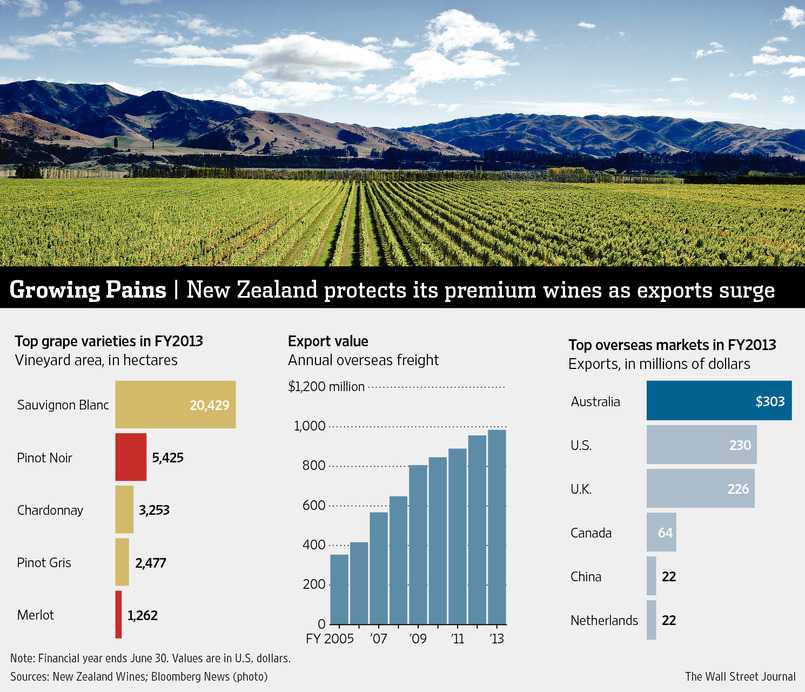
MARLBOROUGH, New Zealand—When the first winemakers harvested grapes here in the 1970s, they joined an army of New World vintners taking on established producers such as France and Spain. Now, New Zealand’s winemakers are resorting to an Old World tactic to fend off a challenge from newer rivals—regional trademarks. As wine consumption booms in countries such as China and Russia, entrepreneurs are setting up vineyards there, raising fears among New Zealand growers about knockoff wines posing as premium labels exported from regions like Marlborough and Central Otago. New Zealand winemakers are lobbying for the same legal protection for their brands that French producers won for Champagne two decades ago. Read more of this post

A renewed attack on social media by the Chinese leadership isn’t just an offensive against bloggers and activists. It’s also an assault by the Communist Party on its own shortcomings

September 16, 2013, 12:44 PM

The Other Side of China’s Social Media Crackdown

By Russell Leigh Moses

A recently renewed attack on social media by the Chinese leadership isn’t just an offensive against bloggers and activists who dominate the daily online discourse in China. It’s also an assault by the Communist Party on its own shortcomings. The sweeping political strategy towards social media that’s been taking shape here began before President and Party chief Xi Jinping left for this year’s G20 summit in Russia, and it picked up speed and suspects while he was away.  That’s a clear sign that there’s consensus in the Party leadership about how to handle dissent. The first part of the attack strategy involved the coordinated clampdown on leading microbloggers and social celebrities whose followings often sideline messages from state authorities. Read more of this post

Japanese tofu prices are going up 20% because of Abenomics

Japanese tofu prices are going up 20% because of Abenomics

By Adam Pasick @adampasick 4 hours ago

Japan’s tofu manufacturers are planning to jack up prices by 20% this autumn—the first markup in 15 years—as a response to the rising price of American soybean imports, caused in part by a stronger Japanese yen. Prime Minister Shinzo Abe has pushed a series of reforms designed to rid the economy of deflation, but the policies have had harsh consequences for industries that must import dollar-denominated commodities like oil, natural gas, and soybeans. Japan is the biggest per capita consumer of soy foods—not just in tofu but in soy sauce, miso, edamame, and the smelly fermented delicacy known as natto—with the average adult consuming 24.3 kilograms per year. The country is reliant on imports for about three-quarters of its supply, according to the US Department of Agriculture; that percentage rose even higher after the Fukushima nuclear disaster, which rendered 22% of domestic supply unusable (pdf, pg 2) because of radiation fears. Yasuo Hachijin, head of an industry group in the Kinki region and president of Kyoto-based Global Protein Foods Inc., said the price of raw materials has climbed 20% over the last five years. He told the English-language Japan Times, that “the hike will not be enough to fill the gap and that the industry will have consider another one.” The Japanese tofu industry’s woes have been exacerbated by drought conditions in the American Midwest, which resulted in six weeks of rising soy prices through Sept. 16—the longest run of rising prices since 2009. Prices eased slightly this week due to reports of much-needed rain—a relief to US farmers, if not necessarily to their clients in Japan’s tofu factories. Read more of this post

Contrary to what we usually believe, the best moments in our lives, are not the passive, receptive, relaxing times. The best moments usually occur when a person’s body or mind is stretched to its limits in a voluntary effort to accomplish something difficult and worthwhile

The Secret To Happiness

by SHANE PARRISH on SEPTEMBER 8, 2013

Psychologist Mihaly Csikszentmihalyi once wrote: While happiness itself is sought for its own sake, every other goal – health, beauty, money or power – is valued only because we expect that it will make us happy.

If money cannot make us happy, what does?

In this excellent TED talk, Csikszentmihalyi looks to those who find pleasure and lasting satisfaction in activities that bring about a state of “flow.” In Flow: The Psychology of Optimal Experience, Csikszentmihalyi writes: Contrary to what we usually believe, moments like these, the best moments in our lives, are not the passive, receptive, relaxing times—although such experiences can also be enjoyable, if we have worked hard to attain them. The best moments usually occur when a person’s body or mind is stretched to its limits in a voluntary effort to accomplish something difficult and worthwhile. Optimal experience is thus something that we make happen. For a child, it could be placing with trembling fingers the last blockon a tower she has built, higher than any she has built so far; for a swimmer, it could be trying to beat his own record; for a violinist, mastering an intricate musical passage. For each person there are thousands of opportunities, challenges to expand ourselves.

Attention is energy.

Attention is like energy in that without it no work can be done, and in doing work is dissipated. We create ourselves by how we use this energy. Memories, thoughts and feelings are all shaped by how use it. And it is an energy under control, to do with as we please; hence attention is our most important tool in the task of improving the quality of experience.

“You have to finish things – that’s what you learn from, you learn by finishing things.” Neil Gaiman’s Advice to Aspiring Writers, Applicable to All Creative Fields

Neil Gaiman’s Advice to Aspiring Writers, Applicable to All Creative Fields

“You have to finish things – that’s what you learn from, you learn by finishing things.”

Neil Gaiman knows a thing or two about the secret of the creative life. In this mashup of Gaiman’s Nerdist podcast interview and scenes from films about writers, video-monger Brandon Farley captures the essence of Gaiman’s philosophy on writing and his advice to aspiring writers – a fine addition to celebrated authors’ collected wisdom on the craft. Transcript highlights below. Echoing E. B. White, who famously scoffed that “a writer who waits for ideal conditions under which to work will die without putting a word on paper,” and like Chuck Close, who declared that “inspiration is for amateurs – the rest of us just show up and get to work,” and like Tchaikovsky, who admonished that “a self-respecting artist must not fold his hands on the pretext that he is not in the mood,” Gaiman argues that the true muse of writing lies not in divine inspiration but in unrelenting persistence of effort and force of will:

If you’re only going to write when you’re inspired, you may be a fairly decent poet, but you will never be a novelist – because you’re going to have to make your word count today, and those words aren’t going to wait for you, whether you’re inspired or not. So you have to write when you’re not “inspired.” … And the weird thing is that six months later, or a year later, you’re going to look back and you’re not going to remember which scenes you wrote when you were inspired and which scenes you wrote because they had to be written. Read more of this post

Stress: the new workplace epidemic

Stress: the new workplace epidemic

PUBLISHED: 0 HOUR 1 MINUTE AGO | UPDATE: 0 HOUR 0 MINUTE AGO

FIONA SMITH

Five years of rolling redundancy and change programs have taken their toll on many employees and increasing numbers are struggling with anxiety and depression. There are few families untouched by the hardship of job loss and those workers who have kept their jobs often find themselves mired in “farewell fatigue”, barely able to rouse themselves to think of something original to add to the card for yet another departing colleague. Mental health speaker and author Graeme Cowan, a former management consultant, says business leaders are neglecting to consider the impact of their corporate restructures on their workforces. “Uncertainty has a huge impact,” he says, noting that one of the major banks he works with announced a restructure and it took six months for people to discover whether they still had a job. “I have never seen stress levels higher amongst Australian ­employees.” Read more of this post

China eyes private funds to tackle bad-debt buildup, avoid bailout

China eyes private funds to tackle bad-debt buildup, avoid bailout

5:23pm EDT

By Gabriel Wildau

SHANGHAI/BEIJING (Reuters) – Faced with a chorus of warnings that China risks choking on bad debts, Beijing is pushing banks to raise private capital in an effort to head off the need for a second government bailout in as many decades. The hangover from a credit binge that powered China’s swift recovery from the global financial crisis, combined with the economy’s slowdown, has prompted expectations of a repeat of the early 2000s, when Beijing shored up its major banks with hundreds of billions of dollars. Right now, however, authorities appear focused on pushing banks to bolster their balance sheets by aggressively enforcing new international bank capital requirements, known as Basel III. Read more of this post

China banks urged to note risks when making new products, adding that it would tighten controls on banks’ leverage level

China banks urged to note risks when making new products

1:32am EDT

BEIJING (Reuters) – China’s banking watchdog has told banks to be cautious in financial product innovation to head off possible risks in the sector, adding that it would tighten controls on banks’ leverage level. “A lesson from the global financial crisis tells us the overlapping of different businesses may intensify hidden risks,” Shang Fulin, the chairman of the China Banking Regulatory Commission, said in a statement on the commission’s website.


Teachers and parents are using Minecraft, a popular video game, to help teach science, history, languages and ethics

SEPTEMBER 15, 2013, 1:28 PM

Disruptions: Minecraft, an Obsession and an Educational Tool

By NICK BILTON

If you were to walk into my sister’s house in Los Angeles, you’d hear a bit of yelling from time to time. “Luca! Get off Minecraft! Luca, are you on Minecraft again? Luca! Enough with the Minecraft!” Luca is my 8-year-old nephew. Like millions of other children his age, Luca is obsessed with the video game Minecraft. Actually, obsessed might be an understated way to explain a child’s idée fixe with the game. And my sister, whom you’ve probably guessed is the person doing all that yelling, is a typical parent of a typical Minecraft-playing child: she’s worried it might be rotting his brain. For those who have never played Minecraft, it’s relatively simple. The game looks a bit crude because it doesn’t have realistic graphics. Instead, it’s built in 16-bit, a computer term that means the graphics look blocky, like giant, digital Lego pieces. Read more of this post

17 Quotes On Writing That Every Wannabe Author Should Read

17 Quotes On Writing That Every Wannabe Author Should Read

MEGAN WILLETT SEP. 14, 2013, 11:30 AM 4,079 1

In a 2002 op-ed in The New York Times, best-selling author Joseph Epstein noted that “81 percent of Americans feel they have a book in them — and that they should write it.” Thanks to the rise of the self-publishing industry, that number’s probably even higher a decade later. So, wannabe authors, before you start writing the next great American novel, here’s some helpful advice from the world’s most famous and successful writers on how to perfect your craft. Learn them. Memorize them. Internalize them.

On Getting Started:

“I always advise children who ask me for tips on being a writer to read as much as they possibly can. Jane Austen gave a young friend the same advice, so I’m in good company there.” – J.K. Rowling, “Harry Potter series.

“I would advise anyone who aspires to a writing career that before developing his talent he would be wise to develop a thick hide.” – Harper Lee, “To Kill A Mockingbird.”

“You can’t wait for inspiration, you have to go after it with a club.” – Jack London, “White Fang.” Read more of this post

Looking for lessons in cancer’s ‘miracle’ responders

Looking for lessons in cancer’s ‘miracle’ responders

8:03am EDT

By Ransdell Pierson

NEW YORK (Reuters) – Nearly every oncologist can tell the story of cancer patients who beat the odds, responding so well to treatment that they continued to live many years disease-free, while most of their peers worsened and eventually died. Dr. David Solit decided to find out why. Solit, an oncologist at Memorial Sloan-Kettering Cancer Center in New York City, delved into the case of a woman with advanced bladder cancer who volunteered for a 45-patient study of the Novartis drug Afinitor. He discovered that a combination of two gene mutations made her particularly receptive to the treatment. “Every other patient died, but she’s without evidence of disease for more than three years now,” said Solit. Over the past century, such patients – sometimes called “outliers” or “super responders” – have stood out by staging remarkable recoveries, or long-term benefit, from cancer drugs that provide little or no help to others. Little heed has been paid to them because there was no way to know why they fared so well. In most cases, the drugs that helped them were abandoned because they helped too few patients. Read more of this post

Germans Export Grandma to Poland as Costs, Care Converge

Germans Export Grandma to Poland as Costs, Care Converge

Sonja Miskulin has forgotten her beloved cat, Pooki. She can’t remember whether she has grandchildren and has no memory of her nine-hour journey one recent Sunday to forever leave behind her home in Germany. Suffering from dementia, the wheelchair-bound former translator celebrated her 94th birthday in a Polish nursing home last month. Her daughter sent her there in a bid for a better life and more affordable care. Read more of this post