The Next Top Model: Kiwis

The Next Top Model: Kiwis

11 SEP 2013 – ASHBY MONK

When governments set out to launch sovereign funds or public pension funds, they are often biased with an assumption that these funds will never be able to compete with the private sector. Over time, this assumption is given credibility by the fact that the sponsors of these funds under-resource the teams in charge, while over-paying external asset managers and service providers. This creates a vicious downward cycle whereby pensions become increasingly dependent on external managers (who increasingly over-charge them for services they claim are beyond their capabilities). As a result, an awful lot of people genuinely believe that investment management is something that only the private sector can do; that public sector organizations are inevitably dysfunctional and should be protected from themselves… And then this happens: A sovereign fund drops some science on the investment management industry with a 26% year and a 9% decennial IRR. That SWF is the New Zealand Superannuation Fund, and it is fundamentally challenging the notion that public funds can’t compete with the private sector. As such, I think it may be time that we coin a new “top model” of institutional investment. But before we get there, let’s review some of the existing models: Read more of this post
BRIC Markets Sink to Worst Place for Investors in Global Poll

BRIC Markets Sink to Worst Place for Investors in Global Poll

The largest developing nations for the first time have the worst market opportunities as optimism for stronger growth shifts to the U.S. and Europe, according to a Bloomberg Global Poll. India fared the poorest, followed by Brazil, Russia and China, a worldwide poll of investors, analysts and traders who are Bloomberg subscribers showed this week. The number of respondents who see the European Union as one of the two best opportunities rose to 34 percent, its best showing in the poll dating to 2009, with the U.S. at 51 percent. Read more of this post

The “Real” America: Near Record 20% Struggle To Afford Food, Highest Since Crisis Began; Years after recession, many in U.S. still struggling

The “Real” America: Near Record 20% Struggle To Afford Food, Highest Since Crisis Began

Tyler Durden on 09/12/2013 10:00 -0400

With US equity markets on a 7-day roll and excited TV anchors proclaiming the worst over and new all-time highs must signal recovery as they ‘celebrate’ five years on from Lehman, the following two charts of the state of real America should open a few eyes to just how blinded American has become to the truth (unless you live it). A stunning 20.0% of Americans were found to have struggled to afford food in the last year – surging in recent months to its highest since the peak of the crisis in 2008 – as American’s ability to consistently afford food has notrecovered to pre-recession levels. Furthermore, Americans access to basic needs (13 factors including housing, healthcare, and food) hovers near record lows – dramatically lower than pre-recession levels. The Gallup polls point to a very different image of American than Dow 15,000 – and is set to get worse as the food stamp program is set to be cut in November. Read more of this post

What Makes the Bonding Stick? A Natural Experiment Involving the U.S. Supreme Court and Cross-Listed Firms

What Makes the Bonding Stick? A Natural Experiment Involving the U.S. Supreme Court and Cross-Listed Firms

Amir N. Licht Interdisciplinary Center (IDC) Herzliyah – Radzyner School of Law; European Corporate Governance Institute (ECGI)

Christopher Poliquin Harvard Business School

Jordan I. Siegel Harvard Business School

Xi Li Hong Kong University of Science & Technology

August 27, 2013
Harvard Business School Strategy Unit Working Paper No. 11-072 

Abstract:      
On March 29, 2010, the U.S. Supreme Court signaled its intention to geographically limit the reach of the U.S. securities antifraud regime and thus differentially exclude U.S.-listed foreign firms from the ambit of formal U.S. antifraud enforcement. We use this legal surprise as a natural experiment to test the legal bonding hypothesis. This event nonetheless was met with positive or indifferent market reactions based on matched samples, Brown-Warner, and portfolio analyses. These results challenge the value of at least the U.S. civil liability regime, as currently designed, as a legal bonding mechanism in such firms.


The Struggle for Work-Life Balance in China; Some Stressed-Out Chinese Are Re-Evaluating Their Priorities

September 12, 2013, 12:57 p.m. ET

The Struggle for Work-Life Balance in China

Some Stressed-Out Chinese Are Re-Evaluating Their Priorities

WEI GU

The public disclosure by one of China’s best-known technology entrepreneurs that he has cancer, and how that has changed his view of life, has caused some businesspeople to re-evaluate their aggressive pursuits of wealth and success. Kai-Fu Lee recently revealed his lymphoma diagnosis in a message to his 50 million followers on Sina Weibo. But what has resonated far wider is his repudiation of the work-comes-first mentality that drives so many Chinese businesspeople. “It’s only now, when I’m suddenly faced with possibly losing 30 years of life, that I’ve been able to calm down and reconsider,” wrote the 52-year-old founder and CEO of technology incubator Innovation Works and former president of Google China. He said macho efforts like seeing who could sleep less were “naive.” Read more of this post

China’s New Spin on a Turbo Tax; Its Consumers Must Contend With Steep Taxes on Everything From iPhones to SUVs, but Some Car Makers Are Turning This to Their Advantage

September 12, 2013, 12:21 p.m. ET

China’s New Spin on a Turbo Tax

Its Consumers Must Contend With Steep Taxes on Everything From iPhones to SUVs, but Some Car Makers Are Turning This to Their Advantage

ABHEEK BHATTACHARYA

Like iPhones, cars are pricier in China because of higher taxes. Chinese consumers are complaining that the new iPhone 5C costs at least $184 more than in the U.S. Most of that difference is due to taxes. Cars face a bevy of levies, too, such as customs duties, value-added taxes and purchase taxes. A big one is a consumption tax of up to 40% based on the size of the car engine, to encourage fuel efficiency. This tax is a big reason car makers are adopting “turbo” engines. Turbocharging technology helps deliver the same power with a smaller engine, by pumping more air into it. Such vehicles accounted for 13% of all cars sold in China last year, double the proportion of the year before, and that may rise to 35% by 2020, says LMC Automotive. Read more of this post

The Chinese Billionaires Who Got Poorer

September 11, 2013, 8:21 PM

The Chinese Billionaires Who Got Poorer

Being rich one year doesn’t guarantee the same fortune the next. An economic slowdown in China that has hit some industries and firms harder than others, along with personal misfortunes, have left a minority of the country’s richest people less well-off this year: According to data from Hurun Research Institute’s annual ranking of wealthy Chinese, some 252 on its richest 1,000 list saw their wealth shrink. Misfortunes amongst the rich shouldn’t come as a surprise after equity in general has had a bad year in China; the Shanghai Composite Index is down 1.2% since the start of the year. In fact, the majority of China’s 315 people who have north of $1 billion got poorer. Read more of this post

For Michael Dell, Saving His Deal Is Just First Step; His Legacy Hinges on Recasting Company as a “Solutions” Provider

September 11, 2013, 8:13 p.m. ET

For Michael Dell, Saving His Deal Is Just First Step

His Legacy Hinges on Recasting Company as a “Solutions” Provider

SHIRA OVIDE

MK-CG210_DELL_NS_20130911183903

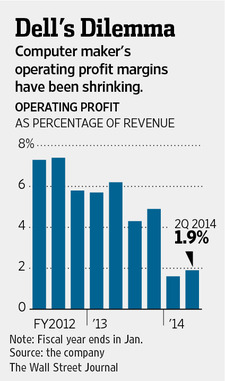
Michael Dell DELL +0.04% is set to win a bruising, yearlong battle for control of his company. His next task—getting Dell Inc. growing again—may be even tougher. Mr. Dell’s proposal to buy the computer company for nearly $25 billion is expected to win approval in a stockholder vote that ends Thursday, according to people familiar with the matter. Dell has said it expects to be a private company by the end of October. Read more of this post

Bank Indonesia Surprises With Rate Increase to 7.25%

Updated September 12, 2013, 10:03 a.m. ET

Bank Indonesia Surprises With Rate Increase

Central Bank Raises Its Overnight Policy Rate to 7.25%

FARIDA HUSNA And ANDREAS ISMAR

AI-CD516_INDORA_NS_20130912055704

JAKARTA—Indonesia’s central bank on Thursday announced a surprise increase in its policy interest rate, reflecting its commitment to protect the country’s currency, as global sentiment remains fragile. Bank Indonesia raised its benchmark rate by a quarter percentage point to 7.25%, just two weeks after raising it by a half percentage point. It also raised a key money-market rate, known as the Fasbi rate, by a quarter percentage point to 5.50%. Read more of this post

Chipotle targets Big Food, skips big branding

Chipotle targets Big Food, skips big branding

Bruce Horovitz, USA TODAY8:21 a.m. EDT September 12, 2013

Chipotle hopes that its new, anti-Big-Food video and downloadable game go viral — even with little mention of the Chipotle brand name or logo.

Chipotle is about to turn the ad world on its head — even as it smacks Big Food in the chops. On Thursday, the Millennial-friendly Mexican food chain will post “The Scarecrow,” a Big-Food-mocking 3½-minute animated video ad — and make available a free downloadable, interactive game on the topic. The twist: Both have virtually no Chipotle branding. Chipotle’s name shows up — in small print — only in the game’s introduction, and its logo is displayed only after the video is over. Read more of this post

Laura Rittenhouse’s Candor Analytics; Inspired by Warren Buffett, a former Lehman analyst figures out that plain-speaking companies have higher performance

September 3, 2013

Sally Helgesen is an author, speaker, and leadership development consultant, whose most recent book is The Female Vision: Women’s Real Power at Work(with Julie Johnson; Berrett-Koehler, 2010).

Laura Rittenhouse’s Candor Analytics

Warren Buffett’s annual shareholder letters are famous, a key element of his mystique. Inevitably, they’re described in the business media as “folksy.” But this description misses the reason these letters compel admiration from and influence the behavior of investors. The true strength of Buffett’s missives lies in their candor. (For example, here’s Buffett in the 2012 annual report of his firm Berkshire Hathaway, on his controversial investments in local newspapers: “Charlie and I believe that [some newspapers] will remain viable for a long time. We do not believe that success will come from cutting either the news content or frequency of publication. Indeed, skimpy news coverage will almost certainly lead to skimpy readership.”) Read more of this post

The Enduring Management Wisdom of Lincoln

Posted: August 26, 2013

James O’Toole is a senior fellow in business ethics at Santa Clara University’s Markkula Center for Applied Ethics and the author of 17 books, including The Executive’s Compass and Leading Change.

The Enduring Management Wisdom of Lincoln

Headlines espousing the relative decline of the U.S. industrial base, despite arecent upsurge, have left American managers focused on today’s news and this quarter’s results. As a result, few have heeded the invaluable lessons of the country’s longest-running manufacturing success story. For nearly a century, the Lincoln Electric Company has consistently ranked among the most productive manufacturing enterprises in the United States, all while not laying off a single permanent employee for more than 60 years and, for 75 years, paying bonuses to its workers that average 60 to 100 percent of their annual salaries. Yet not a single other company in the country has adopted the unique system that led to Lincoln Electric’s continuing record of success—one in which owners, managers, and workers have strong incentives to cooperate to meet the needs of customers.  Read more of this post

MIT’s Williams Decodes Economics of Gene Sequencing

MIT’s Williams Decodes Economics of Gene Sequencing

Heidi Williams’s dad helped with her high school science-fair projects by driving her two hours from their North Dakota town to get books on World War II German cryptography. After studying up, she would present new ways to crack the cipher. These days, Williams is trying to help scientists as they unlock the secrets of a different code: the human genome. The 32-year-old Massachusetts Institute of Technology economist is examining health-care innovation with a $430,000 National Science Foundation CAREER grant, an award given to “exceptionally promising” junior faculty who excel as educators and researchers. Read more of this post

Billionaires Halt Mining Deals on Rupee Erosion

Billionaires Halt Mining Deals on Rupee Erosion: Corporate India

Indian billionaires led by Kumar Mangalam Birla are stalling purchases of mines overseas as the rupee’s 13 percent drop this year inflates the cost of deals. The Aditya Birla Group, which runs the nation’s second-biggest copper and aluminum maker, has put acquisition plans on hold, said a person with direct knowledge of the matter. JSW Steel Ltd. (JSTL), controlled by the billionaire Jindal family, would prefer to wait, Commercial Director Jayant Acharya said. Read more of this post

Sino Biopharm, Market Cap $3 Billion, Plunges After CCTV Bribery Report

Sino Biopharm Plunges After CCTV Bribery Report: Hong Kong Mover

Sino Biopharmaceutical Ltd. (1177) plunged the most in about 13 years before being suspended in Hong Kong trading, after a report by state-run Chinese Central Television alleged bribery at a unit of the medicine maker. Sino Biopharmaceutical fell 16 percent to HK$4.76, headed for the largest drop since October 2000, before being halted at 11:49 a.m. The stock has been suspended pending an announcement to clarify certain information in recent press reports, the drugmaker said today. Two groups of doctors attended 50-minute meetings organized by the company in China and then left on sponsored trips, according to the broadcast yesterday evening. Read more of this post

Hello Kitty Billionaire Found as Plush Toy Sales Surge

Hello Kitty Billionaire Found as Plush Toy Sales Surge

iS1h.Udr6l_w

Tanya Stanich, a 43-year-old lawyer, clutched a handful of pink and black Hello Kitty notebooks at Sanrio Co.’s (8136) store in Manhattan’s Times Square and touched a sequined bag adorned with the face of a cartoon cat. Growing up in Wisconsin, Stanich was introduced to the white feline, which sports a red bow and no mouth, by a California aunt, who sent her a Hello Kitty lunchbox, stickers, hair clips and pencils. Now a resident of New York’s West Village neighborhood, Stanich says she still buys the stationery to brighten up her life. “It’s nice to have something a little girly and flashy and fun,” said Stanich, a slender brunette who keeps her iPhone in a Hello Kitty case. “I could go nuts in here.” Loyal fans like Stanich have helped make Shintaro Tsuji, the 85-year-old founder of Tokyo-based Sanrio, a billionaire. Since introducing Hello Kitty in 1974, Tsuji has captured the hearts and wallets of girls, women and celebrities such as Lady Gaga by licensing the character, which appears as stuffed toys, as well as on airplanes, golf bags and even vibrators. Sanrio’s shares have doubled this year, more than the 39 percent gain in Japan’s benchmark Nikkei 225 (NKY) Stock Average, and reached a 52-week high yesterday. The company, which sells gift cards featuring cartoon characters, operates theme parks and produces and distributes movies, had 74.25 billion yen ($898.6 million) in sales its last fiscal year ending in March. “It must be way up there in terms of the most recognized franchises in the world,” said Ted Bestor, director of the Reischauer Institute of Japanese Studies at Harvard University in Cambridge, Massachusetts. “It’s very hard to see any diminution for the Japanese fondness for cuteness.” Read more of this post

How Wal-Mart’s Waltons Maintain Their Billionaire Fortune

How Wal-Mart’s Waltons Maintain Their Billionaire Fortune: Taxes

download (19)

Visitors to the Crystal Bridges Museum of American Art in Bentonville, Arkansas, leave appreciative notes on a glass wall near the entrance. “Thanks Alice!” reads one. “Merci Alice Walton, pour la vision!” reads another. Wal-Mart Stores Inc. (WMT) heiress Alice Walton founded Crystal Bridges in 2011 in a wooded ravine next to her childhood home, supplying dozens of paintings from her personal collection. Bankrolled by more than $1 billion in donations from her family, the museum attests to the Waltons’ generosity and vast wealth. It’s also a monument to their skill at preserving that fortune across generations. America’s richest family, worth more than $100 billion, has exploited a variety of legal loopholes to avoid the estate tax, according to court records and Internal Revenue Service filings obtained through public-records requests. The Waltons’ example highlights how billionaires deftly bypass a tax intended to make sure that the nation’s wealthiest contribute their share to government rather than perpetuate dynastic wealth, a notion of fairness voiced by supporters of the estate tax like Warren Buffett and William Gates Sr. Read more of this post

More Boom-and-Bust Seen in Dubai’s Cash-Driven Recovery

More Boom-and-Bust Seen in Dubai’s Cash-Driven Recovery

After five years living in Dubai, Akanksha Goel and her husband decided to buy a property instead of paying $68,000 a year to rent their three-bedroom house. It never happened. Though Goel, the owner of a small advertising agency, and her cameraman husband, were prepared to pay 50 percent upfront, the couple was classified as “high-risk” because she’s self-employed. They were offered a mortgage for 30 percent of the home’s value at double the rate given to buyers with the best credit. Read more of this post

Tesla Challenges BMW on Home Turf as Germans Go Green

Tesla Challenges BMW on Home Turf as Germans Go Green

Tesla Motors Inc. (TSLA), the electric-vehicle maker led by billionaire Elon Musk, is pushing beyond the friendly confines of California to take on the world’s biggest luxury-car brands in their home market. Tesla will have six stores in Germany after adding locations in the coming months in Berlin and Stuttgart, home to Mercedes-Benz parent Daimler AG. The start-up already has sales centers in Frankfurt, Dusseldorf, Hamburg and Munich, Bayerische Motoren Werke AG (BMW)’s hometown. Read more of this post

Henkel to Expand Beauty Care Business in Smaller Chinese Cities

Henkel to Expand Beauty Care Business in Smaller Chinese Cities

Henkel AG, the German maker of adhesives and Soft Scrub cleaners, plans to step up expansion in China as the company pushes to sell hair and skin care products in smaller cities outside Beijing and Shanghai. The company will invest “heavily” to lift the proportion of China sales at its consumer business to 30 percent from the current 20 percent, Chief Executive Officer Kasper Rorsted said in an interview today. Adhesives account for 80 percent of the company’s China revenue, he said. Read more of this post

Trigger Finger – Apple fires biometrics into the mainstream

Trigger Finger – Apple fires biometrics into the mainstream

6:04am EDT

By Jeremy Wagstaff and Malathi Nayak

SINGAPORE/SAN FRANCISCO (Reuters) – By adding a fingerprint scanner to its newest mobile phone, Apple Inc is offering a tantalizing glimpse of a future where your favorite gadget might become a biometric pass to the workplace, mobile commerce or real-world shopping and events. Although Apple’s executives said at Tuesday’s launch that its Touch ID technology embedded into the iPhone 5S’ home button would only provide fingerprint access to the phone and its own online stores, analysts said Apple’s embrace of such technology, called biometrics, would be key to wider adoption. Read more of this post

Fashion designers look to patents to fight knockoffs

Fashion designers look to patents to fight knockoffs

5:02pm IST

By Erin Geiger Smith

NEW YORK (Reuters) – Design companies tending to the details of fashion shows have more to think about than skirt lengths and handbag clasps – they must decide whether to seek U.S. patent protection for their looks. Diane von Furstenberg, famous for her wrap dresses, has a design patent on a chain mail-style bag. The popular French line Celine has one on the envelope-style handbag sported by countless fashion experts at New York Fashion Week. Read more of this post

Internet security: Kill or cure; Internet users whinge about passwords but are none too keen on the alternatives. Good news for crooks

Internet security: Kill or cure; Internet users whinge about passwords but are none too keen on the alternatives. Good news for crooks

Sep 7th 2013 |From the print edition

20130907_IRD001_1

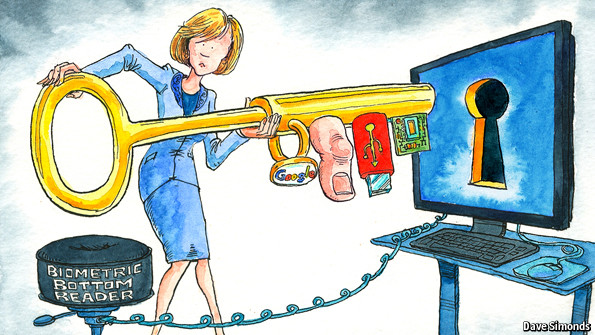
PASSWORDS are a pain. People forget them. Hackers pinch them—this year Twitter lost 250,000 and Evernote, an online notebook service had to reset 50m after a breach. Many companies have been found to store passwords without “salting” them (adding extra data to flummox hackers) or even encrypting them at all. Firms are demanding harder ones: a minimum number of characters, plus numerals and upper- and lower-case letters. Busy and careless people skimp on security: the typical internet user, research suggests, uses just seven passwords to manage 25 online accounts. Even those tend to be easily cracked variations on a theme: “Bageh0t”, “Bageh1t”, “Bageh2t”, etc. The search for alternatives is both urgent and potentially lucrative. Google, along with other behemoths like PayPal and hardware-makers such as Lenovo and LG, have forged the FIDO Alliance, to develop alternative authentication employing a panoply of gadgets. These include USB sticks, chips on fobs and other tokens. (Google is working on a ring.) Read more of this post

More than Just Contrarians: Insider Trading in Glamour and Value Firms

More than Just Contrarians: Insider Trading in Glamour and Value Firms

Alan Gregory University of Exeter – Xfi Centre; University of Exeter Business School

Rajesh Tharyan University of Exeter Business School

Ian Tonks University of Bath School of Management

September 2013
European Financial Management, Vol. 19, Issue 4, pp. 747-774, 2013

Abstract: 
This study examines the patterns of, and long‐run returns to, directors’ (insiders’) trades along the value‐glamour continuum in all stocks listed on the main London Stock Exchange and analyses what these directors’ trades add to a naïve value‐glamour strategy. We consider alternative definitions of value in defining trades and in the construction of our benchmark portfolios so that directors’ trades are evaluated net of any value‐glamour effect, variously defined. We find that directors consistently trade in a contrarian fashion, buying more value stocks and selling more glamour stocks, with purchases following price falls and sales following price rises. Directors’ buy signals in value stocks generate significant positive abnormal returns while the sell signals in glamour stocks generate smaller and generally insignificant negative returns. In contrast to the results from US studies, we find that the positive abnormal returns in value stocks persist for up to two‐years after the initial directors’ trading signal. Abnormal returns are particularly concentrated in smaller value stocks, and are robust to alternative definitions of value.

Equity Vesting and Managerial Myopia

Equity Vesting and Managerial Myopia

Alex Edmans London Business School – Institute of Finance and Accounting; University of Pennsylvania – The Wharton School; National Bureau of Economic Research (NBER); European Corporate Governance Institute (ECGI); Centre for Economic Policy Research (CEPR)

Vivian W. Fang University of Minnesota – Twin Cities – Department of Accounting

Katharina Lewellen Dartmouth College – Tuck School of Business

September 2013
NBER Working Paper No. w19407

Abstract: 
This paper links the impending vesting of CEO equity to reductions in real investment. Existing studies measure the manager’s short-term concerns using the sensitivity of his equity to the stock price. However, in myopia theories, the driver of short-termism is not the magnitude of incentives but their horizon. We use recent changes in compensation disclosure to introduce a new empirical measure that is tightly linked to theory – the sensitivity of equity vesting over the upcoming year. This sensitivity is determined by equity grants made several years prior, and thus unlikely to be driven by current investment opportunities. An interquartile increase is associated with a decline of 0.11% in the growth of R&D (scaled by total assets), 37% of the average R&D growth rate. Similar results hold when including advertising and capital expenditure. Newly-vesting equity increases the likelihood of meeting or beating analyst earnings forecasts by a narrow margin. However, the market’s reaction to doing so is lower, suggesting that it recognizes CEOs’ myopic incentives.

Think Strategically to Enable Growth in Tough times; Strategy is not about the plan

Think Strategically to Enable Growth in Tough times

by Dr. Grant Sieff | Sep 11, 2013

Dr Grant Sieff, Director of the Strategic Thinking and Execution for Growth Programme at the University of Cape Town’s Graduate School of Business, offers five steps towards thinking strategically to enable growth in tough times

The passing of Margaret Thatcher is a signifier of the times: Thatcherism is certainly gone, and so too is any naivety that we can depend on any one simple formula for global economic stability.  Dr Grant Sieff, CEO of IC Growth Group and Programme Director of Strategic Thinking and Execution for Growth at the University of Cape Town’s Graduate School of Business (GSB), describes the environment we find ourselves in as economic anarchy. “It’s not a slow evolution, it’s more like a series of shocks – more shaken than stirred,” he says.  “The nature of business is that it is in constant flux – globally, economies are slowing once again; and technology continues to evolve rapidly. Google Glass, for example, is about to come out, and could revolutionise the way we examine possibilities,” he says. However, Sieff says that inside this cauldron of radical change lie opportunities for businesses to innovate and get ahead; executives who have the ability to think strategically and execute strategies to ensure ongoing growth in the face of uncertainty and change, will prosper. But for that to happen, leaders and executives need to develop the skills to be able to identify and leverage opportunities. Sieff says that these skills can be distilled into five key steps.   Read more of this post

Asia’s Outlook Turns Murky After the 2008 Crisis

September 11, 2013, 2:51 p.m. ET

Asia’s Outlook Turns Murky After the 2008 Crisis

Region Roared Ahead of West, but Ground Has Shifted; Debt Levels Rise

ALEX FRANGOS

AM-BA228_ASIAPL_G_20130911133604

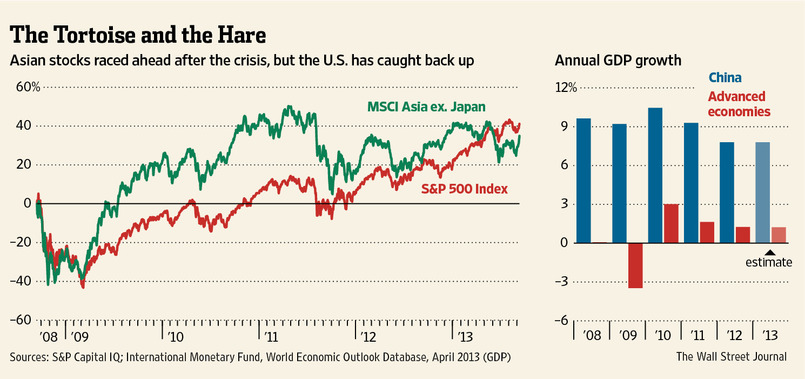
HONG KONG—The early verdict on the global financial crisis was that Asia came out on top. Strong banking systems and a government-directed lending spree in China quickly boosted the region’s economies back to growth. By 2010, investors were betting that there had been a permanent shift in the balance of economic power. They pushed Asian stock markets and currencies to record highs. Just over two years after the failure of Lehman Brothers, Asian stocks were up 40%, outperforming U.S. stocks by 42 percentage points. Read more of this post

Bond investors face annual losses for only third time in 33 years

Bond investors face annual losses for only third time in 33 years

Only a “highly unlikely” fall in interest rates can prevent bond investors losing money over the course of 2013, BlackRock executive says.

The US Federal Reserve, chaired by Ben Bernanke, wants to stop buying bonds Photo: AP

By Richard Evans, Investment Editor

3:59PM BST 11 Sep 2013

Investors face losses on their bond holdings this year for only the third time in more than three decades, a senior expert in the field has said. Jeffrey Rosenberg, who is the chief investment strategist for fixed income at BlackRock, which manages bond investments worth $1.2 trillion or £750bn, said bond investors had lost 3.65pc so far this year and that “avoiding an annual loss will require a major shift lower in interest rates, something we do not expect”. Read more of this post

Companies Act on Rising Interest Rates; Pension Contributions, Trade, Borrowing for Deals All Are Affected

September 11, 2013, 8:15 p.m. ET

Companies Act on Rising Interest Rates

Pension Contributions, Trade, Borrowing for Deals All Are Affected

NOELLE KNOX And VIPAL MONGA

MK-CG214_RISING_NS_20130911181509

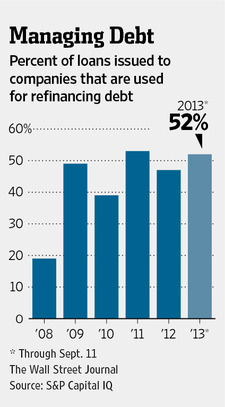
Interest rates for long-term business borrowing have shot up to the highest levels in two years. That’s pushing corporate executives to not only rethink their borrowing and refinancing strategies, but also to adjust pension contributions and overseas trade. Some may even accelerate plans for deals. While most experts say it is too early to see an increase in the number of mergers and acquisitions, which can take months to negotiate, rising rates were a driving factor in Verizon Communications Inc.’s VZ +0.11% recent agreement to buyVodafone Group VOD.LN +1.08% PLC’s stake in their joint U.S. wireless business. That is because fresh funds for acquisitions and other deals will only get more expensive as rates go higher. “Interest rates are presumably the real catalyst here,” said Craig Moffett, senior research analyst at Moffett Research, referring to Verizon. Read more of this post

Mystery of acquiring another language; Neurology helps to learn a language, but hard work is what matters

September 11, 2013 4:13 pm

Mystery of acquiring another language

By Michael Skapinker

Neurology helps to learn a language, but hard work is what matters

In 1987 I interviewed Robert Maxwell, the publishing and printing magnate, at his London headquarters in Holborn Circus. His death and disgrace were some years away. As well as the Mirror newspaper group, Maxwell headed the biggest printing company in Europe and one of the largest in the US. But I was relieved, as he ordered senior managers around for my benefit, that I was observing rather than working for him – and what struck me, apart from the bullying, was his extraordinary English. Born in 1923 in a village on the Czech-Romanian border, Maxwell arrived in Liverpool in 1940 and joined the British army. Although he only started to learn the language at 17 years old, his English was fault-free and spoken with a booming upper-class accent. Read more of this post