Björn Wahlroos may be the most important business executive in Finland. Chairman of three of the biggest companies in the Nordic region – Nordea, the bank, Sampo, the financial services group, and UPM-Kymmene, the paper producer

September 22, 2013 5:15 pm

Finland’s former revolutionary

By Richard Milne

©Bloomberg

Not-so-cuddly: Björn Wahlroos’s nickname of Nalle, a term similar to teddy bear in English, belies his reputation

Björn Wahlroos may be the most important business executive in Finland. Chairman of three of the biggest companies in the Nordic region – Nordea, the bank, Sampo, the financial services group, and UPM-Kymmene, the paper producer – the dapper 60-year-old is renowned in his homeland almost as much for his sharp tongue as for his business prowess. Widely known as Nalle – similar to teddy bear in English – his life has followed an extraordinary trajectory. “I think it’s a great story” he says. Read more of this post
David Ek, the founder of Spotify talks about changing the music business and why ‘screwed-up’ healthcare might be next

September 27, 2013 2:19 pm

Lunch with the FT: Daniel Ek

By Andrew Edgecliffe-Johnson

The founder of Spotify talks about changing the music business and why ‘screwed-up’ healthcare might be next. Plus, listen to his top 10 favourite tracks

The elevated railroad that once ran down Manhattan’s west side was known as New York’s “Life Line”. Erected in 1934, it brought meat and other merchandise to the city’s warehouses from across the US. The last turkeys were unloaded in 1980 though and weeds grew over the steel strip between the West Village and Chelsea until 2009 when, renovated by wealthy locals, the Life Line reopened as the High Line, a fashionable urban park. Read more of this post

The Monkey Business of Pure Altruism

September 27, 2013, 8:30 p.m. ET

The Monkey Business of Pure Altruism

ROBERT M. SAPOLSKY

I’ve been reflecting on how Bill and Melinda Gates resemble a pair of monkeys. Earlier this month, the Lasker Awards were announced. The prestigious prize, known as the “American Nobel,” is given annually to a few extraordinary biomedical scientists. A Lasker for public service is also usually awarded—this year to the Gateses. Great move. They’ve given vast sums of money to medical research and have galvanized other billionaires into doing the same. They’ve targeted research about diseases that bring incalculable misery to the developing world. All with great wisdom. Read more of this post

Kelcy Warren, the billionaire running the third-largest U.S. natural gas pipeline company, says the days of deal making are returning

Pipeline Billionaire Ready for Next Round of Deal Making: Energy

Kelcy Warren, the billionaire running the third-largest U.S. natural gas pipeline company, says the days of deal making are returning. Railroads and competing pipeline operators are taking market share, leaving networks with smaller regions and struggling to find business. To survive, companies need a geographically diverse portfolio of assets across an array of oil and gas products that can weather slowdowns in individual sectors or regions, Warren, chairman and chief executive officer of Energy Transfer Partners LP (ETP), said in an interview. Read more of this post

Jack Ma, the head of China’s Alibaba, heading to Wall Street with global ambitions in online commerce

September 27, 2013 7:17 pm

Jack Ma, the mogul heading to Wall Street

By Jamil Anderlini

The head of China’s Alibaba has global ambitions in online commerce, says Jamil Anderlini

Jack Ma may, at first glance, look a slightly geeky-looking retailer. But in his native China the 49-year-old founder of Alibaba Group enjoys the status of a rock star, as the symbol of a generation on the move. And like many rockstars Mr Ma is prone to bouts of petulance – something the former English teacher proved again this week when he picked a fight with Hong Kong’s stock market authorities. The world’s largest e-commerce marketplace wants to sell shares in an initial public offering in Hong Kong that bankers say could raise $15bn and value it at up to $120bn. But after Hong Kong regulators refused to agreeto its terms, Alibaba quit the stage and started the process of listing in the US instead. Read more of this post

Rethinking equity after Alibaba

September 27, 2013 6:57 pm

Rethinking equity after Alibaba

There may be a place for differential voting shares

The idea that voting power should go hand in hand with share ownership has become so entrenched a principle of corporate governance that it is rarely questioned. This week Alibaba, the Chinese internet group, opted to float in the US because the Hong Kong stock exchange would not bend its rules to allow the company’s owners to control the equity, despite owning only a minority of the shares. Most observers sided with the HK authorities while condemning the US for engaging in a regulatory race to the bottom. Read more of this post

China outlined a plan to allow foreign firms to offer some Internet services in the country and ended a more than decade long ban on the sale of videogame consoles

Updated September 27, 2013, 1:22 p.m. ET

China to Open Door Wider for Foreign Tech Firms

PAUL MOZUR

BEIJING—China outlined a plan to allow foreign firms to offer some Internet services in the country and ended a more than decadelong ban on the sale of videogame consoles as part of new rules issued Friday for a free-trade zone in Shanghai. According to a statement from the State Council, foreign companies operating within the trade zone will be able to offer so-far unspecified information technology services, including Internet, software, data processing and storage services. The Ministry of Industry and Information Technology is expected to release more specific guidelines in the coming months, according to lawyers. Read more of this post

Auction houses in China: Christie’s v the people’s army; Foreign auctioneers have begun to enter China’s huge but unruly art market. They will not find it easy

Auction houses in China: Christie’s v the people’s army; Foreign auctioneers have begun to enter China’s huge but unruly art market. They will not find it easy

Sep 28th 2013 | SHANGHAI |From the print edition

IN 1779 the estate of Sir Robert Walpole, Britain’s first prime minister, sold an art collection to Catherine the Great. The private sale, which included pieces by Rubens and Rembrandt, was brokered by James Christie, a pioneering auctioneer. Though she placed most of these in St Petersburg’s Hermitage museum, the Russian empress traded a few items with the Qianlong emperor for some Chinese masterpieces. Read more of this post

Heineken sewn up in Chinese trademark tangle

September 27, 2013 3:11 pm

Heineken sewn up in Chinese trademark tangle

By Demetri Sevastopulo in Hong Kong

China became the world’s copycatting centre by faking everything from Louis Vuitton bags and PhD diplomas to Apple stores. Now Heineken has become the latest multinational to face an intellectual property challenge – from a tiny Chinese sewing machine company. The global brewer has accused Wujiang Xili Machinery Factory, a company from Jiangsu province with fewer than 50 employees, of pirating its name and logo, and using them at a Shanghai trade show this week. Read more of this post

China to allow banks to sell $49 billion of asset-backed securities: sources

China to allow banks to sell $49 billion of asset-backed securities: sources

Fri, Sep 27 2013

BEIJING (Reuters) – China will allow selected banks to issue asset-back securities (ABS) worth 300 billion yuan ($49 billion) by the end of June next year, expanding a pilot program to support the economy, three industry sources said. The People’s Bank of China (PBOC) asked 20 banks, including big state banks, to submit their ABS issuance plans at a recent meeting which also involved securities brokerages and trust companies, the sources familiar with the development said. Read more of this post

China private bank push sparks speculative stock frenzy

China private bank push sparks speculative stock frenzy

Fri, Sep 27 2013

* Policymakers express support for privately-owned banks

* Speculators feast on stocks linked to private banks

* Hope that private banks can boost financing to small firms

* But officials, bankers say no panacea for SME financing woes

By Heng Xie and Gabriel Wildau

SHANGHAI, Sept 26 (Reuters) – Signs that China is preparing to open its banking sector to privately-owned lenders has raised hopes that they can help ease financing difficulties afflicting smaller firms. A handful of listed companies have also seen their stock prices soar in recent weeks on rumours they are planning moves into banking. But bankers and policymakers say that hopes for private banks have been inflated. At least in the short term, private banks will provide neither big new profits to listed companies nor an easy solution to small- and medium-sized enterprises’ (SMEs) financing woes. Read more of this post

Norway’s innovators help oil industry move to harsher climes

Norway’s innovators help oil industry move to harsher climes

Fri, Sep 27 2013

* Subsidies, rebates, tax breaks fuel innovation

* Norway may lead in automation, Arctic, subsea technology

* Statoil seen driver behind innovation

By Balazs Koranyi and Stephen Eisenhammer

OSLO/ABERDEEN, Scotland, Sept 27 (Reuters) – A drillship that cuts through two metres of ice, radar that detects oil spills in Arctic darkness and a drill that burrows through rock like a mole are among Norwegian innovations helping the oil industry as it moves into harsher climes. Small companies in Norway, backed by tax subsidies, a home-grown oil major and an abundance of experienced engineers, are bringing in technology that is leading the oil and gas industry in Arctic exploration and subsea production. “This is an incredibly conservative industry, and it takes 10 years to adopt and commercialize new technology,” said Stig Hognestad, the chief executive of small technology firm Ziebel. “Nobody wants to be the first because it’s risky … and Norway’s the exception.” Read more of this post

Korean cancer patient to save family from medical costs kills himself; The Park administration had earlier promised to fully cover medical expenses for four terminal diseases including cancer

2013-09-27 16:55

Cancer patient to save family from medical costs kills himself

By Chung Hyun-chae
A 71-year-old man suffering with cancer took his own life in the port city of Busan on Thursday, apparently to relieve his family of financial pressure, police said Friday. The man surnamed Kim was diagnosed with liver cancer earlier this month, and was scheduled to undergo surgery on Saturday. He was to enter hospital on Friday. Kim’s son, 38, discovered the body of his father who hanged himself from a gas pipe in his studio apartment. A suicide note was found taped to the victim’s chest. “Please forgive me. If I undergo a surgery, it would pose a financial burden on all of you. Even though it is a pittance, please keep the 130,000 won in my purse and what’s left in my bank account,” the note read. “It appears he took his own life in order to not impose a financial burden on his children,” said a police officer. Kim lost his wife about 10 years ago and lived alone. Along with his son he leaves behind a 40 year old daughter. Read more of this post

Park eats her words. Can, and will, South Korea’s president make more just, equal society?

2013-09-26 16:59

Park eats her words

Can, and will, president make more just, equal society?        
President Park Geun-hye Thursday expressed regrets about her failure to fully deliver campaign promises on key social welfare programs. “I will try my best to realize these pledges during my term of office,” Park said while presiding over a Cabinet meeting.
Koreans can neither understand why President Park is backtracking on the most important election pledges nor accept the way she is doing so. Park cited the slower-than-expected economic recovery and consequent hole in government revenue as the main reason. This means that she won the election on a pledge that can change by the fluctuations in the business cycle. Read more of this post

A Seoul appeals court handed down severe verdicts to the brothers who run SK Group, the country’s third-largest conglomerate

Appeals court jails 2 SK brothers

Tougher than original verdict, judges also shoot down new trials

Sept 28,2013

A Seoul appeals court yesterday handed down severe verdicts to the brothers who run SK Group, the country’s third-largest conglomerate.

Chairman Chey Tae-won was sentenced to four years in prison, and his younger brother, Chey Jae-won, SK’s vice chairman, was sentenced to three-and-a-half years.
The Seoul High Court yesterday upheld the four-year verdict given to the 52-year-old chairman by a lower court back in January for embezzling 45.1 billion won ($41.8 million) from two SK affiliates for personal investments.  Read more of this post

Hyosung, CJ E&M in tax hole; Cho Suck-rae, chairman of the country’s 26th largest conglomerate Hyosung Group, is likely to be prosecuted for evading hundreds of billions of won in tax

2013-09-27 17:00

Hyosung, CJ E&M in tax hole

By Na Jeong-ju
Cho Suck-rae, chairman of the country’s 26th largest conglomerate Hyosung Group, is likely to be prosecuted for evading hundreds of billions of won in tax.
Sources from the National Tax Service (NTS) said Friday it discovered Cho allegedly dodged paying tax by manipulating account books and setting up a slush fund.
“The case may be referred to the prosecution as early as next week,” an NTS official said on condition of anonymity. Read more of this post

The fate of the troubled Tongyang Group has been left to the market and its chances of getting back on its feet by itself are looking increasingly slim

2013-09-27 17:23

Fate of Tongyang tossed to market

By Kim Rahn
The fate of the troubled Tongyang Group has been left to the market and its chances of getting back on its feet by itself are looking increasingly slim. No fresh credit line is forthcoming with government regulators telling it to expect no help. The core of its problems is corporate bills and bonds it and its affiliates issued to keep afloat because banks turned its loan requests down. Tongyang International and Tongyang Leisure need fresh funds to repay maturing debts or face bankruptcy. Read more of this post

Beer, gambling and Mad Men lead stocks boom

September 27, 2013 3:25 pm

Beer, gambling and Mad Men lead stocks boom

By FT Reporters

When it comes to big stock market gains, investors should look to beer, gambling, the macho culture of Mad Men and box office hits such as The Hunger Games. While many have opted for safety as equities have rallied in the wake of the financial crisis – favouring big, reliable dividend-payers – an eclectic group of global small-caps are setting a blistering pace. The MSCI World Small Caps index has climbed almost 22 per cent already this year, touching a record high last week, thanks largely to growing confidence in the strength of the US economic recovery and hopes for growth in Europe and Japan. Meanwhile, the blue-chip World Index has lagged behind, gaining 16 per cent in 2013. Read more of this post

On the march, small-caps that punch above their weight

September 27, 2013 6:48 pm

On the march, small-caps that punch above their weight

By Jonathan Eley

SmallCap

Small is beautiful. Elephants don’t gallop. A flea can jump 200 times its own height. There’s no shortage of appropriate metaphors for the tendency of small-cap shares to outperform their larger brethren – and in recent years, no shortage of examples of them doing so. Shares in companies outside the top echelon of the market have been on a tear this year. The FTSE Fledgling index is up 27 per cent this year to date, while the FTSE Small-cap is up 25 per cent and the Numis Smaller Companies index has risen 21 per cent – more if the investment trusts are stripped out. That compares with a gain of 11 per cent for the FTSE 100, which tracks the biggest companies. Read more of this post

Byron Wien is Wary of Market’s Optimism; Be defensive “when most others think almost everything is headed in the right direction”

SATURDAY, SEPTEMBER 28, 2013

Byron Wien is Wary of Market’s Optimism

By BYRON WIEN | MORE ARTICLES BY AUTHOR

Be defensive “when most others think almost everything is headed in the right direction,” writes the veteran Wall Street strategist.

We all had plenty to brood about over the Labor Day weekend. President Obama was contemplating sending missiles into Syria to punish President Bashar al Assad for using chemical weapons against his own people and to discourage him from using them again. The President also had to choose a successor to Federal Reserve Chairman Ben Bernanke and his preferred choice, Larry Summers, faced opposition in the Senate, threatening his confirmation. The Federal Reserve, by the way, had indicated in May that it might reduce its $85 billion bond-buying program in the fall, causing interest rates to rise and creating turbulence in the emerging markets. Everyone awaited the Fed’s decision on how much restraint they would implement. The nation’s debt ceiling loomed in October with the Republicans taking the position that unless the Affordable Care Act was deprived of funding, they would not agree to raising the borrowing limit. Finally, as if the political situation in the Middle East were not complicated enough, Iran proceeded with its nuclear weapons development program. Read more of this post

Berkshire’s Benjamin Moore Seeks Third Chief in Two Years

Berkshire’s Benjamin Moore Seeks Third Chief in Two Years

By Zachary Tracer – Sep 28, 2013

Benjamin Moore, the paint maker owned by Warren Buffett’s Berkshire Hathaway Inc. (BRK/A), said Chief Executive Officer Robert Merritt left the company. Benjamin Moore, which hired Merritt last year, is searching for a new leader and expects to name a replacement “in the coming week,” the Montvale, New Jersey-based company said yesterday in a statement on its website. The paint company last year hired Merritt, a former executive at restaurant companies including Cosi Inc., to replace Denis Abrams. The unit has staff of about 2,200 people, according to the most recent annual report from Omaha, Nebraska-based Berkshire. Buffett, 83, agreed in 2000 to buy the paint company for about $1 billion as he expanded housing-related operations. He has identified the business as one of four Berkshire units that counts Tracy Britt as chairman. Another of the units, building products provider Johns Manville, in November named Mary Rhinehart as chief executive officer, replacing Todd Raba. Britt didn’t immediately return a message seeking comment. Eileen McComb, a spokeswoman for Benjamin Moore, also didn’t return a call.

To contact the reporter on this story: Zachary Tracer in New York at ztracer1@bloomberg.net

New York City Opera Plans for Bankruptcy After Years of Bungling

City Opera Plans for Bankruptcy After Years of Bungling

New York City Opera said today that it plans to file for bankruptcy next week after years of board missteps and an emergency fundraising appeal that flopped, according to the New York Times. The move marks the end of the 70-year-old company, once dubbed “the people’s opera” by Mayor Fiorello LaGuardia and a breeding ground for young talent that included Beverly Sills and Placido Domingo. Read more of this post

Thai central banker warns on subsidies largesse

September 27, 2013 10:00 am

Thai central banker warns on subsidies largesse

By Michael Peel in Bangkok

Thailand’s central bank chief on Friday fired a broadside against populist government policies, echoing wider fears that climbing consumer debt levels and more spending on commodity subsidies are underminingsoutheast Asia’s second-largest economy. Prasarn Trairatvorakul, governor, warned that Thai households could become “undisciplined” and “addicted to easy money”, amid a succession of handouts by government ranging from subsidies to rice farmers to tax breaks on first-time car buys. Thai household debt has risen to about 80 per cent of gross domestic product, from 55 per cent in 2008. Much of that growth has come from lending to subprime lenders, according to Fitch, the rating agency – a practice that helped unravel the US economy. Read more of this post

Trend-following funds head for third down year

Trend-following funds head for third down year

Fri, Sep 27 2013

NEW YORK (Reuters) – Long-term trend following funds are headed for a third straight year of losses unless the underlying commodity and financial markets they trade settle into a more predictable pattern, which does not seem likely given the Federal Reserve’s mixed signals on the U.S. economic stimulus. Many of the so-called Commodity Trading Advisors (CTAs) were whipsawed in the first half by market gyrations over whether the Fed would cut its bond buying this year. Further volatility seems likely after the Fed said last week it needed more time to decide on the stimulus. Some CTAs trading on shorter time horizons and focused on gold made money as bullion prices swung on speculation over the Fed. Other funds gained in the past two months by following a relatively steady rally in oil caused by Middle East tensions, and a run-up in cattle prices. Read more of this post

Latin America’s Middle-Class Mirage

Eduardo Levy Yeyati

Eduardo Levy Yeyati, former Chief Economist at the Central Bank of Argentina and Head of Emerging Markets Strategy at Barclays Capital, is Director of Elypsis Partners, Professor at Universidad Torcuato Di Tella, and President of the Center for Public Policy (CIPPEC).

Latin America’s Middle-Class Mirage

25 September 2013

BUENOS AIRES – Rising incomes across the developing world will bring some 400 million people into the middle class by 2020, up from 1.8 billion today. Their increasing spending power, especially on non-essential consumer goods and services, is being hailed as the great hope for the global economy. But closer examination of their economic circumstances suggests that these new consumers are neither as wealthy nor as secure as we may think. Read more of this post

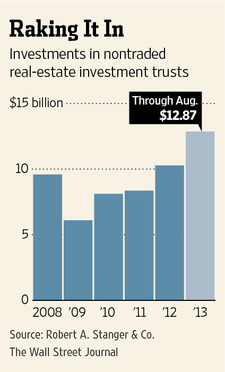
Investors are pouring money into nontraded real-estate investment trusts, despite repeated warnings from regulators

September 27, 2013, 6:48 p.m. ET

A REIT That Could Bite Back

A target of regulators, nontraded REITs are drawing record assets.

LIZ MOYER

BF-AF859_NOTREI_NS_20130927112105

Investors are pouring money into nontraded real-estate investment trusts, despite repeated warnings from regulators. The products, which often sport yields of more than 6%, have proved popular among income-hungry investors looking to diversify beyond bonds. Like their exchange-listed cousins, nontraded REITs pool investor money into income-generating properties, such as office buildings, hotels or shopping malls, and pay dividends. As their name implies, they aren’t publicly traded and can lock up investor money for a number of years. Critics contend that the products are hard to understand and that investors aren’t being adequately warned about the risks. Read more of this post

China puffer fish tower adding to GDP prompts a huff about state spending

China puffer fish tower prompts a huff about state spending

Viewing tower in the shape of a giant copper puffer fish is seen under construction on the banks of a river in Yangzhong county

7:18am EDT

BEIJING (Reuters) – A Chinese viewing tower in the shape of a giant, copper puffer fish has raised an online huff about the latest in a series of bizarre and extravagant targets of state investment. Encased in 8,920 copper plates and built at a cost of around 70 million yuan ($11.4 million), the tower on an island in Yangzhong county, eastern Jiangsu province, hovers 15 storeys above ground. The government has often been criticized for wasteful investment to power the world’s No. 2 economy. Beijing acknowledges the problem and wants consumption to overtake investment as a driver of growth. Residents who welcome the fish tower say it improves the county’s image. Less enthusiastic residents question whether such expensive and impractical buildings are needed. “To spend so much money on something so meaningless, I really admire these ‘wealthy’ people,” Mother988 said on Sina Weibo, China’s version of Twitter, with apparent heavy irony. The People’s Daily, the Chinese government’s main mouthpiece, acknowledged that the construction had polarized opinion. “Once this giant puffer made its appearance, it caused a heated debate online,” it said. Public records show Jiangsu’s local government bodies are the most indebted in the country. Jiangsu says its debt is manageable, but took steps this week to rein in risk by announcing plans to control land sales, becoming the first Chinese government to do so. Yangzhong aims to promote the tower as the world’s biggest metal construction in terms of volume, the People’s Daily said. Central Henan province drew controversy in 2011 when a state-backed charity tried to build an eight-storey sculpture of Song Qingling, second wife of modern China’s founding father Sun Yat Sen. Construction was scrapped half-way through. The eastern province of Zhejiang also came under the spotlight after it modeled one of its city court houses on Capitol Hill.($1 = 6.1 yuan)

Termites’ powerful weapon against extermination? Their own natural-antibiotic poop

Termites’ powerful weapon against extermination? Their own poop

12:13pm EDT

By Barbara Liston

ORLANDO (Reuters) – Scientists trying to understand why destructive wood-eating termites are so resistant to efforts to exterminate them have come up with an unusually repugnant explanation. Termites’ practice of building nests out of their own feces creates a scatological force field that Florida scientists now believe is the reason biological controls have failed to stop their pestilential march all over the world. A nine-year study concluded that termite feces act as a natural antibiotic, growing good bacteria in the subterranean nests that attack otherwise deadly pathogens, according to the findings published this month in the Proceedings of the Royal Society B. Read more of this post

Half of British pilots admit to falling asleep in cockpit – survey

Half of British pilots admit to falling asleep in cockpit – survey

8:33am EDT

By Sarah Young

LONDON (Reuters) – More than half of British airline pilots say they have fallen asleep in the cockpit, a survey said, ahead of an EU vote on flying hours which a pilots’ association said could compromise flight safety. According to the British Airline Pilots’ Association (BALPA), 56 percent of 500 commercial pilots admitted to being asleep while on the flight deck and, of those, nearly one in three said they had woken up to find their co-pilot also asleep. Read more of this post

Online retailers go hi-tech to size up shoppers and cut returns

Online retailers go hi-tech to size up shoppers and cut returns

9:58am EDT

By Emma Thomasson

BERLIN (Reuters) – Online retailers are trying to cajole consumers into revealing their vital statistics with new sizing technology tailored to turn back a tide of returned garments that is hurting profits. Up to half of the clothes bought online are sent back, many due to poor fit, squeezing retailers’ margins and creating logistical problems in recovering and re-selling rejected stock. Read more of this post