Swedish banks: Tips from an ageing model; Where banks are both safe and profitable

Swedish banks: Tips from an ageing model; Where banks are both safe and profitable

Sep 28th 2013 |From the print edition

ASK almost any banker in New York or London whether banks can have strong capital ratios and still generate mouthwatering returns for shareholders, and they will probably think you a fool. A doubling of the capital a bank has will, all else being equal, halve the bank’s return on equity (ROE). For most bankers there is an uneasy tension between making banks safer and making them attractive investments. Developments in Sweden, however, suggest it is possible to have both safety and profitability. Read more of this post

Mobile banking in Myanmar: Leapfrog spotting: Mobile phones may regenerate the country’s withered banking system

Mobile banking in Myanmar: Leapfrog spotting: Mobile phones may regenerate the country’s withered banking system

Sep 28th 2013 | Yangon |From the print edition

FOR a foreigner at least, it is still a bit of a thrill to use an ATM machine in downtown Yangon. After years of carting around wads of dog-eared dollars to exchange for even larger wads of ancient, crumbling kyat, the local currency, immaculate new machines now disgorge crisp new banknotes. It is a minor miracle. Linked to the international payment system only late last year, hundreds of ATMs around the country can now be used on Visa’s payments system. Read more of this post

America’s dominance of the global helium market is ending

America’s dominance of the global helium market is ending

Sep 28th 2013 |From the print edition

NOT every commodity contributes both to the gaiety of existence and life-saving technology. Helium does not just fill balloons and render voices squeaky. In gaseous form the inert, lighter-than-air gas is used in a range of applications from welding and fibre-optic technology to deep-sea diving. Super-cold liquid helium is essential to making and running the superconducting magnets for MRI scanners and to manufacturing electronic devices from TVs to phones. The world stands on the edge of a “helium cliff” precisely because the gas has always proved so useful. Read more of this post

Has Brazil blown it? A stagnant economy, a bloated state and mass protests mean Dilma Rousseff must change course

Has Brazil blown it? A stagnant economy, a bloated state and mass protests mean Dilma Rousseff must change course

Sep 28th 2013 |From the print edition

20130928_LDP002_0

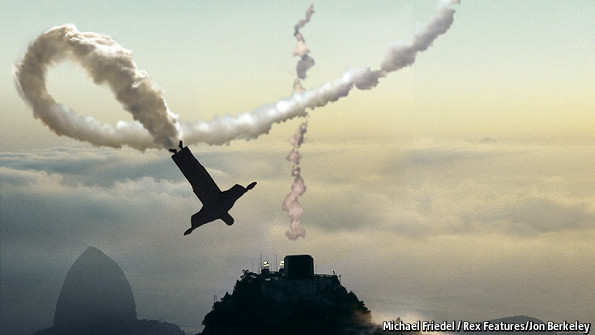
FOUR years ago this newspaper put on its cover a picture of the statue of Christ the Redeemer ascending like a rocket from Rio de Janeiro’s Corcovado mountain, under the rubric “Brazil takes off”. The economy, having stabilised under Fernando Henrique Cardoso in the mid-1990s, accelerated under Luiz Inácio Lula da Silva in the early 2000s. It barely stumbled after the Lehman collapse in 2008 and in 2010 grew by 7.5%, its strongest performance in a quarter-century. To add to the magic, Brazil was awarded both next year’s football World Cup and the summer 2016 Olympics. On the strength of all that, Lula persuaded voters in the same year to choose as president his technocratic protégée, Dilma Rousseff. Read more of this post

Farmers in Kansas are starting to adapt to declining stocks of groundwater

Farmers in Kansas are starting to adapt to declining stocks of groundwater

Sep 28th 2013 | CHICAGO |From the print edition

MITCHELL BAALMAN’S well is drying up. This is bad news for a farmer of thirsty crops in parched north-western Kansas. Four years ago Mr Baalman and other local farmers realised that unless they started saving water there might not be enough left for their children and grandchildren to irrigate the soil. So they are trying something new: voluntarily cutting back on the amount they use, even though they will grow less. Read more of this post

Nonfinancial Commercial Paper Rises to Most Since 2001, Fed Says

Nonfinancial Commercial Paper Rises to Most Since 2001, Fed Says

The market for short-term IOUs by nonfinancial companies climbed to the highest mark in 12 years. The seasonally adjusted amount of commercial paper issued by the firms climbed $13 billion to $242.5 billion outstanding in the week ended yesterday, the highest level since June 2001, the Federal Reserve said today on its website. The central bank’s unprecedented economic stimulus measures pushed borrowing costs to record lows for debt issuers in May, spurring record offerings of dollar-denominated company bonds that have reached an all-time monthly high in September. Read more of this post

Bonds-for-Chickens Barter Feeds Debt Selloff in Venezuela

Bonds-for-Chickens Barter Feeds Debt Selloff in Venezuela

Venezuela will pay for $600 million of food imports including milk and live chicks from Colombia with dollar-denominated bonds, a sign the nation is running out of money to address the chronic shortages of basic goods fueling the world’s fastest inflation. Venezuela’s borrowing costs, which fell this month on speculation it would start a foreign-exchange system to boost the dollars needed to buy necessities from abroad and alleviate inflation of 45 percent, surged by the most in three weeks yesterday after El Nacional newspaper said China wouldn’t loan the cash intended to fund the change. Yields on the benchmark 2027 bonds rose 0.23 percentage point to 11.4 percent, almost four times the increase for junk-rated emerging market debt. Read more of this post

Norway Oil Fund Chief Warns on Bonds With Returns Close to Zero

Norway Oil Fund Chief Warns on Bonds With Returns Close to Zero

The head of Norway’s sovereign wealth fund, the world’s biggest, said the bond market will offer scant returns as the investor looks to expand into other asset classes to safeguard the nation’s wealth. “Returns in the bond markets are low and look to remain so for a good while ahead,” Yngve Slyngstad, chief executive officer of the $780 billion Government Pension Fund Global, said today in a speech in Bergen published on the central bank’s website. “The safest investment alternative gives today a return after inflation close to zero.” Read more of this post

Zoom, sputter, aagghhh!! The biggest loss-making cars in Europe

Zoom, sputter, aagghhh!! The biggest loss-making cars in Europe

Sep 25th 2013, 13:27 by S.W. and L.P.

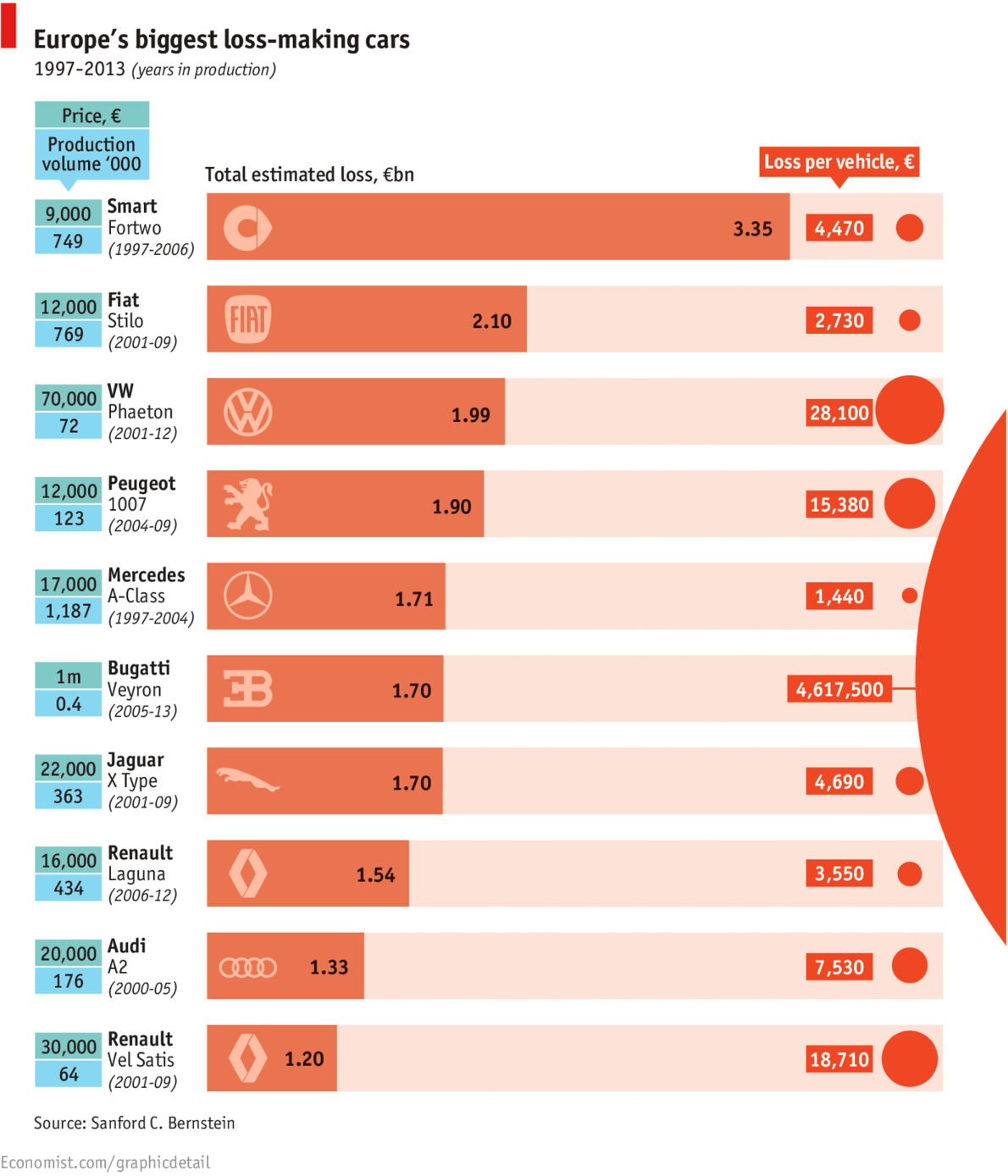
CARMAKERS in Europe are facing a rough ride, with sales at a 17-year low region-wide. So it seems cruel of Sanford C. Bernstein, a brokerage, to remind them of their biggest commercial wrecks. Most major makers suffered billions in losses. Yet not all cars failed by accidents of poor design, ill-judged technological leaps or wildly optimistic production forecasts. VW knew its Bugatti Veyron, a quick and complex supercar made in tiny numbers, would not make money but hoped it might burnish the brand. Daimler believed it could transfer know-how from its sleek executive saloons to small cars. It did—but it brought the same high costs too: its Smart Fortwo had the biggest loss. Renault produced reasonable cars but was overly optimistic about sales. Fiat failed to compete with the VW Golf. As for tomorrow’s pile-ups? Bernstein reckons that the latest bunch of electric cars could some day join the list.

20130928_gdc977_1190_6


The shadow of Fukushima, the world’s worst nuclear disaster after Chernobyl, hangs over Japan’s energy future

The shadow of Fukushima, the world’s worst nuclear disaster after Chernobyl, hangs over Japan’s energy future

Sep 21st 2013 | TOKYO |From the print edition

THIS week Japan’s last working nuclear reactor was switched off. At Oi, on the west coast of the country’s main island, the closure was supposedly for routine maintenance and safety checks. Yet no firm date is in sight for reopening Oi or any other of Japan’s 50 reactors, shut in the wake of the triple meltdown at the Fukushima Dai-ichi plant. Before the earthquake and tsunami of March 2011 turned so much of Japan’s world upside down, the country counted on nuclear power for 30% of its electricity—one of the highest proportions in the world. Now it is entirely without nuclear power for only the second time since 1970. Read more of this post

Flaws in the ASEAN “diamond decade”

Flaws in the diamond

In the different disputes in the East China Sea and South China Sea, China’s aims are the same

Sep 21st 2013 |From the print edition

LEE KUAN YEW, Singapore’s elder statesman, who turned 90 this week, offers some characteristically blunt analysis of China’s approach to territorial disputes in the East and South China Seas. In a new book (“One Man’s View of the World”), Mr Lee notes: “The Chinese know that they are the biggest boy in the neighbourhood and that, as they grow in power, they can expect more respect for their rights from their neighbours.” If the respect is lacking, China becomes menacing. Tensions with Japan over the Senkaku islands (known in China as the Diaoyu) have been mounting again. On September 11th China resentfully marked the first anniversary of the “nationalisation” of three of the five islands, which the Japanese government bought from their private owner. At the same time China’s dispute with the Philippines over islets in the South China Sea is deepening. Read more of this post

Man Controls Artificial Leg Using Only His Brain, Researchers Say

Updated September 25, 2013, 7:16 p.m. ET

Man Controls Artificial Leg Using Only His Brain, Researchers Say

RON WINSLOW

Man Controls Artificial Leg Using Only His Brai

Researchers say that 32-year-old Zac Vawter successfully controlled movements of a motorized artificial leg using only his own thoughts. Video: Rehab Institute of Chicago.

In an advance that could eventually improve the mobility of thousands of people living with amputations, researchers said a 32-year-old man successfully controlled movements of a motorized artificial leg using only his own thoughts. Aided by sensors receiving impulses from nerves and muscles that once carried signals to his missing knee and ankle, the patient was able to climb and descend stairs and walk up and down inclines much as he could with a natural leg, based on directions that came from his brain. Importantly, he was able to flex the device’s ankle, enabling a near-normal gait, something not possible with current prosthetics. “It’s night and day” between the experimental bionic leg and the mechanical prosthetic limb he uses every day, said Zac Vawter, a software engineer from Yelm, Wash., who lost his right leg in a motorcycle accident four years ago. “Going upstairs with my normal prosthetic, my sound leg goes up first for every step,” he added. “With this I go foot-over-foot up the stairs and down the stairs.” Read more of this post

The 3 Books Amazon’s Jeff Bezos Asks His Senior Managers To Read

The 3 Books Amazon’s Jeff Bezos Asks His Senior Managers To Read

MAX NISEN SEP. 25, 2013, 5:02 PM 15,990 4

Jeff Bezos is one of the most successful entrepreneurs out there, able to build a company deeply integrated into people’s lives, all but ignoring Wall Street, and constantly looking toward the future.  But that doesn’t mean he doesn’t value other people’s advice. In a post on LinkedIn, CNBC tech correspondent Jon Fortt said the Amazon CEO had three all-day book clubs for his senior managers over the summer. It’s not a surprising management technique from a man who revers the written word. He typically starts meetings of his “S-team” of senior executives with 30 minutes of silence while they read through dense, six-page printed memos, so they’re all starting with the same ideas and framework in mind. In the recent book clubs, Bezos had those top executives read classics that helped him sketch out the future of his company. They are:

“The Effective Executive” by Peter Drucker

Drucker is one of the principle founders of modern management theory, helping create and broadly popularize ideas that seem commonplace now, like the fact that companies should be decentralized rather than run via command and control, and “management by objectives,” where both leaders and employees work toward a set of goals they understand and agree on. This particular book focuses on how to develop the personal habits of time management and effective decision-making that allow an executive to stay productive and contribute their best to an organization.

“The Innovator’s Dilemma” by Clayton Christensen

This book, first published in 1997, can safely be called one of the most influential business books of all time. Even if the term “disruption” has since been co-opted by the startup world and dramatically overused, his core theory of how businesses get disrupted is just as relevant today. New technology allows smaller companies to make cheaper products, which at first appeal only to customers at the margins. But before the largest businesses realize it, they take over entire markets.

“The Goal: A Process of Ongoing Improvement” by Eliyahu M. Goldratt and Jeff Cox

The last book is very different from the two previous ones. It’s not a classical business book based on a series of studies of a real-world company, but is instead a novel about a manager tasked with turning around a failing manufacturing plant. It sounds strange, but it was a best-seller and has helped spawn business theories in its own right.
12 Extremely Successful People Reveal How They Find Talent: Look for people who make you somewhat uncomfortable. Look for intellectual curiosity and people who are different than you

12 Extremely Successful People Reveal How They Find Talent

MAX NISEN AND VIVIAN GIANG SEP. 25, 2013, 4:06 PM 49,326

Talent is the most important asset in any company, and the most successful leaders know it. In a new LinkedIn series titled “How I Hire,” more than 80 top executives — including billionaire Richard Branson, former Bank of America exec Sally Krawcheck, and Warby Parker’s Neil Blumenthal — break down the core of their hiring philosophies.  Although these entrepreneurs and business leaders have stepped outside of the day-to-day process of hiring, they still spend a lot of time thinking about the sort of people they want on board. A common theme? Resumes and qualifications are less important than they seem. These leaders also look for passion, and seek people with unusual experience that can add something new. In other words, you can have the wrong resume, but still be right for a job. Virgin Chairman Richard Branson: Hire for personality first, and look at qualifications last. Read more of this post

Failure versus face: how can Asia produce startups despite its culture?

Failure versus face: how can Asia produce startups despite its culture?

September 26, 2013

by Anh-Minh Do

You can blame China. It’s the biggest, most influential, and most long-standing civilization in Asia that came up with such aphorisms as:

A family’s ugliness should never be publicly aired.

By ugliness it means misfortune. And since Chinese civilization has dominated, conquered, influenced, and traded with almost every civilization in the Asian continent, rest assured the Middle Kingdom’s values have spread far and wide. Asians don’t want to lose face, much less misplace it. This is a nightmare for building a healthy startup culture.

What face does for failure

As some historians and translators have noted, it’s impossible to translate ‘face’. But it boils down to doing what is acceptable and honorable in society in light of what other people think of you and yours. Failing will surely result in losing face. Is it any wonder then why Asian parents want their children to become doctors, engineers, and lawyers? These are secure jobs that are guaranteed careers. The Asian status quo is wealth, good family, and health. Breaking the status quo is certain to cause a loss of face. It’s too risky. But that’s what startups are about. Read more of this post

The Koffler Group, a US-based family office, has traditionally travelled light when it comes to debt, but Campden talks to the third-gen who has been fearless in making sure it now has a mixed bag of investments

TRAVEL MONEY

ARTICLE | 26 SEPTEMBER, 2013 10:43 AM | BY PAUL GOLDEN

OLYMPUS DIGITAL CAMERA

The family fortune may have been made by an inherently conservative investor with a flair for designing suitcases, but when it comes to investment strategy subsequent generations of the Koffler family have been determined not to carry any baggage. Sol Koffler is a poster child for the American dream. Arriving in the US from eastern Europe in 1920 at the age of 13, he started selling $1 suitcases as the Great Depression reached its peak. Over the next 46 years he built American Tourister into the second largest luggage company in the country. The Koffler Group family office was established in 1979 from the proceeds of the sale of American Tourister to the Hillenbrand Company and for 14 years was run on the same prudent lines by an entrepreneur who didn’t believe in taking on debt. Read more of this post

Barclays Plc will stop offering wealth management services in about 130 countries by 2016 and cut jobs in the unit

Updated: Thursday September 26, 2013 MYT 9:06:19 AM

Barclays too shut Wealth Management Services in 130 countries

LONDON: Barclays Plc will stop offering wealth management services in about 130 countries by 2016 and cut jobs in the unit as part of an effort to rein in costs and boost profit, the Financial Times reported on Wednesday, citing the British bank. Barclays announced plans in April to restructure its wealth business so it works more closely with retail and corporate banking divisions. Further details on the wealth strategy had been expected. The bank appointed Peter Horrell as the wealth and investment management unit’s chief executive on Monday. Horrell has held the position on an interim basis since May. – Reuters


Nomura Says China May Allow Defaults of Local Debt

Nomura Says China May Allow Defaults of Local Debt

(Corrects name in second paragraph.)

Policy makers in China may allow some local governments’ debt to default next year to improve market discipline as borrowings surge, according to Nomura Holdings Inc. Local government financing vehicles’ debt grew 39 percent from 2010 to 19 trillion yuan ($3.1 trillion) as of the end of 2012, Nomura economists led by Zhang Zhiwei wrote in a report released today. That’s 37 percent of gross domestic product, according to the investment bank. China will complete an audit of the debt this month to assess risks to its financial system, ahead of a Communist Party meeting in November to set economic policy. Non-performing local-government and corporate liabilities will probably have a “significant impact” on China’s credit and economic growth, according to half of the economists in a Bloomberg News survey conducted in July. Read more of this post

What Investors Should Know About Shanghai’s Free-Trade Zone

September 26, 2013, 10:05 a.m. ET

What Investors Should Know About Shanghai’s Free-Trade Zone

WEI GU

Shanghai’s free-trade zone is set to launch Sunday despite almost no clarity about what exactly will be freely tradable. Investors have bid up the shares of real-estate companies in the zone and pundits have made predictions ranging from currency convertibility to access to Facebook FB +1.86% . In the first case, investors are thinking too narrowly; in the second, the pundits aren’t thinking much at all. The Chinese government historically hasn’t made big, bold changes all at once, but has taken incremental approaches to new and risky ventures. The step-by-step internationalization of the yuan is a good example. Read more of this post

Maersk Line CEO: We Misjudged Container-Shipping Demand when we ordered billions of dollars’ worth of new vessels two years ago

September 26, 2013, 7:04 a.m. ET

Maersk Line CEO: We Misjudged Container-Shipping Demand

Shipper Now Counting on Cargo-Sharing Alliance to Cut Costs

COSTAS PARIS And CLEMENS BOMSDORF

Søren Skou, the chief executive of Maersk Line, said the Danish group misjudged the strength in demand for container shipping, which has proved far more sluggish than it expected when it ordered billions of dollars’ worth of new vessels two years ago. Photo: Bloomberg

COPENHAGEN—The chief executive of Danish shipping group Maersk Line said Thursday the company misjudged the strength in demand for container shipping, which has proved far more sluggish than it expected when it ordered billions of dollars’ worth of new vessels two years ago. The world’s biggest container shipper is now counting on the planned P3 cargo-sharing alliance with European rivals CMA CGM and Mediterranean Shipping Co. to cut costs and reduce the number of their ships plying major routes between Europe and Asia to 250 from 300, Soren Skou said in an interview with The Wall Street Journal. Read more of this post

Two thirds of Australian family businesses do not have a succession plan in place despite the majority of family chief executives being over the age of 50 and nearly 20% being over the age of 65

AUSTRALIAN FAMILY FIRMS FAILING TO PREPARE FOR SUCCESSION

ARTICLE | 23 SEPTEMBER, 2013 04:40 PM | BY JESSICA TASMAN-JONES

Two thirds of Australian family businesses do not have a succession plan in place despite the majority of family chief executives being over the age of 50 and nearly 20% being over the age of 65, according to a KPMG and Family Business Australia survey. Seventy-two per cent of family businesses listed balancing family and business issues as the primary challenge for their family firm, and 67% said maintaining family ownership was a primary concern. The biennial report, this year titled Performers: resilient, adaptable, sustainable and conducted in collaboration with the University of Adelaide’s Family Business Education and Research Group, found 71% of families intend to retain family ownership, but around half would consider a sale if approached. First generation firms were more likely to consider a sale than family firms in their second generation or beyond. Read more of this post

BlackBuried: Indonesia Failings Offer Lessons for Apple, Samsung

BlackBuried: Indonesia Failings Offer Lessons for Apple, Samsung

By Jeremy Wagstaff & Kanupriya Kapoor on 4:37 pm September 25, 2013.
Indonesia has long been a surprising jewel in the crown of BlackBerry Ltd, a rare market where its devices enjoyed mass appeal. But the country also highlights the struggling company’s failure to embrace the emerging economies that are leading smartphone sales growth across the globe. Indonesia is still one of BlackBerry’s biggest markets, accounting for about 15 percent of global users but its share of smartphone sales in Southeast Asia’s biggest economy has fallen fast to 21 percent in the second quarter from 39 percent a year earlier, according to data from telecoms consultancy IDC. Read more of this post

Abenomics Speeds Corporate Investment, But Not in Japan

Abenomics Speeds Corporate Investment, But Not in Japan

By Wayne Arnold & Orathai Sriring on 3:05 pm September 26, 2013.
Hong Kong/Bangkok. Japanese Prime Minister Shinzo Abe got an early sign of how his blueprint to revive Japan’s industrial vim and economic vigor was working when two of his country’s biggest car makers unveiled $900 million worth of investments to boost production. There was one drawback: the new assembly plants and expanded factories announced by Mazda Motor and Honda Motor are not in Japan, but more than 2,000 miles away, in Thailand. Read more of this post

Park’s Budget Scales Back Pledged Aid to South Korean Aged as the government forecast the first drop in revenue in four years

Park’s Budget Scales Back Pledged Aid to South Korean Aged

South Korea President Park Geun Hye was forced to scale back aid she pledged to pensioners in her 2014 budget and delayed plans to eliminate the deficit as the government forecast the first drop in revenue in four years. In her first budget draft since taking office in February, Park boosted welfare spending to a record while scaling back a plan to expand pension benefits as dwindling revenue restricts her ability to increase support for an aging population. The deficit is forecast to remain at 1.8 percent of gross domestic product, a seventh straight year of shortfalls in Asia’s fourth biggest economy, the finance ministry said in its proposal. Read more of this post

What Should I Do Next with My Life? New Ways to Define Success

What Should I Do Next with My Life? New Ways to Define Success

Sep 24, 2013 

Wharton professor G. Richard Shell‘s new book, Springboard: Launching Your Personal Search for Success, encourages readers to embrace major transitions in life, from college to a first job, from one career to the next or from work to retirement. Based on a popular course Shell teaches at Wharton, the book departs from the conventional “how to succeed” formula by challenging readers to define success for themselves.

An edited version of the transcript appears below.

Knowledge@Wharton: You are well known for your work in negotiation and persuasion, so why write a book about success?

Shell: It’s been a long journey. The materials on success actually preceded the materials on negotiation and persuasion. I’ve been interested in success since I was in my 20s, and it also feeds into a passion I have in my teaching to help students and executives bring more self awareness to their career choices, whatever they are. The subject of success allows me to do that directly. Read more of this post

How to keep your indie soul; it can be a challenge for small, independent brands to maintain their spirit as they expand

September 25, 2013 4:25 pm

How to keep your indie soul

By Ian Sanders

Independent mindset: Dorian Waite of restaurant Honest Burgers

It is Monday lunchtime in London’s Soho and there is a line of people waiting outside Honest Burgers on Meard Street. There is plenty of choice for a lunchtime burger in Soho but Honest, a three-restaurant business that launched in Brixton market in 2010, is popular. The business seeks to differentiate itself through an independent spirit; having worked for chain restaurants in the past, co-founder Dorian Waite says he is striving for a different approach. “A lot of big businesses seem happy to deceive their customers,” he says. “Everything’s built around making money, not giving people what they want. We felt there was an opportunity to turn that on its head.” Read more of this post

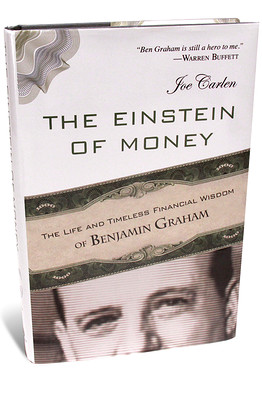
Ben Graham: The Einstein of Money

Ben Graham: The Einstein of Money

by ValueWalk StaffSeptember 24, 2013

Book-Review-Einstein-of-Money

In 1934, Benjamin Graham revolutionized the investment world with the publication of his book Security Analysis. “The Value Bible,” as modern investors affectionately call it, contained Graham’s accumulated wisdom from years of evaluating and expertly buying/selling stocks in an unprecedented, but radically successful, manner. In fact, Graham defied all contemporary investing strategies in such a way that Warren Buffet, cited as the third richest man in the world, would credit Graham as the predominant influence on his investment strategy in an article published over 70 years after Security Analysis. Read more of this post

A massive statue of Buddha believed to be over 1,000 years old was shown to the media for the first time at the Haeinsa Temple in Hapcheon, South Gyeongsang Province

2013-09-25 19:48

1,000-year-old Buddha open to public

Baek Byung-yeul

130925_p01_buddha

Tourists take photos of the “Maebul” or the rock-carved standing Buddha at the Haeinsa Temple in Hapcheon, South Gyeongsang Province, Wednesday. The temple unveiled the ninth-century statue prior to the opening of the 2013 Tripitaka Koreana Festival, which kicks off today for 46 days.
/ Korea Times photo by Shim Hyun-chul

HAPCHEON, South Gyeongsang Province — A massive statue of Buddha believed to be over 1,000 years old was shown to the media for the first time Wednesday at the Haeinsa Temple in Hapcheon, South Gyeongsang Province. The temple, which also keeps the “Tripitaka Koreana,” a 13th-century collection of Buddhist texts recorded on 80,000 woodblocks, and listed as a UNESCO Cultural Heritage, will unveil the statute to the public from Thursday to Nov. 10 to promote its annual “Tripitaka Koreana Festival.”
The sculpture, carved on a spread of rock located deep behind the temple complex, has been accessed only by monks since its creation in the 9th century, perhaps around the time when Haeinsa was built during the Silla Kingdom (57 B.C.-935 A.D.). It’s one of the country’s largest “maebul,” or rocked-carved standing Buddha statues, measuring 7.5-meters in height and 3.1 meters in width, and is a designated national treasure. “The Cultural Heritage Administration has been strictly limiting pedestrian access to the 2.7-kilometer trail (on the slopes of Mt. Gaya) that connects the statue with the temple. Permission for public access is temporary and only between 10:30 a.m. to 4 p.m.,” said an official from the temple. “The trail has been protected as a revered place for monks who regularly visit the statue for prayer, so we would like to request visitors to be extra considerate. There will be security guards placed around the statue and Haenisa monks will serve as guides.” The Tripitaka Koreana Festival, which was inaugurated in 2011, offers a variety of cultural events that organizers say can be enjoyed by all people. Tickets cost 4,000 won for children, 6,000 won for middle and high school students and 8,000 won for adults. It will open from 10 a.m. to 7 p.m. For more information, call (055) 211-6251 or visit its official English webpage at www.tripitaka-festival.com/english.do.

Jesus was the world’s first tweeter: Vatican

Jesus was the world’s first tweeter: Vatican

Wednesday, September 25, 2013 – 22:26

AFP

ROME – Jesus Christ was the world’s first tweeter because his pronouncements were “brief and full of meaning”, Vatican cardinal Gianfranco Ravasi said Wednesday. Christ “used tweets before everyone else, with elementary phrases made up of fewer than 45 characters like ‘Love one another'”, said Ravasi, the Vatican’s equivalent of a culture minister. “A bit like in television today, he delivered a message through a story or a symbol,” Ravasi said at a conference with Italy’s leading newspaper editors. The cardinal emphasised the importance of clergy making full use of modern-day computer technology. “If a cleric, a pastor is not interested in communication, they are defying their duty,” he said. The Vatican has stepped up its presence on the Internet in recent years, initially under Benedict XVI and now under Pope Francis, who has more than three million followers on Twitter in English alone. Francis has also resorted to more traditional media, cold-calling ordinary faithful who have written to him and writing lengthy letters on religious issues that have appeared in the Italian press.

The Benefits of Negative Feedback

The Benefits of Negative Feedback

by John Butman  |   9:00 AM September 16, 2013

I recently gave a lunchtime “author’s talk” at Children’s Hospital in Boston and, although I thought the talk went well, somebody in the audience didn’t like it at all. On the evaluation form, the person in question wrote a single word in the comment box: CONFUSING. Thank you, whoever you are. While everybody else gave me good marks and said nice things, which I appreciated, my critic forced me into self-examination. Was he the only one forthright enough to speak up, or was he the only one not paying enough attention to get it? What was confusing? The ideas? The presentation? Read more of this post