Kicking footballs into the future: The head of soccer innovation at Adidas tries to anticipate how the sport is changing; Innovation is based on ideas “and we need a constant flow of them”
February 1, 2014 Leave a comment
January 30, 2014 4:30 pm
Kicking footballs into the future
By Emma Jacobs
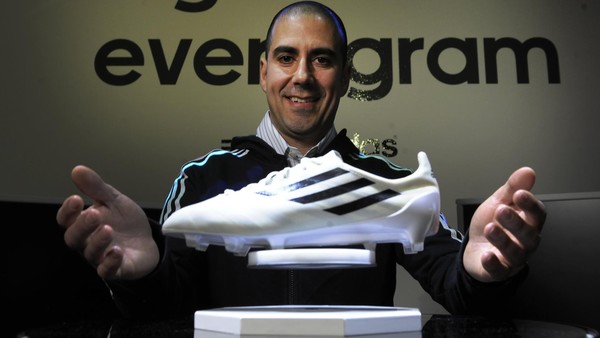
End goals: Antonio Zea’s job at Adidas involves developing the official match ball for the 2014 world cup
Employees in Antonio Zea’s department are encouraged to put interesting pictures up on the wall in the hope the surroundings will foster creativity and spark new ideas. On the whiteboard in his office it says, “Make cool s**t”. He likes to point to this mantra often. It “keeps things simple”, he says.Mr Zea, 42, is head of innovation for soccer at Adidas, the German sportswear company, which is based in Herzogenaurach, in Bavaria, which is where Mr Zea works and which is also the location for rival Puma.
Last month he unveiled the company’s latest creation, the Brazuca, the official match ball for the 2014 football World Cup that will take place in Brazil in June. After the German company came under fire for the Jabulani, the official ball at the last World Cup, Mr Zea came under pressure to improve this tournament’s ball. In 2010 Carlos Verri, Brazil’s coach, got into a spat with Jerome Valcke, Fifa secretary-general, challenging him to come on to the pitch and attempt to control it. Fabio Capello, who was then the England coach, said some of his players complained it moved too fast. Goalkeepers claimed the Jabulani was too difficult to handle.
So this time, Mr Zea has made sure that the new ball was tested by more than 600 players, more than ever before. Disguised Brazucas were used in friendlies and the Under-20 World Cup in Turkey; it has also been blasted in wind tunnels and kicked by robotic legs.
As innovation director for football, he tries to anticipate where the game is going. “Does it get faster or more technical. How do we support it?” He looks at demographic changes to see what players’ needs are. Urbanisation for example, is an issue. “The game in urban areas is played differently – they have smaller fields, fewer players than 11 versus 11.” Climate is also a factor as it determines the surfaces people play on.
In America it’s all about winning. If you’re not winning people don’tcare
He encourages his team to talk to young football players. “I want to get out into the marketplace – understand the kid.” Observation is key to his role. “We watch what they wear, how they wear it, what they may change or alter in products. We also watch how people shop, what they pick, why, we watch everything.”
Mr Zea, who is originally from New Jersey, describes himself as the “strange American kid who never played basketball or baseball”. His Spanish father instructed him to support Real Madrid like all his other relatives, except for the “black sheep cousin” who is an Atletico Madrid fan. His father, a retired engineer, coached the junior Zea. (Today when father and son get together in New Jersey they have lively debates about Fifa’s refusal to update rules, styles of play and the father’s antipathy towards the cable company for not screening La Liga in his area).
“I don’t know the rules to American football,” he says, reflecting on a childhood as “an inbetweener”, spending summers in Spain and aspiring to be a professional footballer (“I soon realised that dream would be unfulfilled”). At Rutgers, where he was a student of American Studies, he played for the university team which reached the national championships final, although unfortunately he was on the bench. Nonetheless, he was determined to work in football, networking furiously with the Adidas representatives who worked on the sponsorship of his college team.
“As a kid in America you grow up with Nike. But as an ‘inbetweener’, the idea of this company that wasn’t American intrigued me.”
His efforts paid off: after graduating he secured a marketing job at Adidas, working in Washington with a club it sponsored – DC United of the then newly formed professional Major League Soccer.
As a self-confessed “shoe dog”, he became fixated on working in footwear. Unlike some trainer geeks, he did not just want to collect rare pairs and keep them stored box-fresh, he preferred to use them.
“I loved trainers but I wanted to wear them. I didn’t want them to sit on a shelf. I would wear them until they were destroyed.”
In 1997 he managed to get on to a programme at Adidas’s Bavarian headquarters that taught a select few (in his year, it was just four employees) how to make trainers and hiking boots. Staying in a guest house, he would trudge two miles through the snow to learn how to cut leather with a knife by hand, how to stitch shoes together. The reward for his first pair? A blister.
At the end of the year, having learnt the shoemaking process from end to end, he was relocated to Guangzhou, armed only with “survival Mandarin”, to become development manager in an Adidas factory overseeing the development of all sorts of sport shoes – from soccer to hiking. His chief job was to finesse prototypes to the point that they were ready for the production line. The facility, which had tens of thousands of factory workers, produced shoes for different brands. “It was the best way to understand how to commercialise shoes on a large scale,” he says.
While the job was enjoyable, he grew tired of living in serviced apartments in hotels and not being able to blend in to the local culture. “I never felt I fit in because I looked different. Little kids would point at me. I wanted to feel like I was home.”
After a stint in Portland, the company’s US headquarters, developing shoes for the outdoors and then football, he became head of football for North America in 2007. In that role, he had to sell football to Americans. “We don’t think we will leapfrog basketball and baseball,” he says understatedly. Moreover, Nike sponsors the national team. “In America it’s all about winning. If you’re not winning people don’t care.” The growth, he says, comes from Hispanic consumers. “The demographic change makes us hopeful . . . It’s not a sprint, it’s a marathon.”
Being up to speed on new manufacturing techniques is also key to his role. “We look at different industries, phones and cars in particular, to understand developments in materials and looks.” The company works quite closely with Continental, the German car parts supplier that has developed technology in rubber compounds that helped Adidas look at new developments in shoe bottoms and traction. “A good idea can come from anywhere,” he notes.
Key to innovation, he insists, is allowing people to “fail and fail often”. He encourages his team to make their products (they use 3D printers), break them, modify and try again. They can test the products on the lab’s artificial turf pitch inside or the natural grass field outside.
Recent products he has overseen are the 99g Adizero football boot, the lightest the company has ever made, and a smart football that allows players to track their speed, spin and trajectory.
His goal is to ensure players, both amateur and professional, view the brand as cutting-edge. Innovation is based on ideas, he says, “and we need a constant flow of them”.
 About bambooinnovator
 Bamboo Innovator