Two-year construction boom in Philippines shows signs of slowing; ‘many middle class and ordinary people are already finding the prices too expensive.”
February 1, 2014 Leave a comment
January 30, 2014 5:48 pm
Two-year construction boom in Philippines shows signs of slowing
By Roel Landingin in Manila
Despite a 30km commute to work that takes 90 minutes each way, Jun Siongson does not regret buying an 80 sq m apartment on the outskirts of Manila.
“My wife and I can now enjoy complete privacy,” says the 49-year old database developer who, until recently, had no choice but to live with his mother in an overcrowded flat in the capital.
Mr Siongson is not alone. With a housing shortfall expected to rise to 5.8m homes by 2016, from 3.6m in 2010, according to government estimates, overcrowding is common. But thanks to record low interest rates and lower downpayment requirements, thousands have for the first time found themselves able to afford their own homes.
The phenomenon is helping to fuel a construction boom that is helping boost the Philippine economy – one of Asia’s fastest growing in the past two years.
Despite the devastation of November’s Typhoon Haiyan, which killed more than 6,000 people, data out yesterday showed full-year economic growth of 7.2 per cent in 2013 following a 6.8 per cent rise in 2012, the first time in 23 years the Philippines has posted growth above 6 per cent for two consecutive years. By value, construction and real estate sectors accounted for almost a fifth of the economy – almost as much as manufacturing.
Underlining the breakneck speed of development, Romeo Arahan, research analyst at Colliers International, a real estate consultancy in Manila, estimates that up to 25,000 residential condominium units will be built in the city’s main business districts in the three-year period to 2016. That is almost half the stock of 58,000 units built in the last 40 years.
Demand is coming from Filipinos working overseas as well as a growing middle class. Chris Capili, a 22-year-old advertising media buyer, said: “I like to stay in a condominium despite the cramped space because it signifies an independent lifestyle.”
Mr Arahan calculates that between 2013 and 2016, 1.5m sq m of new offices will be constructed – a quarter as much again as the 6.2m sq m existing at the end of 2012, he says. Most is being built in anticipation of the continued growth in call centres and other business outsourcing services, a sector expected to double its workforce to 1.3m by 2016.
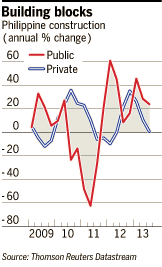
But after almost two years of rapid growth, there are signs construction activity could be slowing.
After surging 18.2 per cent in the first half of 2013, the annual growth in the value of private construction activity slowed to 0.6 per cent in the third quarter and contracted by 0.4 per cent in the last three months of 2013. Public construction also eased in the last three months of 2013 after growing 31.8 per cent in the first nine months.
But Arsenio Balisacan, the economic planning secretary, says the fourth-quarter drop in public construction does not reflect a permanent slowdown. Rather, he says, it is a consequence of front-loading infrastructure spending in the first six months of the year to avoid the rainy season and recent time limits imposed on when agencies must spend budget allocations.
Reconstruction after the Haiyan typhoon – which affected more than 4m people across 51 of the country’s 87 provinces – will also lift public spending on construction, he says.
Luz Lorenzo, chief economist at ATR Kim Eng Securities, a brokerage, also sees the construction slowdown as a blip. “[It] is just temporary as property developers stop new product launches to clear out existing inventory,” she says.
But some property market insiders caution that the slowdown in activity could be a sign of faltering demand. Wilson Flores, a property broker, says there are signs of oversupply for homes in Metro Manila.
“It is taking longer and longer to dispose of property as supply of new houses and units continues to rise,” Mr Flores says. “Many newly built units remain unsold for months.”
He also worries that rapidly rising property prices could further limit demand. “With interest rates at record lows and lacking lucrative investment outlets, many wealthy Filipinos are investing in real estate, artificially inflating prices,” he says.
In the Makati central business district, implied land values were up 12 per cent year on year in the third quarter compared to the average rise of 4.5 per cent in 2011 and 2012, according to Colliers.
Although today’s land prices in real terms are still less than half the levels before the 1997 Asian financial crisis – one reason that policy makers and analysts discount the likelihood of a risky property bubble – Mr Flores warns that they could crimp demand.
“I’m in real estate and would like to sell more property,” he says. “But many middle class and ordinary people are already finding the prices too expensive.”
 About bambooinnovator
 Bamboo Innovator