India: Narendra Modi’s market model; Critics of Gujarat’s chief minister question whether he could replicate state-level success across the country
February 7, 2014 Leave a comment
February 5, 2014 8:16 pm
India: Narendra Modi’s market model
By Victor Mallet
Critics of Gujarat’s chief minister question whether he could replicate state-level success across the country
To see the vast industrial complexes on the Arabian Sea coast of Gujarat is to understand why big business thinks Narendra Modi could – and should – beIndia’s saviour.
The roads are wide. Electricity runs 24 hours a day. Around the Gulf of Kutch, the night sky is illuminated by the world’s largest oil refinery. The modern petrochemical plants and pumping stations handling 80 per cent of India’s oil imports seem a world away from the ramshackle infrastructure of the north Indian hinterland.
“Gujarat has always been a major industrial hub, and the attitude of the government has always been to invite industrial activity,” says Ramamurthy Palepu, who heads operations at Essar Oil’s five-year-old refinery near Jamnagar. The plant, the biggest in India after theReliance Industries complex over the road, processes 20m tonnes of crude oil a year. “What we see is the government is really proactive with industry and supportive, and there is less of a bureaucracy.”
Compared with the fulsome eulogies of Indian tycoons, that is mild technocratic praise for Gujarat and its chief minister Mr Modi who – if he wins this year’s general election and unseats the governing Congress party – will become prime minister of India at the head of the Bharatiya Janata party.
At last year’s “Vibrant Gujarat” business summit, Mukesh Ambani of Reliance Industries and Shashi Ruia of Essar were among those promising billions of dollars of new investment in the state. Mr Ambani’s brother Anil, who heads Reliance Group, called Mr Modi “a leader among leaders, a king among kings”.
Buoyed by this support from business and by victories in three of the five state elections held at the end of last year, Mr Modi and the Hindu nationalist BJP have deliberately toned down their once vociferous support for Hindu religious causes and focused their election campaign on the economy.
Vote for the BJP, the argument goes, and Mr Modi will do for the rest of India what he has done for Gujarat during his 12 years as chief minister: encourage investment, improve roads, electricity and water supply, and create the jobs desperately needed by the 10-12m young Indians entering the workforce each year.
Mr Modi contrasts himself and the BJP with what he portrays as a sclerotic and corrupt Congress party. Under the octogenarian prime minister Manmohan Singh, say BJP leaders, the Congress-led coalition in power for the past decade has overseen a sharp slowdown of the Indian economy and a collapse of the country’s international reputation.
Yet there are two important questions that Indian voters (particularly Mr Modi’s opponents) are asking about the so-called “Modi model” of governance and economic development. First, does it actually deliver prosperity to the 60m inhabitants of Gujarat? And second, if it does work in Gujarat, can it be effectively applied to the rest of the country and benefit all 1.3bn Indians?
Mr Modi himself is in no doubt. Campaigning recently in poverty-stricken Uttar Pradesh (UP) – whose 200m inhabitants and 80 parliamentary seats (out of 545) make it electorally the most important state in the union – he was attacked by regional political strongman Mulayam Singh Yadav for his alleged role in a massacre in Gujarat.
It’s Darwin’s model of survival of the fittest and to hell with the rest of us
That was a reference to the killing of hundreds of Muslims in riots in 2002, shortly after Mr Modi took power. Mr Modi, however, focused his counter-attack almost entirely on development when he addressed his own political rally shortly after. “Do you know the meaning of converting UP into Gujarat?” he roared in a rhetorical question directed at Mr Yadav. “It means 24-hour electricity, no power cut for 365 days in every village. You can’t do it. It requires a 56-inch chest.”
Reliable electricity, attracting investors and decisive leadership are the achievements lauded by Mr Modi’s supporters in the towns and villages of Gujarat. Modi fans are not hard to find. He and the BJP won nearly two-thirds of the seats in the Gujarat state election in December 2012.
“He’s done good work in building roads, he’s connected small villages,” says Bakulbhai Rajveer, standing in front of a heap of freshly harvested cotton at his ginnery near Surendranagar west of Sanand, the motor industry hub where Ford and Tata Motors have built factories. “We used to get power for only eight hours, now we get it for 24.”
It is the same story in Bhuj away to the west near the salt flats of the Rann of Kutch. “Twenty years back you couldn’t get ice-cream in a village because electricity was uncertain and so there were no refrigerators,” says Maheshdan Gadhavi, who runs a restaurant in the town. “Now all these small businesses can do their business in their own village.”
Zafar Sareshwala, a Muslim industrialist and BMW merchant in Ahmedabad, who once bitterly opposed Mr Modi but is now among his most vocal supporters, predicts the BJP leader will emerge as a moderniser of a “sort of New Labour” party if he wins the general election. That reference to the UK Labour party’s abandonment of its orthodox socialist past implies Mr Modi would tone down the BJP’s old-fashioned Hindu militancy and concentrate on reforming the Indian economy.
“If you want to transform the economy of a country, it has to be ultimately based on manufacturing,” says Mr Sareshwala. “Modi’s very decisive . . . He has a lot of ideas and he’s a very tough taskmaster.”
Mr Modi’s opponents are equally vehement. Even when they set aside their suspicions about his role in the bloodletting in 2002 and examine Gujarat’s development since, they dismiss many of his boasts about the economy as “hype” and “marketing”.
While it is true that Gujarat’s economy has grown rapidly – more than 10 per cent annually on average in the six years to 2012 – that is only to be expected for a state with a long and successful history of industry and international trade, Mr Modi’s critics say. His government, they add, has failed to use the wealth generated by this growth to do much to improve education and healthcare.
“It’s Darwin’s model of survival of the fittest and to hell with the rest of us,” says Mallika Sarabhai, a renowned classical dancer, social activist and supporter of the new, anti-corruption Aam Aadmi (Common Man) party that has emerged in Delhi. Mr Modi’s model favours the rich, marginalises the poor and destroys the environment, she says. “It’s very much a CEO model, because a CEO has to maximise profits for investors and shareholders.”
. . .
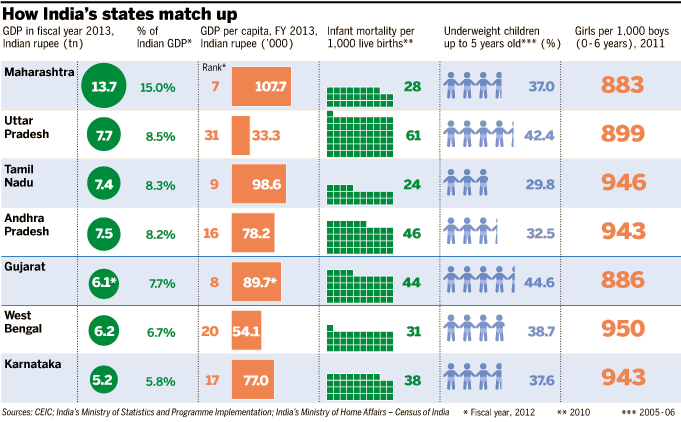
Gujarat is prosperous by Indian standards, ranking eighth out of 32 territories in per capita income, but its social indicators are unimpressive. Data from the latest Indian census in 2011 shows that only 79 per cent of Gujaratis had basic literacy, well below top performer Kerala with 93 per cent, albeit better than the laggard states in the sixties.
By one important measure – the level of implied female foeticide as a result of parental preference for boys – Gujarat does exceptionally badly for such a developed state. For every 1,000 boys aged up to six, there were just 886 girls, putting Gujarat seven places from the bottom of the list of 35 states and territories.
“Everything that’s being done in the name of development excludes the poor,” says Hanif Lakdawala, a doctor who runs Sanchetana, a group in Ahmedabad focused on slum improvement. Gujarat’s urban slums are expanding and their inhabitants are “living in hell”, while government schools are bad and private schools too costly. “The dropout rate is high. The government claims that we enrol 100 per cent of girl children and all that, but our data show [it is] much lower.” Nearly half of children under five are malnourished, more than half of women are anaemic, and infant mortality and maternal death in childbirth are high, he says.
While the war of words rages between Mr Modi’s business supporters and his leftwing opponents, ordinary Gujaratis are living with the varied impact of his policies. Ahmedabad’s Khanpur slum is a mixed community of Hindu and Muslim families sandwiched between a modern hotel and the city’s Rifle Club. They have had their old homes demolished, ostensibly to make way for a new concrete embankment and riverside expressway along the Sabarmati.
They claim no particular gripe with Mr Modi but have re-erected shacks of brick, wood and plastic sheeting, complaining that the replacement homes offered by the government are too far away from their jobs as laundrymen, dyers and car mechanics.
“The development work that’s going on, it’s good and we’re not against that, and whatever the leaders of Gujarat are doing, we agree with their decision,” says Mohammed Ali Fulchan, who spray-paints cars for a living and is standing on the rubble of his former home next to the river. “But after the demolition of our houses here we’ve become jobless.”
. . .
Mr Modi is still a long way from winning the Indian election, which must be held by May. But if he succeeds, he would probably be at the head of a fractious coalition government. If he starts implementing a pro-business “Modi model” nationally, he would be confronted with thousands of Khanpurs across India.
He has already alienated India’s largely anti-capitalist intelligentsia, and is unlikely to win their support. But he would still need to solve the dilemma facing any Indian prime minister in modern times: how to modernise the economy without angering those moved to make way for new roads, airports, factories and mines.
Gujarat has swaths of infertile scrubland, particularly in the far west, home to some of the biggest industrial complexes. Most of India has less space to spare, and inexorable population growth means there will be another 500m or so inhabitants by the middle of this century.
Even if Mr Modi and a BJP government can somehow accelerate land acquisition for industry and infrastructure to usher in a new era of investment and growth, there remains the question of whether he has the strategy or the personality to revive the faltering Indian economy.
“I don’t think he has any new economic plan,” says Ghanshyam Shah, a political analyst in Ahmedabad. “I wonder how he would bring new investment in the country. So I don’t expect India to become an Asian tiger . . . If he becomes prime minister, that would be a disaster. He’s an authoritarian person.”
But Mr Sareshwala says Mr Modi’s record and his attention to business and investment over the past decade make him “a symbol of hope”.
Mr Modi himself talks of a “policy-driven” approach and says he knows no single solution can be applied to every corner of such a large country.
If he achieves his ambition to be prime minister, Indians will see whether he can make his much disputed style of government work in the world’s largest democracy.
——————————————-
Earthquake aftermath: Recovery epitomises state conflict
Jubeda does not think much of Gujarat’s chief minister or the “Modi model” of development. “Narendra Modi doesn’t give anything to the poor. It’s the big people who get all the money,” she complains.
She is standing next to the shack where she lives in the old walled town of Bhuj, which was all but destroyed in the January 2001 earthquake in the district of Kutch in western Gujarat. Kutch is partly salt-flat desert and sparsely populated with only 2m inhabitants. The earthquake killed 20,000 and flattened 400,000 homes. Mr Modi took power later that year.
Down the street, a few children on plastic chairs in the dust are singing and waiting for a government teacher, who appears only once or twice a week. A man with an injured leg sits on the ground, methodically tearing up an old leather suitcase for recycling.
But the story of Kutch’s drawn-out recovery from disaster is not a simple one of government failure. Jubeda lives next to her sister’s newly built two-storey house. For every Jubeda there is a family happily rehoused in a relocation zone or someone such as Harish Joshi, a hotel receptionist, who thinks the government and charities “gave very nice help”.
Life in Kutch reflects many of the conflicts between development and tradition being fought in Gujarat, with all the flaws and advantages of the Modi model.
Entrepreneurs, fiercely proud of Kutch and its global diaspora, praise the government for attracting industries such as steel and cement to a previously neglected district with a five-year tax break after the earthquake. “We’ve got some of the best infrastructure,” says Nikhil Pandya, assistant editor at Kutch Mitra, a Gujarati newspaper. “Just before the earthquake in 2001, visible industrial development in this area was negligible.”
Now the residents of Bhuj hope to profit from Mr Modi’s drive to promote desert tourism in the Rann of Kutch.
“Modi marketed the Rann, so now we are all doing good business,” says Maheshdan Gadhavi, a restaurant owner and journalist in Bhuj.
“Stability is important. Here, there’s been one-party rule [by the Bharatiya Janata Party] and one chief minister, so that has also helped the development of the state.”
 About bambooinnovator
 Bamboo Innovator