Norway: Cruise control; There are fears that the country’s reliance on oil wealth is threatening its growth prospects
February 8, 2014 Leave a comment
February 6, 2014 8:23 pm
Norway: Cruise control
By Richard Milne
There are fears that the country’s reliance on oil wealth is threatening its growth prospects
On a wintry Thursday afternoon, just before 3pm, a family car laden with ski gearpulls into a Statoil petrol station just west of Oslo’s city centre. Paal, his wife and two children are off to their winter hut for a long weekend, returning on Monday. “This is our third trip this winter – it’s great to get a bit of extra time off,” he says.
Paal is not the only one getting away on a Thursday instead of a Friday. Norway’s statistics office says many people have started to call Friday fridag – “free day” in Norwegian. The state railway company says commuter trains serving the capital are less full on Fridays, and the main toll road operator says traffic is noticeably quieter on Fridays and on Mondays.
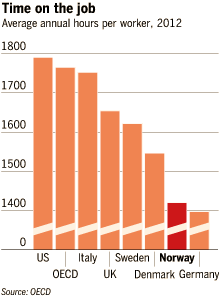
The trend is worrying the country’s policy makers and business executives. Norwegians work the third fewest hours in the developed world, according to the OECD. The hourly wage in manufacturing is the highest in the world, 40 per cent above Germany’s and about double that of the US, Japan, Italy or UK, according to the US Bureau of Labor Statistics.
The culprit? The same factor that has propelled Norway to become one of the world’s richest nations in a matter of decades: oil. The country’s experience provides salutary lessons for resource-rich nations, not least Scotland as it prepares for a referendum on independence this September.
Norway has won plaudits for how it has handled its oil riches, setting up what has become the world’s largest sovereign wealth fund and spending only a small proportion of that each year. It has been held up as the prime example of how a country can escape the oil curseor Dutch disease – when resource wealth kills off other productive parts of the economy.
But both in and outside the Nordic country there are growing concerns that it is slowly succumbing to a more subtle form of Dutch disease in which its rich and contented population works less, takes more sick leave and becomes complacent. That in turn leaves doubts about what the country will look like in a decade or two when the oil starts to run out.
“Things are going so well in Norway that we are moving industry and jobs abroad and we don’t care because we have things so good – but we are fooling ourselves,” says Ketil Solvik-Olsen, transport minister and deputy leader of the populist Progress party. “That is where Dutch disease comes in: it’s how we spend the oil wealth.”
Kristin Skogen Lund, head of national employers’ organisation the NHO and a former executive at Telenor, the Norwegian telecoms group, says: “It’s almost inevitable when things are going well for so long. My own children, 14 and 11, have never grown up with anything other than affluence. Of course it does something to us.”
Norway is certainly not in crisis. Its gross domestic product per capita is second only to that of Luxembourg, according to the International Monetary Fund. It has an unemployment rate of 3.5 per cent, lower than any EU member state. And its budget surplus – including use of money from the oil fund – is more than 10 per cent.
Its model of separating oil revenues from general government spending and putting most of that money into its $810bn oil fund for the benefit of future generations is widely praised. Scotland’s nationalists are only the latest of those seeking to emulate its approach.
Equally, the restraint exercised in using only 4 per cent of the fund’s assets each year in the budget has been lauded, even if 4 per cent today gives almost 10 times the return that it did a decade ago. “In the totality of things we have handled our oil wealth very well compared with other countries,” says Ms Skogen Lund.
Still, there are warning signs both in the short and long term. Despite the efforts to insulate the Norwegian economy from its oil wealth, economists think it is more and more dependent on petroleum. “The business cycles we see are synchronised with oil. We have shown just how dependent the Norwegian economy is on oil,” says Hilde Bjornland, a professor at BI Norwegian business school and an expert on oil’s impact on the economy.
Economists at Nordea, the region’s biggest bank, expect growth in Norway to slow this year compared with last year, in contrast with other Nordic countries. By next year Nordea forecasts that Norway will have the slowest-growing economy in the region with a rate of just 1.2 per cent. At the same time, Norway’s housing market is coming under pressure after a period of almost uninterrupted price growth for the past two decades.
These may be blips but there are several longer-term issues. One is the plight of Norway’s non-oil industries. Prof Bjornland, in a paper entitled “Boom or gloom?”, writes that there is no sign of Dutch disease but there is a very distinct two-speed economy.
That is a big concern for Ms Skogen Lund and her member companies. “What we call the two-track economy is a reality. There is such a concentration of investments in the oil sector and an investment drop in the rest.”
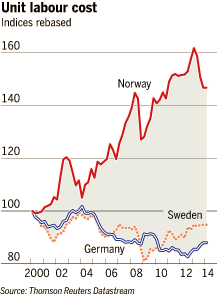
She worries about a loss of competitiveness, with manufacturing wages having soaredby 150 per cent since 1997 against just 50 per cent in the US and Germany. Ms Skogen Lund adds that wages are 60-70 per cent higher than the weighted average of Norway’s trading partners, meaning “that for every hour worked here we need to be 60 per cent more productive”.
. . .
The good news for Norway is that it is the most productive industrialised country in the world, with GDP per hour worked a third ahead of the US. It also enjoys extremely high labour participation rates for women, above the OECD average. The former Labour-led government was given to declaring that the large number of women in the workforce was worth more to the country than oil. “Much more important than oil and gas is that Norwegians are going to work every morning,” Jens Stoltenberg, the former prime minister, said in a speech on “Avoiding the oil curse” at Harvard University last year.

The bad news is that Norway’s GDP per capita hasstalled for the past five years
, as Oystein Olsen, Norway’s central bank governor, pointed out last February. “Growth is being supported by immigration and employment growth, and not by increased productivity,” he added. Head into any restaurant or corner shop in Oslo and you see his point – many of the workers are Swedish, attracted to Norway by the higher wages. “The Swedes have become the Turks of Norway,” says a leading Swedish industrialist, only half-joking.

 About bambooinnovator
 Bamboo Innovator