Why South Korea Will Be The Next Global Hub For Tech Startups
2/06/2014 @ 12:35PM 2,343 views
Why South Korea Will Be The Next Global Hub For Tech Startups
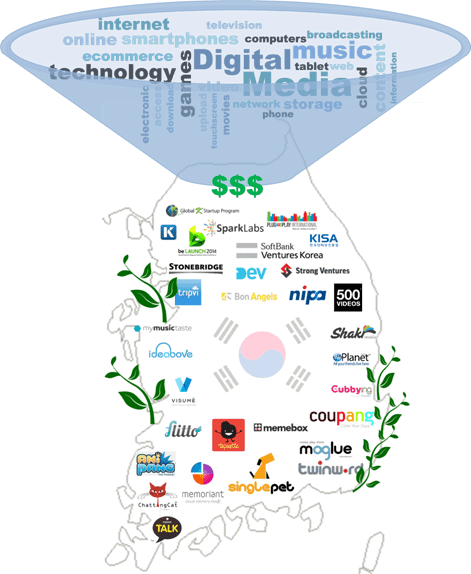
American business has long led the way in high tech density or the proportion of businesses that engage in activities such as Internet software and services, hardware and semiconductors. The US is fertile ground for tech start-ups with access to capital and a culture that celebrates risk taking. Other countries have made their mark on the world stage, competing to be prominent tech and innovation hubs. Israel has been lauded as a start-up nation with several hundred companies getting funded by venture capital each year. A number of these companies are now being acquired by the likes of Apple, Facebook and Google. Finland and Sweden have attracted notice by bringing us Angry Birds and Spotify among others. But a new start-up powerhouse is on the horizon – South Korea.
Bloomberg News recently published the Bloomberg Global Innovation Index and ranked South Korea first among all nations by comparing a group of indicators such as research & development capability, productivity, tech density and patent activity. South Korea’s ranking is not a surprise. In recent decades, South Korea has transformed into an economic heavyweight, having systematically applied substantial resources to research and development. As a result, South Korea has become the world leader in patent activity, and information and communication technology. The country has the highest broadband penetration in the world at 97 percent and is a leader in broadband speed with an average peak connection of close to 50 megabits per second.
Success in manufacturing and exporting cutting edge electronics products has burnished the country’s image as a leader in technology but the connection goes deeper. Koreans are avid consumers of digital media and apply the lion’s share of their bandwidth resources to online gaming. South Korea is home to the World Cyber Games, the world’s largest video game competition, and has three television channels fully dedicated to eSports featuring professional gamers. South Korea’s home grown, highly visual K-Pop music videos are streamed by the millions and have become a significant global export. Last year streaming of mok-bang
through Afreeca TV, a peer-to-peer online video network, became the rage. For the uninitiated, mok-bang videos feature self-made celebrities eating massive amounts of food for hours.
Increasingly young technologists are fueling a fledgling start-up scene that is led by mobile game developers and social media entrepreneurs. This is complemented by entrepreneurs returning from overseas with an eye on conquering the globe. These entrepreneurs are coming back with a sense of how to take on the US market, a greater willingness to assume risk, and an interest in building things that aren’t just made for Korea. This has attracted the interest of American technology companies. Google has taken an active role in nurturing South Korean companies, introducing their favorites in the US to help them build a global profile. A company called Sparklabs was formed a little over a year ago with offices in Seoul and San Francisco to incubate Korean start-ups.
There is a growing interest from overseas VCs in the South Korean venture ecosystem as well as a rise of angel groups, accelerators and event organizations to promote entrepreneurship in Korea. Softbank Ventures, StoneBridge Capital, and Strong Ventures are a few examples of established VCs moving to get a foothold in South Korea. My firm, Digital Entertainment Ventures, is pursuing a South Korea strategy as well. However, to fully understand the Korean venture capital industry, it is critical to recognize the important role of the government in promoting and supplementing private fund-raising and investment in the venture capital market. In 2013, South Korean President Park Geun-Hye announced the desire for a more “creative economy” and launched the new Ministry of Science, ICT and Future Planning. For 2014, the ministry’s budget increased to more than (USD equivalent) 12 billion, with over two billion going directly into fostering growth for the startup ecosystem along with elimination of many restrictions on the venture industry’s activities.
It is logical for South Korea to follow this path. The country is smaller than the state of New York, is not rich in oil or other natural resources, and has limited agriculture and manufacturing capacity. Korean’s must promote technology and innovation to be competitive as a nation since just trying to contend on cost or scale is likely to fail. While the South Korean Chaebols, or large family-controlled corporate groups, focus on exporting and manufacturing, there is a clear recognition that South Korea needs to have a more diverse economy. Thus, the tides are shifting towards supporting smaller businesses and promoting entrepreneurship.
Formulating new business ideas and inventing IP is only the first part of the equation. South Korea can ascend to the next level by developing a new venture ecosystem that provides operational support, a broader network and ready access to early stage capital; one that rewards risk taking by Korea’s best and brightest. These entrepreneurs have the opportunity to target new markets but they need to be funded and properly equipped to design their products for localization by language and culture. CEO’s of early stage companies need access to advisors that can assist them in creating effective pitch presentations and preparing them for exposure to foreign markets and investors. With the right blend of investment and guidance, early-stage Korean companies can take on the US and other global markets and really scale their businesses.
Many of the fundamentals are already in place. Just as Samsung transformed the consumer electronics business, Korean start-ups are poised to have an explosive impact on digital media and services.
Janny Lee, COO of Redbadge and an advisor to DEV, contributed to this article
 About bambooinnovator
 Bamboo Innovator