Nielsen has a near monopoly in measuring TV viewership — and a new growth plan; CEO Mitch Barns: “We have products that scale very well.”
February 9, 2014 Leave a comment
SATURDAY, FEBRUARY 8, 2014
Nielsen’s Measured Approach
By LESLIE P. NORTON | MORE ARTICLES BY AUTHOR
Nielsen has a near monopoly in measuring TV viewership — and a new growth plan. Shares could rise 40%.
“Words are words, explanations are explanations, promises are promises, but only performance is reality,” the celebrated businessman Harold Geneen once said. That accounts for the enduring popularity of the Nielsen TV ratings system, the flagship product of Nielsen Holdings . Nielsen’s ratings, prized by advertisers, are why the Super Bowl can charge $8 million for a minute of commercials. Nielsen’s enviable client list is topped by customers who’ve used its services for more than 30 years.
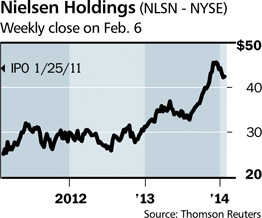
This year’s downdraft has created a tempting opportunity in Nielsen shares, which could easily rise to $48 from a recent $43.50, thanks to the company’s strong growth and plans to return capital to shareholders. Longer term, a case for a 40% increase is plausible. Says Pivotal Research analyst Brian Wieser, who upgraded Nielsen (ticker: NLSN) to a Buy last week: This is “a good entry point for short-term and long-term investors alike.”
CEO Mitch Barns: “We have products that scale very well.”
Founded in 1923 by Arthur Nielsen, who invented the concept of market share, Nielsen today operates in more than 100 countries. It consists of two main operations that measure performance: the so-called Buy business, which tracks spending at retailers as varied as Wal-Mart and street vendors in emerging markets, and the famous Watch business, which measures TV audiences. Watch is highly profitable, accounting for an estimated 42% of revenue but 62% of earnings before interest, taxes, depreciation, and amortization, due to Nielsen’s quasi-monopoly status.
To be sure, judging the size of audiences has become increasingly difficult, as people watch TV online and on mobile devices. Thus, upstarts like comScore (SCOR) have grown prominent measuring online usage. With so much at stake, Nielsen has stepped up its efforts to compete. For example, it recently reached an agreement with Google(GOOG) for Nielsen measurement across all of that company’s properties, including YouTube.
This fall, Nielsen will begin providing data about TV viewership on tablets and smartphones. And having recently purchased Arbitron, it can now track listeners of traditional and digital radio.
Nielsen has a near monopoly in measuring TV viewership — and a new growth plan; CEO Mitch Barns: “We have products that scale very well.”
Such moves are why Nielsen has hung on to its top 10 clients, including Coca-Cola, NBC Universal, and Procter & Gamble, for decades. Says CEO Mitch Barns: “We have a consistent business model that delivers steady growth, of which 70% is recurring revenues. We have long-term clients, a broad global presence, and syndicated products that scale very well.”
In addition to providing customers with data about what the famed Nielsen families are watching, the company tracks what they and others buy and marries it with data from credit-card companies and other providers. For example, Nielsen recently added Harris Interactive, the parent of the Harris Poll, to its arsenal.
Such initiatives help clients like Bob Rupczynski, vice president of media and consumer engagement for Kraft Foods, plan upfront buys for products like Oscar Mayer Lunchables and “shift our [advertising] inventory, based on what people have actually done.” Says CEO Barns: “That part of the business is underpenetrated and will start to contribute meaningfully to the overall growth rate. You can answer a whole new range of questions. All of that plays to our core strengths.”
Strong Ratings
Nielsen is using its strong free cash flow to pay down debt, buy back shares, and boost its dividend.
| Recent Price | $43.50 |
| 52-Week Hi-Lo | $46.20 -$31.38 |
| Market Value (bil) | $15.9 |
| Revenue 2013E (bil) | $ 5.7 |
| Net Income ’13E (mil) | $750 |
| EPS 2013E | $2.00 |
| EPS 2014E | $2.50 |
| P/E 2014E | 17.4 |
| DividendYield | 1.8% |
| E=Estimate. Source: Thomson Reuters |
|
This week, Nielsen is expected to report that 2013 revenue rose 2%, to $5.7 billion, with net income up 7%, to $750 million, or $2 a share. Those numbers will keep growing as the global economy recovers and new initiatives become popular with customers. “As media becomes more fragmented, with more types, on more devices, the ability to measure consumption is of increasing importance. They are effectively the only game in town,” says Andrew Peck, manager of the Baron Asset fund (BARAX), which owns the shares. Peck reckons that Nielsen’s earnings will jump to $3.89 a share in 2017, nearly double the level of 2013. At a price/earnings ratio of 16, which is the S&P 500’s median historical level and a lower multiple than they now fetch, the shares would be worth $62.
DRIVING NIELSEN’S GAINS is an expanding top line. Ad spending on TV will climb this year, with the Winter Olympics and political elections. Goldman Sachs expects 4% to 5% annual growth to be attainable in coming years, as the economies of Europe and the rest of the world rebound.
The Bottom Line
With rising earnings and a rising dividend payout, Nielsen’s shares could climb to $62 in two years, from a recent $43.50.
The company’s financial position is also improving. Nielsen came public in January 2011 after a 2006 leveraged buyout. Net debt has been cut by $2 billion, to $6.1 billion, or 3.9 times net cash flow. Barns wants to get that ratio below three. By 2016, annual free cash flow probably will hit $1 billion, from about $550 million last year, as profits from syndicated research pile up. Nielsen intends to spend 20% on debt repayment; 45% on dividends, which it expects to grow in the midteens; and 35% on buybacks.
Harold Geneen used to call growth the secret of happiness. Last year, Nielsen paid a 72-cent dividend. By next year, Goldman expects a payout of $1.22 a share—a 2.8% yield, based on the current quote. You don’t need a Nielsen study to know that would be popular with investors.
 About bambooinnovator
 Bamboo Innovator