Satya Nadella, Microsoft’s engineer chief: The cerebral new chief is charged with reviving the faltering tech group
February 9, 2014 Leave a comment
February 7, 2014 7:10 pm
Satya Nadella, Microsoft’s engineer chief
By Richard Waters
The cerebral new chief is charged with reviving the faltering tech group, writes Richard Waters
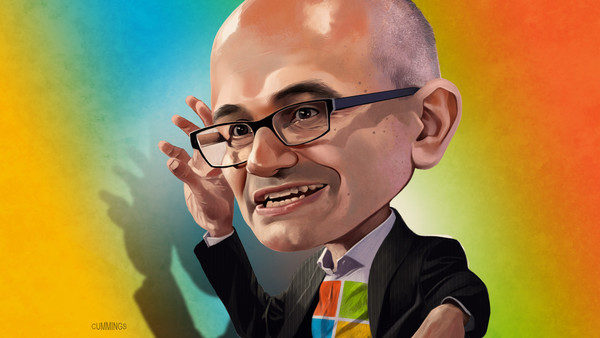
Talk to almost anyone who knows Satya Nadella
, the new boss of Microsoft, and sooner or later they will come up with the same observation: he is the anti-Steve Ballmer.
The man who has stepped aside after 14 years as head of the world’s biggest software company has always exuded an overabundance of energy, running the gamut from ebullience (jumping sweatily around a stage to inspire an audience) to temper tantrum (throwing a chair across the room when a lieutenant quits).
The thoughtful, Indian-born engineer who has filled his shoes is from a different mould. “In personal style, he’s the opposite,” says Reed Hastings, the chief executive of Netflix and a former Microsoft director. “Steve is boisterous. Satya is steady.” Steady hardly does it justice. Intellectually intense, he has a piercing gaze softened by a faint, slightly quizzical smile. If Mr Ballmer was the effervescent marketing dynamo, Mr Nadella is the quintessential engineer.
“He’s a cerebral guy, he’s not a pound-the-table kind of guy,” says John Connors, a former senior Microsoft executive. But along with the cool, he adds, Mr Nadella is “one of these rare guys” who is also business-savvy with “a strong emotional IQ”.
Whether that will be enough to put Microsoft back on top in the technology world is another question. While milking its giant Windows and Office businesses for cash, Mr Ballmer has left it to his successor to drag the company out of its PC past.
Running Microsoft has also become “insanely complicated” because of its wide range of products, says Mr Connors. Top that off with a company-wide reorganisation that is halfway to completion, and the task looks daunting. Within weeks, Mr Nadella will also inherit one of the thorniest parts of the Ballmer legacy: the acquisition of the struggling Nokia handset business and its 35,000 nervous employees.
At 46, the new Microsoft chief is one of the first Indian-born executives to make it to the top of the US tech industry – though engineers from the subcontinent have long supplied much of the brain power, figuring prominently in recent years among the founders of West Coast start-ups.
Born in Hyderabad, a centre of the Indian IT industry, Mr Nadella took a degree in electrical engineering at Mangalore University before moving to the US, where he went on to complete a masters in computer science and an MBA.
In a carefully airbrushed official biography and an introductory email to staff, he made much of his cricket obsession (he was once a right-handed off-spin bowler) and devotion to family. He wrote about his marriage to Anupama Priyadarshini – at 22 years, as long as his attachment to Microsoft – and three children, as well as what he called a “thirst for learning”.
When you have just got to the top, just about everyone has a good reason to talk well of you. But Mr Nadella, in particular, is “universally liked and respected” inside the company, says Matt McIlwain, a Seattle-based venture capitalist. Indeed, some are worried that he is too nice for the tough decisions ahead. Wall Street has pushed for cost-cutting and the spin-off of businesses such as the Xbox video games console. For much of the five months it took to find a new chief executive, many investors called for an outsider who would not be prevented by personal loyalties from making hard choices.
Popularity could be a sign that he ducked tough decisions on the way up, Mr McIlwain says – particularly at Microsoft, where clashing personalities have led to tensions at the top. Mr Nadella’s ability to rise without apparently making enemies along the way has left him in the right place at the right time.
People who have worked with him say this is not because he takes the soft option to avoid conflict. “He will demand a lot but do it in a very consensual way,” says Mr Connors. As Mr McIlwain concedes there is no way of telling whether this quality will survive the responsibilities and isolation that are about to hit him.
A deeply technical engineer with an eye for what is going on in corporate data centres, Mr Nadella is closely associated with the hottest trend reshaping the software world: the cloud. “If you love the cloud, you’ll love Satya Nadella,” says Mr Hastings, who points out that his first job was at Sun Microsystems, an early champion of the idea.
He is also credited with attacking technology orthodoxies at Microsoft. Those have included bringing Linux – the open-source software once seen as a mortal threat to the business – to Azure, its cloud platform. And, in a sign that the new boss wants to go further in ending insularity, people who have worked with him say he has an insatiable interest in the start-ups and new ideas bubbling up elsewhere in the tech industry.
He does not, however, have direct experience in the field most critical to Microsoft’s future: hitting back at Apple and Google in mobile computing.
One immediate test will be whether he can keep Bill Gates in his place. The Microsoft co-founder this week gave up his position as chairman but will take on a more active role as a technical adviser. People who have worked with both men say they have been able to work closely on big technical initiatives – for instance, when Mr Nadella ran the Bing search engine. “He’s perfectly able to stand up to Bill,” says Mr Hastings.
If Mr Nadella can hang on to the likeability, meanwhile, it could be one of his main assets in rebuilding Microsoft’s battered self-confidence. There was widespread relief at the company at the news of his appointment this week.
“They need this inspiration now,” says Mr McIlwain. “They’ve been in limbo mode, a little beaten-up, under-appreciated.” Bringing back the self-belief might not be enough on its own to put Microsoft back on a path to relevance in the tech world, but it would be a start.
What’s the fuss about, Satya Nadella’s father says
Sudipta Sengupta,TNN | Feb 8, 2014, 02.18 AM IST
HYDERABAD: The world could be going gung-ho over the extraordinary story of a mediocre student’s journey-from a public school in Hyderabad to the Microsoft headquarters in Redmond- but Satya Nadella’s father Bukkapuram Nadella Yugandhar
does not seem to understand just what this hoopla is about. So, while he is aware of the frenzy surrounding his 46-year-old son, the former bureaucrat chooses to remain oblivious to it all. He also fails to fathom how anecdotes about the new-crowned CEO’s childhood could be of any interest to the rest of the nation.
“I don’t know why I should speak about his (Satya’s) childhood. How is that even important,” the plainly-dressed Yugandhar told this TOI correspondent, waiting to get a dekho of the proud daddy, as he returned home after his daily hour-long evening walk at the KBR National Park nearby.
“Yes I wish him well, but that’s all I have to say,” the father retorted on being repeatedly asked for a reaction. “All this is unnecessary hype. I don’t understand why it is required,” he added. And before the next question could be posed at him, Yugandhar had turned away to head for the front door of his conventional south-Indian home, reeking of modesty – a term that’s become synonymous with the family over the past one week. “Please spare us now,” he finally said, as he walked in.
Though that might sound tad strange to some ears, who’d expect the father to be jubilant at this stage instead, Maqsood bhai insisted that quiet celebrations have been on within the four walls of the house.
“Sab bahut khush hai (everybody is very happy),” said Maqsood, a family driver for four years now. He had other things to share too, mostly about his bhaiya (Satya) who he claimed visited the city twice every year: once in October for work and once in December for a 15-day vacation.
“He is a gem of a man. Can speak fluent Hindi and Telugu,” Maqsood said, making no attempt to hide his pride while announcing how he played chauffeur to the Microsoft biggie, each time he came home. “Woh aache insaan hai. Jaane ke waqt hamesa khush hoke kuch deke jaate hai hume, (He is a nice man. Before returning to the US, he always gives us something as a sign of gratitude),” he stressed.
A glimpse of similar affection for the only son of the house was visibly on the face of mother Prabhavati Yugandhar too, when she made a fleeting appearance at the request of this correspondent. But much like her husband, the graceful lady neatly draped in a pink silk saree, refrained from commenting on the ‘Satya saga’. “It is best that you speak to my husband. He is my son, yes, but I would not wish to say anything else,” she said, courteously smiling all the while. Some joys, perhaps, are best felt in private.
Satya Nadella’s appointment: Celebrations ring out at Microsoft’s Hyderabad office
 About bambooinnovator
 Bamboo Innovator