Shale: miracle, revolution or bandwagon?
February 7, 2014 1:27 pm
Shale: miracle, revolution or bandwagon?
By Terry Smith
Investors are far from certain to make money from shale
Unless you have been in hibernation for the past few years you will have heard that there is a shale hydrocarbon “revolution” or “miracle” under way. Barack Obama, the US president, pledged support for shale gas development in his 2012 State of the Union speech. David Cameron has urged opponents of fracking to “get on board”.
“Fracking” has passed into the vernacular. The term was added to the Oxford English Dictionary last June. It involves releasing a high-pressure mix of water, sand and chemicals to crack rocks and release oil and gas from shale. Environmentalists have all sorts of objections to this practice. And there are other problems with the concept ofshale as a saviour
– either in terms of cheap energy or as an investment.
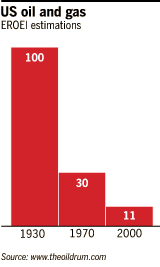
The first is the concept of “energy return on energy investment” or Eroei. This is the ratio of the amount of energy generated from an energy source to the amount of energy expended to obtain that energy. It is an important and mostly ignored ratio which determines both the efficiency of our economies – how much of our resources have to be expended into getting our energy – and the economics of energy exploration and generation.
The oil discoveries which took place a century or more ago were mostly in onshore locations, often in politically stable countries and close to key consumer markets. However, there is a natural tendency to pick the low hanging fruit first, and over time, oil and gas exploration and production has, out of necessity, moved to less hospitable and remote locations, which place logistical barriers between oil and gas and the markets.
Shale gas/oil and fracking are just an extension of this trend. US oil production had an Eroei of 100:1 in the 1930s – every hundred units produced required one unit to be expended. By 2000, despite huge technological advances, that had dropped to 11:1. The ratio for shale oil is about 5:1. This is a critical difference.
There is also the issue of depletion. An old trick in investment analysis is to ask whether an annual return of £20 for an investment of £100 is good or bad. Most people will say it is a good return. But you lack other vital information necessary to assess the investment: the asset life and maturity value. If the asset only lasts for three years and is then worthless, it is a bad investment, as you will only recoup £60 in total from £100 invested. If it lasts for 20 years, it’s a good investment, as you will recoup £400.
Asset life is critical to assess all investments. In the case of oil and gas exploration and production, it is the period until the well or field is no longer economically viable and has to be abandoned.
The steepness of decline in production rates for shale oil wells has been a surprise. A typical well in the Bakken Formation, North Dakota, drilled in 2012 is likely to be producing at less than 30 per cent of its initial production rate today. Recent disappointing performance relative to expectations at the newer Utica shale play in the northeast US and Canada mirrors this.
Investor returns on shale gas investments have broadly come in two main periods. From the discovery of most shale gas in 2002 until 2007, share prices of shale companies rose rapidly. Once the newly discovered gas came on stream, natural gas prices fell – and so did returns and share prices. The largest shale player in the UK is Cuadrilla Resources, which was founded in 2007 and is owned by AJ Lucas, Riverstone Holdings and Carlyle and is exploring for shale gas deposits in Lancashire. AJ Lucas, a quoted Australian company, owns 42 per cent of Cuadrilla. Its own shares are just a quarter of what they were worth in 2009.
Shale: miracle, revolution or bandwagon?
Nor is this disappointing performance limited to small companies. BP wrote off $1bn on shale in July 2012 whilst the Canadian company Encana said it lost almost $2bn on its shale gas assets in recent years. Shell is selling its stake in the Eagle Ford shale reserve in Texas, having written off more than $2bn on its assets there. It claims more than 200 wells are incapable of reaching their production target. Peter Voser, the former Shell chief executive, has said the rhetoric about the US shale revolution being exported to other countries was “hyped”, and that the rest of the world was in an early “exploration phase” which could yield “negative surprises”.
As the late Jimmy Goldsmith was fond of saying: “If you see a bandwagon, it’s too late.” The shale bandwagon may already have passed.
Terry Smith is chief executive of Fundsmith LLP
 About bambooinnovator
Kee Koon Boon (“KB”) is the co-founder and director of HERO Investment Management which provides specialized fund management and investment advisory services to the ARCHEA Asia HERO Innovators Fund (www.heroinnovator.com), the only Asian SMID-cap tech-focused fund in the industry. KB is an internationally featured investor rooted in the principles of value investing for over a decade as a fund manager and analyst in the Asian capital markets who started his career at a boutique hedge fund in Singapore where he was with the firm since 2002 and was also part of the core investment committee in significantly outperforming the index in the 10-year-plus-old flagship Asian fund. He was also the portfolio manager for Asia-Pacific equities at Korea’s largest mutual fund company. Prior to setting up the H.E.R.O. Innovators Fund, KB was the Chief Investment Officer & CEO of a Singapore Registered Fund Management Company (RFMC) where he is responsible for listed Asian equity investments.
KB had taught accounting at the Singapore Management University (SMU) as a faculty member and also pioneered the 15-week course on Accounting Fraud in Asia as an official module at SMU. KB remains grateful and honored to be invited by Singapore’s financial regulator Monetary Authority of Singapore (MAS) to present to their top management team about implementing a world’s first fact-based forward-looking fraud detection framework to bring about benefits for the capital markets in Singapore and for the public and investment community.
KB also served the community in sharing his insights in writing articles about value investing and corporate governance in the media that include Business Times, Straits Times, Jakarta Post, Manual of Ideas, Investopedia, TedXWallStreet. He had also presented in top investment, banking and finance conferences in America, Italy, Sydney, Cape Town, HK, China. He has trained CEOs, entrepreneurs, CFOs, management executives in business strategy & business model innovation in Singapore, HK and China.

 Bamboo Innovator