Winners and losers in the new China; Traditional state-backed industries are yesterday’s story
February 9, 2014 Leave a comment
February 7, 2014 6:21 pm
Winners and losers in the new China
By Rafael Halpin
“It will be very painful and even feel like cutting one’s wrist.” So predicted Li Keqiang, China’s premier, as he discussed the task ahead of him during his first press conference last March.
Not the most inviting prospect for investors looking to make a play on China. But they should certainly take heed of these words. Li is the man who, together with president Xi Jinping, must lead a reform programme regarded by analysts as the most fundamental in decades. It will affect almost every part of an economy worth $9.4tn (Britain’s annual output, for comparison, is $2.4tn).
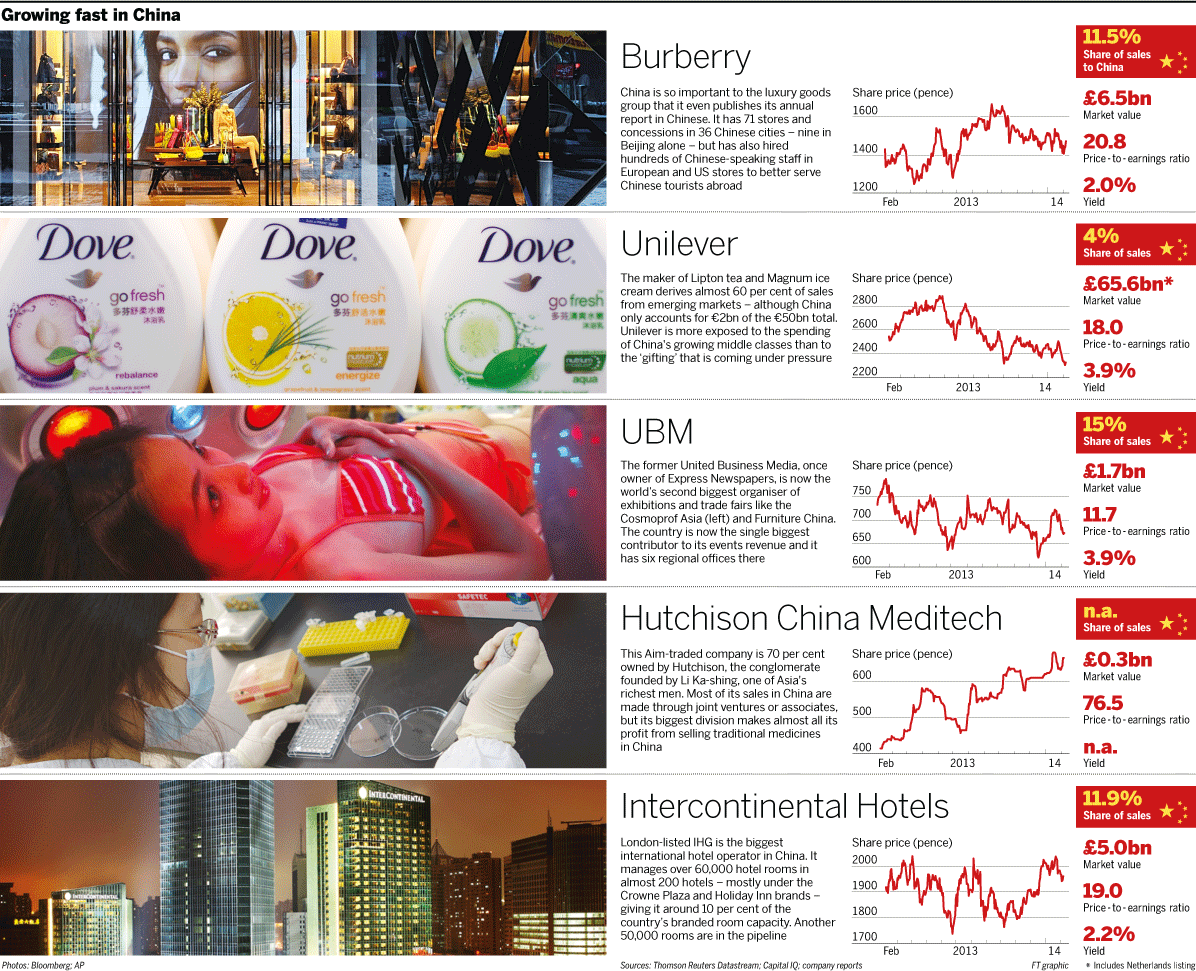
So what are these reforms? And why does China’s new leader think that their implementation will be so painful? There are three key areas which investors should note.
——————————————-
The shrinking state
The first area of reform is reducing the role of the state in the Chinese economy. There is a broad consensus among analysts – and, increasingly, among Chinese policy makers – that the government’s influence over key parts of the economy is threatening the health of the economic system.
Nowhere is this truer than in the role the government plays in dictating key prices in the economy. By letting the state rather than the market set the price of key resources, distortions have developed which now threaten economic growth.
The cost of borrowing, for example, has been kept artificially low by the government. Real lending rates since 2004 have averaged just 2.9 per cent, and at times have even fallen below zero. The consequences have been dire. Cheap money has encouraged a splurge of capital expenditure on fixed assets and infrastructure, which has led to high levels of overcapacity in many parts of the economy.
Prices of everyday essentials such as water, oil, natural gas, electricity and freight have also been kept artificially low to make Chinese manufactured goods competitive abroad and to keep a lid on domestic inflation. But such low input costs have encouraged rampant overproduction, with devastating consequences for the environment. Industrial air pollution is now at dangerously high levels in many of China’s urban areas.
This level of state intervention is increasingly regarded as unsustainable. But reducing it will not be easy; it was the curbing of the state’s reach that Mr Li likened to “cutting one’s wrist”. He was referring to a Chinese legend, in which a warrior who had been bitten by a snake cut off his hand to save the rest of his body.
Managers of those companies that have benefited from artificially cheap credit and energy will almost certainly feel like cutting their own wrists. As the market has a bigger role in setting prices – and the state a smaller one – input costs will inevitably rise. Companies in the industrial and manufacturing sectors – many still state-owned and woefully inefficient – will be particularly hard hit.
Companies will also face higher financing costs if lending rates are liberalised. While the official one-year benchmark rate for loans is currently 6 per cent, annual lending rates in the liberalised, unofficial, shadow banking system are generally above 10 per cent. State-owned giants which have enjoyed preferential access to cheap loans from unquestioning banks will struggle to access finance on more normal commercial terms.
——————————————-
Out of the shadows
The second and related area of reform is moves to rein in the country’s shadow banking system. For decades, lending by state-controlled banks was dictated by policy imperatives rather than the commercial considerations. That meant the funding needs of many private-sector areas of the economy were neglected, and an unofficial banking and finance system sprang up to serve those companies unable to secure capital from the official banking sector.
But lending in this shadow system is notoriously opaque. Most of the capital required for lending is raised not from conventional deposits, but from investment products sold to middle-class Chinese savers with little or no information as to where the money is invested or how the return is generated.
The shadow banking system is also increasingly used as an alternative lending channel by official banks, because it enables them to circumvent strict capital adequacy requirements and restrictions on lending to risky parts of the economy.
The combination of murky investment vehicles and a boom in risky off-balance sheet bank lending is raising alarm bells and forcing Beijing to take action. To understand why, look at the case of Credit Equals Gold No. 1, a shadow investment product sold through banks. It had loaned Rmb3bn (£304m) to a coal mine operator that collapsed, jeopardising the fat returns it had promised its investors. It was rescued – but it won’t be the last such case.
Curtailing the riskiest practices and making capital markets more transparent is going to hit a key source of lending; one reason the government backed away from an earlier confrontation. Analysts estimate than nearly a third of all bank loans originate in the shadow banking system. Government efforts to rein in shadow bank lending led to year-on-year growth in total social financing, slowing from a 19 per cent rate of expansion in the first nine months of 2013, to an 18 per cent contraction in the final three months of the year.
This resulted in a slower rate of growth in fixed-asset investment, with year-on-year growth moderating from 20 per cent to 18 per cent during the same period. Growth in the final quarter of 2013 was the lowest quarterly rate of expansion in seven years.
The slowdown in fixed-asset investment – new buildings, factories, ports, roads and the like – has been particularly bad news for the global commodities market. China is the world’s biggest market for most base and industrial metals, and soaring demand pushed prices for those commodities to record levels. That’s now moderating; copper prices have fallen by about a quarter from their 2011 peaks.
——————————————-
Consumption and corruption
Some analysts have described this trend as Chinese-style tapering. But reduced spending on new assets ties in with another of the leadership’s objectives: to rebalance the economy away from investment-led growth and exports towards one driven primarily by domestic consumption.
China is already a vast market for consumer goods, but there is still a long way to go – capital formation still accounted for more than half of GDP growth in 2013.
The final element in Beijing’s transformation plan is a big clampdown on corruption. This is partly a side-effect of moves to reduce the power of the state. By signalling that officials will no longer be allowed to personally gain from their influence over swaths of the economy, Beijing reduces one of the biggest obstacles to rolling back state power. It is also linked to social stability; anger has long been mounting in the cities over corruption scandals and in the countryside over illegal land seizures. When citizens start to question the legitimacy of the ruling Communist party, alarm bells ring – because the lesson of history from a Chinese perspective is that a disunited China is a subjugated China.
This anti-corruption drive has already had a marked impact on the consumer goods sector. Restrictions on official banqueting and gift-giving have hit companies such as Kweichow Moutai, China’s high-end spirit manufacturer that had previously profited from the culture of currying favour with officials by proffering expensive gifts. Other victims of the anti-graft drive have included restaurants specialising in “hairy crabs”and purveyors of golden chopsticks. Even the biggest companies aren’t immune; one employee at state-owned giant China Telecom recently complained that the office lunar new year party had been moved from a five-star hotel to the staff canteen.
The campaign has also curtailed demand for high-end goods by discouraging ostentatious displays of wealth among party officials. This has damped demand for imported luxury goods, from Swiss watches to French wine. Last year, the head of Asian operations for Samsonite, the US luggage maker, cautioned that sales in Chinawould moderate
amid the more austere climate.
Rafael Halpin is an analyst at the FT’s China Confidential
They might be giants? They already are
“It invests in fast-growing, consumer-related companies that reflect a vibrant China,” he says.
 About bambooinnovator
 Bamboo Innovator