The Connected TV Landscape: Why Smart TVs And Streaming Gadgets Are Conquering The Living Room
February 11, 2014 Leave a comment
The Connected TV Landscape: Why Smart TVs And Streaming Gadgets Are Conquering The Living Room
MARK HOELZEL FEB. 7, 2014, 10:31 PM 2,425 3
Connected TVs are on pace to take over the television viewing experience. There will be more than 759 million televisions connected to the Internet worldwide by 2018, more than double 2013’s number, according to Digital TV Research.
The first wave of connected TVs, called “Web TVs,” failed because they assumed that people would use their televisions as a computer, by browsing the Internet and reading email. Now, a new generation of Internet-enabled TVs is succeeding. These connected televisions enhance the everyday experience of watching television by offering a better viewing experience for your favorite programs and movies, as well as an alternative way to interact with music and photos.
In a new report from BI Intelligence, we dissect the connected TV landscape, analyzing the factors, trends, and key players that are shaping the market. We explore the explosive growth of streaming devices, such as Google’s Chromecast and Apple TV, and compare it to the growth smart TVs from manufactures like Samsung and Vizio. We also examine the relationship between connected TVs and the pay TV industry.
Here are some of the key takeaways from the report:
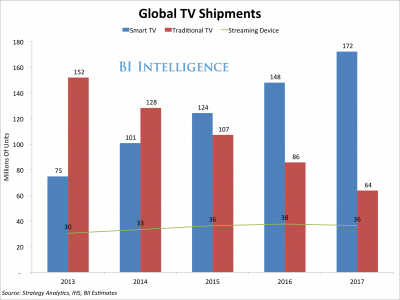
Streaming devices currently comprise the majority of connected TVs. But we believe distribution will shift to smart TVs, as prices decrease and the television upgrade cycle shortens.
Apple TV and Roku hold the largest market share for streaming devices, but Chromecast, which Google released last summer, has also achieved stellar sales numbers. Market research data shows that 8 million Apple TVs and 4.5 million Rokus shipped in 2013 in the U.S.
Smart TVs will account for the majority of television shipments by 2014. By 2015, more households will have smart TV than connected TVs.
On both streaming devices and smart TVs there is a division between open and closed platforms. Chromecast, LG, and Roku have embraced open platforms that allow developers a great deal of freedom to develop apps for their devices. Samsung, Apple, and others are betting on closed ecosystems, which follow a more careful curatorial approach.
Despite platform fragmentation, HTML5 offers at least a faint hope for increased unification between connected TVs, just as it does on mobile. LG and Chromecast have integrated it into their connected TV development environments.
How will developers and operating system operators monetize smart TV apps? Media downloads, subscriptions and — to a much lesser degree — advertisements will drive the dollars. Smart TV platform operators have begun experimenting with ads.
Changes to the pay TV industry, namely cable and satellite providers, will also have a huge impact on the future of connected TV. It’s now an open question as to how — and how effectively — cable providers will use their power to shape the future of connected TV.
In full, the report:
Outlines the connected TV landscape as it stands today and how it will change in the near future.
Highlights the key players, platforms, and devices that are shaping the connected TV market.
Looks at the latest streaming devices to come to market and how each has altered the TV landscape.
 About bambooinnovator
 Bamboo Innovator