Asian Group Tries to Stem Rubber’s Swoon; Bangkok-Based Group Urges Members Not to Sell After Commodity’s Prices Drop on Signs of Economic Slowdown in China
February 12, 2014 Leave a comment
Asian Group Tries to Stem Rubber’s Swoon
Bangkok-Based Group Urges Members Not to Sell After Commodity’s Prices Drop on Signs of Economic Slowdown in China
HUILENG TAN
Feb. 10, 2014 7:13 a.m. ET
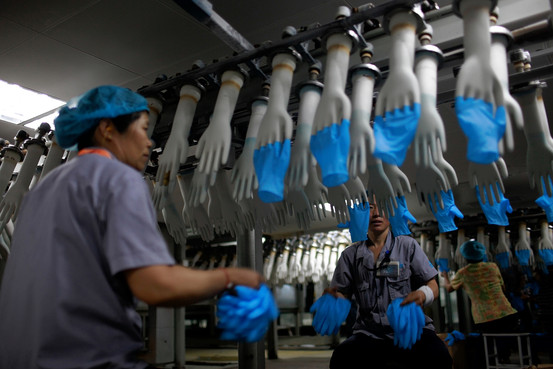
LOOKING FOR A BOUNCE: The Bangkok-based International Rubber Consortium told members not to sellthe commodity, an effort to stem a plunge in the price of rubber. Above, a glove assembly line in Zibo, ChinaReuters
The Southeast Asian cartel that controls the majority of the world’s rubber production urged its members not to sell the commodity, to help stem a plunge in prices so far this year.
Natural rubber, used to make items from tires to latex gloves, has been under pressure in recent weeks due to increasing signs of a slowdown in China, the world’s biggest buyer of the industrial commodity.
While that is a boon for companies that buy the product, it threatens to cut the incomes of farmers who rely on the rubber crop for their main income, and who have protested in the past when prices have dropped.
After a weekend meeting, the Bangkok-based International Rubber Consortium, which helps set production and export levels and acts like the OPEC of rubber, stepped in and said prices are now “unreasonably low” given that inventory levels in Thailand, Indonesia and Malaysia already are low and may fall further. Less supply typically helps bolster prices as demand chases fewer stocks.
“[We] would immediately advise respective trade associations in the [three] countries to jointly encourage their members not to offer natural rubber at prevailing low prices,” said the organization, which represents more than two-thirds of the supply of natural rubber.
The statement was a confidence booster, sending global benchmark Tokyo rubber futures up by as much as 3.0% Monday, just days after hitting a 171/2 -month low Thursday. Themarket is valued at more than $30 billion a year and is the second-largest tropical crop after palm oil. Benchmark futures are traded in Japan and physical trading takes place primarily in Southeast Asia.
“Prices have fallen by so much that market sentiment was very negative, so investors just needed a government [authority] to say something,” said Gu Jiong, an analyst at Tokyo-based brokerage Yutaka Shoji Co. 8747.TO +2.66%
Rubber futures on the Tokyo Commodity Exchange are still 17% lower year to date, and the slump this time of the year is especially unusual as prices typically rise now because it is the so-called wintering season when rubber trees shed their leaves and output slows to a trickle.
“The low stock level would be further aggravated in the coming months with wintering expected to be severe in the three producing countries,” the organization added.
It also has said in recent days that it is trying to work with Vietnam, where rubber production is rising fast and presents another potential source of supply that could destabilize prices further.
Telling rubber traders to not sell at current low prices shouldn’t be a challenge as farmers tend to tap the trees less when prices are low. Plus, many rubber farmers in Thailand have already put down tools to join political rallies in the capital against the ruling government, placing a further strain on supply.
In the past, they also have complained about the price of rubber, with the last major protesttaking place from late August to early September last year.
The Thai government has in the past few years implemented measures which includedbuying rubber at above market rates
and providing subsidies for replanting, which reduces production in the short term.
 About bambooinnovator
 Bamboo Innovator