Banking on good sense and a prayer; As head of ICICI Bank, India’s biggest privately owned lender and the nation’s second largest by assets, 52-year-old Chanda Kochhar is a vastly influential figure in her native country.
February 12, 2014 Leave a comment
Banking on good sense and a prayer
Tuesday, Feb 11, 2014
Ravi Velloor
The Straits Times
The global leaders and the famous who flock to the Swiss resort of Davos for their annual conclave in January have often spotted a slim Indian woman, draped in the traditional sari, glad-handing key decision-makers and customers between meetings.
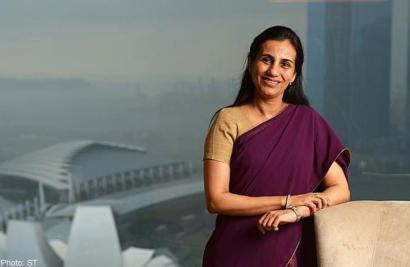
As head of ICICI Bank, India’s biggest privately owned lender and the nation’s second largest by assets, 52-year-old Chanda Kochhar is a vastly influential figure in her native country.
Out on the Alpine mountaintop, however, her presence signifies more than yet another corporate star networking with others similar to her.
Indeed, in many ways she is a national statement for the India that unshackled itself from socialist shibboleths and threw opportunities in the way of its young, including the women it had suppressed for centuries.
Mrs Kochhar, born to the principal of an engineering college in the small, tradition-bound city of Jaipur, capital of Rajasthan state, is emblematic of that cohort.
Recruited from Mumbai’s Jamnalal Bajaj Institute of Management Studies by ICICI Ltd, a lender to industries, she was the first in her family to be a banker.
Later, when ICICI Ltd got a commercial banking licence, she was Employee No.1 for the new ICICI Bank.
The new firm soon marked itself out as an aggressive player in a market dominated by staid state-owned lenders, catching the eye of investors like Singapore’s Temasek Holdings in the process.
In that male-dominated, high-testosterone environment she thrived, successfully handling a variety of assignments. Early in her career, as head of ICICI’s western region, she made a presentation to her bosses on the changes she had implemented.
Then chief executive officer K.V. Kamath interrupted her: “Who did you ask before doing all this?”
“Nobody,” she responded.
Mr Kamath congratulated her on the initiative.
That reputation for clear thinking and decisive action helped her rapidly pierce glass ceilings until, in 2009, she was appointed CEO of the bank.
It wasn’t the happiest of times for ICICI.
In the aftermath of the global financial crisis, the market worried about its solvency. Its US$80 million (S$101 million) exposure to Lehman Brothers notes, though a fraction of its balance sheet at the time, weighed on investor sentiment. Rivals joked that Mrs Kochhar’s practice of using her commute time to read the Satyanarayan Katha, a Hindu prayer to Lord Vishnu, the Preserver, was well-directed.
It was a situation that needed a cool mind, even temper, deep faith and a resilience that comes only to those trained in the school of hard knocks.
Perhaps Mrs Kochhar, who lost her father at age 13 and, in the tradition of many northern Indian women, keeps an annual fast for her husband’s longevity, was just the right person.
“We did have twin issues,” she told The Sunday Times in a recent interview, sitting with back erect in her suite at the Ritz Carlton hotel. “One was the crisis in the financial markets. The other was ICICI Bank itself – clearly there was a crisis of perception.”
Her response was twofold. First, to handle the perception issue, she communicated at every level – from the regulator to the smallest rural customer – that the crisis was contained and that the exposure to Lehman was minimal. The second was to change the strategic direction of the bank itself.
“We focused on consolidating the balance sheet,” she says. “We cut off the very volatile bulk deposits and focused on a secure portfolio, building granular deposits such as CaSa – the current accounts and savings accounts – which are far less volatile. It really meant a hardworking model because we were building one part of the balance sheet while cutting back on the other side.”
Just two years earlier, at a Singapore investor conference, the ICICI mantra had been all about sustaining “leadership position in credit franchise” and “leveraging corporate relationships”.
Instead, she began to preach a new way of thinking: Cut volatile bulk deposits, improve credit quality and conserve capital.
Today, she says, CaSa has doubled to 40 per cent, putting ICICI Bank among the best four in the industry. Net interest margins have risen to 3.3 per cent and return on assets has doubled to 1.75 basis points.
That puts the bank on a path towards sustained profitability.
“I changed the definition of growth,” says Mrs Kochhar. “We still remain a driven organisation but we just redefined what we wanted to grow.” Alongside, she spent time winning stock analysts to her strategy. While some thought she had taken the bull energy out of the bank, others endorsed her approach.
The recent quarterly profit announcement has given her further vindication. On Jan 29, ICICI Bank declared a record profit of 25.3 billion rupees (S$516 million) for the three months ended Dec 31 last year, a 13 per cent gain from the year earlier.
In an investment climate skittish about the impact of the United States Federal Reserve’s quantitative easing and the rout in emerging market, ICICI Bank shares have dropped just 12 per cent in the year to date, according to Bloomberg Analytics. That compares favourably with crosstown rival HDFC Bank, regarded as India’s best-run lender, whose shares dipped 28 per cent in the same period.
Still, Mrs Kochhar has some distance to travel before she can stare down the redoubtable Aditya Puri, a former Citibanker who has run HDFC Bank since its inception in 1994.
HDFC Bank’s profit, while slowing to its smallest pace in a decade, still grew 25 per cent in the December quarter.
Her gross bad loan ratio, at just over 3 per cent, has improved from the previous year’s but is still about three times higher than that of HDFC Bank.
Mrs Kochhar will have to work on those numbers even as the banking landscape around her is changing swiftly. A decade ago, for instance, 95 per cent of customer transactions used to take place inside the branch. Today, that figure is less than 15 per cent.
“In the first five to seven years, most of the migration was from the branch to the ATM channel,” she says. “Since then, the biggest pickup is in the Internet and mobile banking channels. But the biggest transformation to come is really in how we do our rural business.”
India, it is said, lives in its more than half-a-million villages. New government policies such as rural work guarantees and food subsidies are linked to individual identity cards being promoted across the vast nation.
That gives financial companies opportunities to give customers a basic account, channel their earnings and spending, then build up a credit history to offer more sophisticated financial products.
It is an exciting opportunity.
“Not just rural incomes, rural consumption is rising also,” she says. “I think we have just scratched the surface as far as the rural markets are concerned.”
A third of ICICI Bank’s some 3,500 branches are in rural or semi-urban areas, as are half of all new branches coming on stream.
What is her management strategy? And how much of it is ruled by instinct rather than reason?
“It has to be a bit of both,” Mrs Kochhar confesses. “You should know when to stop asking for more and more data, and use your instinct. As when we decided to strengthen the balance sheet rather than just go after growth. It wasn’t a totally proven path and you had to have the gumption to go for it and implement it.”
The mother to two children, now growing into adulthood, she gives much credit to her husband Deepak, her business school classmate, for robustly backing her career and the recognition that has come with it, including a seat on the Indian Prime Minister’s Advisory Council on Industry and figuring in Fortune magazine’s 50 Most Powerful Women in Business three years running.
“It takes a very confident man to not feel threatened about your spouse’s success,” she says.
Juggling motherhood and a career also wasn’t always easy. Some days, she says, you just had to live through the guilt of not being at your son’s school for an event. Other days, you decided you would not go in to work because your daughter was ill.
And what of those saris in cold Davos, when women corporate leaders, even in much warmer India, feel more confident in pantsuits?
“I find it a beautiful and graceful outfit,” she says. “I think I am best-dressed in a sari.”
 About bambooinnovator
 Bamboo Innovator