Australia Manufacturers Forced to Look Beyond Big Auto Makers
February 21, 2014 Leave a comment
Australia Manufacturers Forced to Look Beyond Big Auto Makers
RHIANNON HOYLE And ROSS KELLY
Feb. 11, 2014 7:38 a.m. ET
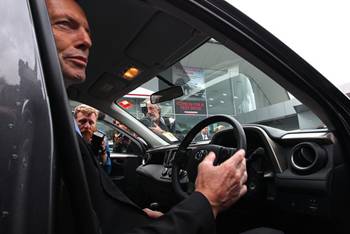
Tony Abbott, then leader of the Australian opposition, sat in the driver’s seat of a locally made Toyota on Aug. 30 in Melbourne, Australia. Lisa Maree Williams/Getty Images
Brake-maker Peter O’Connor is remarkably upbeat amid the doom that has descended on Australia’s auto industry after Toyota Motor Corp. 7203.TO +0.43% said it would stop producing cars in the country.
Mr. O’Connor said the writing was on the wall long before the Japanese auto makerannounced Monday it would join U.S. rivals Ford Motor Co. F +0.81% and General MotorsCo. GM +1.00% in departing the country in the next few years, ending nearly a century of auto-making here.
“It’s a shame, but you can’t stick your head under a rock and say it’s going to go away,” Mr. O’Connor, the general manager of Sydney-based Disc Brakes Australia said.
Until last year, the company was supplying products to Holden, the Australian division of GM, for use in its sporty HSV-model sedans.
But it had already decided to focus on niche products of higher value for racing enthusiasts before the plant closures were announced, Mr. O’Connor said. Disc Brakes now exports high-performance brakes to the U.S. and Russia.
End of the Line
A history of auto production in Australia
1856 James Alexander Holden starts saddlery business in Adelaide that evolves from repairing car upholstery to producing vehicle bodies.
1925 Ford Australia founded in Geelong, Victoria.
1931 General Motors and Holden merge.
1958 The construction company Theiss Brothers starts importing Toyota LandCruisers to work on the Snowy Mountains hydroelectric-power project.
1963 Melbourne factory produces first Toyota ever built outside Japan.
1974 Annual auto production in Australia peaks at about 500,000 vehicles.
1992 Nissan pulls out of Australia.
2008 Mitsubishi Motors pulls out of Australia.
2010 Australian dollar reaches parity with the U.S. dollar.
2012 Annual production falls to about 200,000 units.
2013 Ford and GM both say they’ll end production in Australia.
2014 Toyota says it will withdraw by end of 2017.
The company is one of a number of Australian manufacturers who have realized they must diversify or die amid a broader reordering of the global auto industry. As new centers of auto production emerged in developing markets such as China over the past decade, less competitive regions have declined.
In Australia, the previous center-left government invested heavily in propping up the country’s auto industry, but a September change in government brought a different approach.
Conservative Prime Minister Tony Abbott resisted calls from manufacturers for more aid to help keep plants open and insisted companies take responsibility for their own futures.
His stance has been criticized by opposition lawmakers and unions who warn of a 21 billion Australian dollar (US$18.9 billion) hole in the economy and a loss of up to 45,000 jobs—both direct and indirect—if the auto industry dies.
The demise of auto manufacturing in Australia coincides with a sharp slowdown in the country’s resources industry following a long investment boom. The economy expanded by 2.3% in the year through September, much slower than recent annual rates as high as 4% in 2012. Unemployment is hovering close to financial-crisis highs as falling commodity prices have prompted mining companies to shed workers and shut mines.
Australia’s manufacturing industry employs close to 1 million people, about 50,000 of whom are involved in the auto sector, according to government figures. Manufacturers have been battered in recent years as the Australian dollar has traded at historic highs above parity against the U.S. dollar, making Australian exports less competitive.
Melbourne-based MtM Pty. Ltd., which makes auto products such as gear shifters, began looking for new overseas customers in the 1990s, when Nissan Motor Co.7201.TO +2.03% ceased manufacturing in Australia. At the time, the business was 100% reliant on local car makers, Managing Director Mark Albert said.
After securing buyers from North America to India, the company started looking to nonautomotive markets such as leisure and marine craft to boost sales in 2006, Mr. Albert said. Auto makers such as Toyota and Holden now account for only half of its business, a share the company expects to shrink to about 30% by the end of the year.
“We made a conscious decision to win other business, but that took a very long time,” Mr. Albert said.
Not all manufacturers have the ability to diversify away from auto manufacturing, however. Car parts maker Autodom Ltd. was placed into administration in late 2012 and liquidated last year, citing declining automotive volumes.
“If you’re a business that’s geared to just making trim clips [fasteners for door panels or fender guards] for [local auto companies], it’s very hard to get out of it,” said Mr. O’Connor, of Disc Brakes Australia.
The Federation of Automotive Products Manufacturers, an industry body, estimated about 33,000 jobs in the automotive supply chain could be at risk as car makers withdraw from the country.
“The whole industry is in jeopardy,” said Richard Reilly, chief executive of the group, which was formed in 1958 and has about 80 members.
“Many have tried over a number of years to diversify out of the sector—tried to diversify into other markets, or internationally—but not everyone has been able to do that.”
Greg Lowe, general manager of South Australia-based auto-parts maker TI Automotive Australia, said there were limits to diversification. “You can’t stop what you have been doing for 60 years—it’s not realistic,” said Mr. Lowe, whose firm bought new equipment to make nylon hose products in 2012, after years of making brake and fuel lines out of steel. “The important thing a lot of people forget is that you tend to have to diversify around what you already do. So if the industry dies, it all goes.”
 About bambooinnovator
 Bamboo Innovator