On Looking: Eleven Walks with Expert Eyes
February 24, 2014 Leave a comment
On Looking: Eleven Walks with Expert Eyes Hardcover
by Alexandra Horowitz (Author)
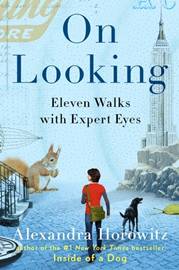
From the author of the giant #1 New York Times bestseller Inside of a Dog comes an equally smart, delightful, and startling exploration of how we perceive and discover our world.
Alexandra Horowitz’s brilliant On Looking: Eleven Walks with Expert Eyes shows us how to see the spectacle of the ordinary—to practice, as Sir Arthur Conan Doyle put it, “the observation of trifles.” On Looking is structured around a series of eleven walks the author takes, mostly in her Manhattan neighborhood, with experts on a diverse range of subjects, including an urban sociologist, the well-known artist Maira Kalman, a geologist, a physician, and a sound designer. She also walks with a child and a dog to see the world as they perceive it. What they see, how they see it, and why most of us donot see the same things reveal the startling power of human attention and the cognitive aspects of what it means to be an expert observer.
As the million-plus readers of Inside of a Dog have discovered, Alexandra Horowitz is charmingly adept at explaining the mysteries of human perception. Trained as a cognitive scientist, she discovers a feast of fascinating detail, all explained with her generous humor and self-deprecating tone. On Lookingpresents the same engaging combination, this time in service to understanding how human beings encounter their daily worlds and each other.
Page by page, Horowitz shows how much more there is to see—if only we would really look. On Lookingis nutrition for the considered life, serving as a provocative response to our relentlessly virtual consciousness. So turn off the phone and other electronic devices and be in the real world—where strangers communicate by geometry as they walk toward one another, where sounds reveal shadows, where posture can display humility, and the underside of a leaf unveils a Lilliputian universe—where, indeed, there are worlds within worlds within worlds.
Alexandra Horowitz’s On Looking confirms her place as one of today’s most illuminating observers of our infinitely complex world.
Editorial Reviews
From Booklist
It is charming to take a walk with Horowitz. Engaging, amusing, and relatable, the psychology professor guides readers through 11 urban walks in the company of various experts. Beyond simply looking, this is about what makes up the world around us and the foundations of human perception. Horowitz brings the same attention to the human brain as she brought to our canine companions in Inside of a Dog (2010). She makes cognitive functioning eminently understandable by unraveling the role expectation plays in limiting what we see. The experts she walks with, from scientists to a toddler and a dog, reveal the underpinnings of a wide range of urban phenomena, such as the uncanny ability of rats to avoid traps. The descriptions of the walks are detailed but not overlong, with just enough information to give a taste of a geologist’s or typographer’s expertise. Even when relying only on your own inexpert eyes, you will look at the world with more attention after reading these fascinating essays, though it’s likely you still won’t be able to find millennia-old worm tracks or recognize the fishlike behavior of pedestrians. –Bridget Thoreson
Review
“Supplemented by recent research in cognitive psychology and biology, her book is an informative and often charming 21st-century Thoreauvian guide on how to transform physical transport into mental and sensory transportation — and ‘be here now.'”
– Glenn C. Altschuler, The Oregonian
“In this elegant, entertaining book, Horowitz exhorts readers to learn, or to re-learn, how to see what we pass as we walk through our cities and towns.”
– Boston Globe
“Horowitz writes like a poet, thinks like a scientist, and ventures like an explorer. Her book will have you looking in a new way at the world around you, and make you glad you did.”
(Susan Orlean Rin Tin Tin)
“These eleven exquisite, clever and and tenderly recounted small adventures remind me of something I learned back when I lived in India: the need to perceive “the scent behind the smell.” Alexandra Horowitz has attempted much the same thing with her eyes – much aided by the seeing of others – and has in consequence become increasingly successful in perceiving what one might call “the sight behind the scene.” Her resulting epiphanies are available to us all, if we take care to learn from her, in this lovely book, just how it is done.”
(Simon Winchester author of The Map that Changed the World and Krakatoa)
“Alexandra Horowitz’s new book is as wonderful as her first. Inside of a Dog helped us to imagine the worlds of our beagles, collies, greyhounds and mutts. On Looking teaches us that the world is just as rich, strange and charmed when seen through the eyes of our local artists, doctors, architects and toddlers. On Looking also teaches us that Alexandra Horowitz is a writer to watch.”
(Jonathan Weiner author of Beak of the Finch and Long for this World)
About the Author
Alexandra Horowitz is the author of the bestselling Inside of a Dog: What Dogs See, Smell, and Know. She teaches psychology, animal behavior, and canine cognition at Barnard College, Columbia University. In New York City, Alexandra walks with her husband, the writer Ammon Shea, her son, and two large, non-heeling dogs.
Excerpt. © Reprinted by permission. All rights reserved.
Amateur Eyes
You missed that. Right now, you are missing the vast majority of what is happening around you. You are missing the events unfolding in your body, in the distance, and right in front of you.
By marshaling your attention to these words, helpfully framed in a distinct border of white, you are ignoring an unthinkably large amount of information that continues to bombard all of your senses: the hum of the fluorescent lights, the ambient noise in a large room, the places your chair presses against your legs or back, your tongue touching the roof of your mouth, the tension you are holding in your shoulders or jaw, the map of the cool and warm places on your body, the constant hum of traffic or a distant lawn-mower, the blurred view of your own shoulders and torso in your peripheral vision, a chirp of a bug or whine of a kitchen appliance.
This ignorance is useful: indeed, we compliment it and call it concentration. Our ignorance/concentration enables us to not just notice the scrawls on the page but also to absorb them as intelligible words, phrases, ideas. Alas, we tend to bring this focus to every activity we do—not just the most complicated but also the most quotidian. To a surprising extent, time spent going to and fro—walking down the street, traveling to work, heading to the store or a child’s (or one’s own) school—is unremembered. It is forgotten not because nothing of interest happens. It is forgotten because we failed to pay attention to the journey to begin with. On the phone, worrying over dinner, listening to others or to the to-do lists replaying in our own heads, we miss the world making itself available to be observed. And we miss the possibility of being surprised by what is hidden in plain sight right in front of us.
It was my dog who prompted me to consider that these daily journeys could be done . . . better. Bring a well-furred, wide-eyed, sharp-nosed dog into your life, and suddenly you find yourself taking a lot of walks. Walks around the block, in particular. Over the last three decades, living with two dogs, my blocks have been classic city blocks—down the street and three right corners and home; they have been along sidewalked small towns and un-sidewalked, hilly villages. But what counted as a “block” was changeable. Heading out for what I imagined would be a quick circumnavigation, I often found myself led elsewhere by my dog: our “blocks” have become tours of city parks, zigzagging meanders through canyons, trots along the sides of highways, and, when we were lucky, down narrow forest paths.
After enough waylaid walks, I began trying to see what my dog was seeing (and smelling) that was taking us far afield. Minor clashes between my dog’s preferences as to where and how a walk should proceed and my own indicated that I was experiencing almost an entirely different block than my dog. I was paying so little attention to most of what was right before us that I had become a sleepwalker on the sidewalk. What I saw and attended to was exactly what I expected to see; what my dog showed me was that my attention invited along attention’s companion: inattention to everything else.
This book attends to that inattention. It is not a book about how to bring more focus to your reading of Tolstoy or how to listen more carefully to your spouse. It is not about how to avoid falling asleep at a public lecture or at your grandfather’s tales of boyhood misadventures. It will not help you plan dinner for eight as you listen to books-on-tape and as you consult the GPS—all while you are driving.
In this book, I aimed to knock myself awake. I took that walk “around the block”—an ordinary activity engaged in by everyone nearly every day—dozens of times with people who have distinctive, individual, expert ways of seeing all the unattended, perceived ordinary elements I was missing. Together, we became investigators of the ordinary, considering the block—the street and everything on it—as a living being that could be observed.
In this way, the familiar becomes unfamiliar, and the old the new. My method took advantage of two elements. The first is inherent in each of us. We all have the capacity to really see what is in front of us. On moving to a new home, one’s first approach is wide eyed—with senses alert to the various ways that this new block differs from one’s old home: the trees provide more shade, or the cars are more plentiful, or the sidewalks are leaner, or the buildings are more deeply set back from the street. It is only after we have moved in, after we have walked the same street again and again, that we fall asleep to the block. Even the feeling of time passing changes on our walk: with less to notice, time speeds up. The capacity to attend is ours; we just forget how to turn it on.
The second element takes advantage of individual expertise. There is a certain bias in everyone’s perspective that has been named, by the French, déformation professionnelle: the tendency to look at every context from the point of view of one’s profession. The psychiatrist sees symptoms of diagnosable conditions in everyone from the grocery checkout cashier to his spouse; the economist views the simple buying of a cup of coffee as an example of a macroeconomic phenomenon. In the wrong context these experts are merely the people you try to avoid sitting next to at a dinner party. But applied to this project, these people are seers: able to bring attention to an element of a person’s manner, or to a social interaction, that is often missed.
I live and work in a city—New York City—and thus have a special fascination with the humming life-form that is an urban street. To investigate, I took all the walks for this book in this and other cities, around ordinary blocks. My companions on these walks were people who have a distinct perspective on the world. Often, it was a perspective forged from explicit training, as with a doctor. For others, their sensibility was shaped by their passion—finding insect tracks or studying lettering, for example. Finally, for some, the way they see the world is part of their very constitution, as with a child, a blind person, or a dog. What follows is the record of eleven walks around the block I took with expert seers, who told me what they saw.
• • •
Well, twelve walks. I began by walking around the block by myself. I wanted to record what I saw before I was schooled by my walking companions.
The air was already drunk with humidity when I stepped outside on that first morning. I chose to walk the blocks around my home because they are not particularly special blocks; I have a certain fondness for my neighborhood blocks, born of familiarity, but even as they have grown familiar, I realize that I rarely look at them. Nonetheless, I was sure that I would be able to describe them well. My eyes were not altogether amateur: I was knowingly walking to “see what I could see” and, furthermore, professionally I study animal behavior using a method that is, in essence, looking closely. On this walk, I set off at a slow pace with a reporter’s notebook in hand, planning to reconstruct the scene later. Feeling wide eyed, I turned down the block.
My eyes rested first on the bags of trash by our curb. Shredded, formerly private papers were visible in their clear recycling bags. A beagle pulling on a long leash trotted by and unceremoniously defined the corner of the trash pile by urinating on it.
I scribbled down something about flowers in a tree pit. When I looked up, I was at the corner, flanked by two large, somber apartment buildings. I briefly coveted a free parking spot, a gaping space between cars along the curb. There was no decoration in front of the near building save two pipes—one a humble water pipe, the other a mysterious two-headed gnome. I did not investigate. A child scurried by. I was passed by a series of dog-person pairs, headed toward the park that was now at my back.
The walkers trod silently; the dogs said nothing. The only sound was the hum of air conditioners. A pretty, red brownstone, with a gracious, curved stoop, sat between a large stone building and a handful of white- and red-bricked specimens. But I barely looked up. There was too much to see on the ground. Each building on the block was marked by its characteristic pile of bags of trash. Something dribbled from each: a Q-tip (how does a Q-tip escape? I wondered), a chicken bone, sundry crumpled papers. I saw another Q-tip, and started to wonder about the ear health of my neighbors. As I continued, the trash piles grew messier, or the sidewalk narrower, or both. Moving aside to let someone pass, I was nearly seated in a small alcove along a building—perhaps a place to sit, but it was lined with spikes. I did not sit there.
I approached the next intersection, Broadway, a wide avenue with traffic running both directions. An older gentleman was resting in the median, unable to make it across both lanes of traffic in one go. As he resumed, he teetered, and I swung widely around him so as to not knock him off course.
Across the avenue, continuing east, a few commercial stores had escaped onto the side street: a small grocery, a rash of crushed cigarette butts outside its door; a hair salon, with a long awning to its entrance, oddly formal for a haircuttery. A stream of cars reversed its way down the block, some vehicles pulling into parking places and some backing heedlessly onto the avenue. I smelled trash. The sounds of a garbage truck straining to crush its load wafted from up ahead. A spill of spaghetti, cooked and sauced, formed a sunburst at my feet, attended to by a cluster of pigeons.
The garbage truck was out of sight, but it left a path of garbage leavings—marking the meals, cleaning habits, and unwanted memories of the h…
 About bambooinnovator
 Bamboo Innovator