Can Reader’s Digest return to its glory days with Frisky 50s? New owner Mike Luckwell spells out plan to expand 76-year-old UK publication into new fields after buying it for a nominal sum
February 25, 2014 Leave a comment
Can Reader’s Digest return to its glory days with Frisky 50s?
New owner Mike Luckwell spells out plan to expand 76-year-old UK publication into new fields after buying it for a nominal sum
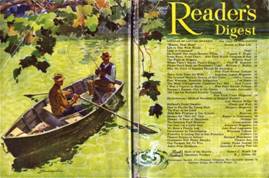
Reader’s Digest was first published in 1938 in the UK
3:54PM GMT 17 Feb 2014
In an episode of the 1960s period drama Mad Men, an advertising executive puffs on his cigarette and curses a crackdown on tobacco marketing.
“So what if Reader’s Digest says [cigarettes] are dangerous? They also said Bambi was the book of the century,” he spouts, cursing the series of investigations by the title into tobacco’s health effects.
At the time in question, Reader’s Digest was one of the world’s most popular journals, with its British edition alone boasting a circulation of millions.
Like the excesses of New York’s advertising industry, however, the publication’s better days are now behind it.
The UK edition, which has been printed for 75 years, was this weekend sold by John Moulton’s private equity firm Better Capital for a nominal fee to the media veteran Mike Luckwell, just four years after Better Capital bought it out of administration.
Mr Moulton’s management team had little success turning Reader’s Digest around, despite the title’s administration freeing it of a £125m black hole in its pension fund.
In selling Reader’s Digest for next to nothing, Better Capital has written off £23m of investment in under four years. After paying £14m for in 2010 and investing an extra £9m since, Mr Moulton claims it is “not worth the time and effort” it now takes to run.
The magazine, now best known for lining doctors’ waiting rooms with recipes, financial advice and health tips, has seen UK circulation fall from over 400,000 when Better Capital took control to less than half that number, according to industry figures.
Last year, it cut three-quarters of its print staff in London and entered a company voluntary agreement in order to avoid a second administration after closing its CD and DVD sales business.
It is not only the UK edition of Reader’s Digest that has run into trouble. RDA Holdings, the parent company of the US edition which owned the UK business before selling it to Better Capital, filed for bankruptcy 12 months ago, the second time in four years it had done so. To save the business, RDA swapped most of its $465m (£278m) debt for shares.
Mr Luckwell seems to be facing an uphill battle, but appears to have the pedigree to make Reader’s Digest a success. After founding his own production business, The Moving Picture Company, in 1970, he made his fortune building up and selling stakes in Carlton Communications and WPP.
Other investments have included HIT Entertainments, which produced Bob The Builder, and the Riverside health centre chain, sold for £61m in 1997.
Mr Luckwell now believes he can quickly turn Reader’s Digest UK profitable. He plans to focus on an untapped part of the reading public, what he calls the “frisky over-50s” who are increasingly active and under-served by other media groups.
“Over-50s have a very different life than they did 20 years ago,” Mr Luckwell said. “People over 65 are jumping out of aeroplanes now, it’s a younger type of audience with a ridiculously high proportion of the wealth and only 10pc of advertising.”
He plans to reboot the Reader’s Digest product sales business, a year after it was shut by Better Capital, and will invest in its online services, potentially charging for access to its website. He also plans to expand into financial services, pointing to the success of the insurance group Saga, which has its own magazine.
“I looked at the [financial services] market and where it intersects with my background in media, I looked around and I could only find Saga, so let us hope I can have a few of their crumbs,” he said.
No matter how successful Mr Luckwell is in reinvigorating the publication, Reader’s Digest is unlikely to return to its 20th Century glory days. But he is determined that one of the most recognisable names in media will not die out.
 About bambooinnovator
 Bamboo Innovator