Samsung Builds Retail Clout in Europe, North America
February 25, 2014 Leave a comment
Samsung Builds Retail Clout in Europe, North America
South Korean Technology Giant Tries to Expand Presence in Two of Its Largest Markets
WILL CONNORS in Toronto and SAM SCHECHNER in Paris
Feb. 18, 2014 12:22 a.m. ET
Samsung Electronics Co. 005930.SE +0.78% became the world’s biggest smartphone maker largely without the help of its own retail stores.
Now, faced with a horde of cheap, new rivals and the prospect of slowing growth, it is trying to increase its clout among consumers by expanding its retail presence in two of its largest markets—Europe and North America.
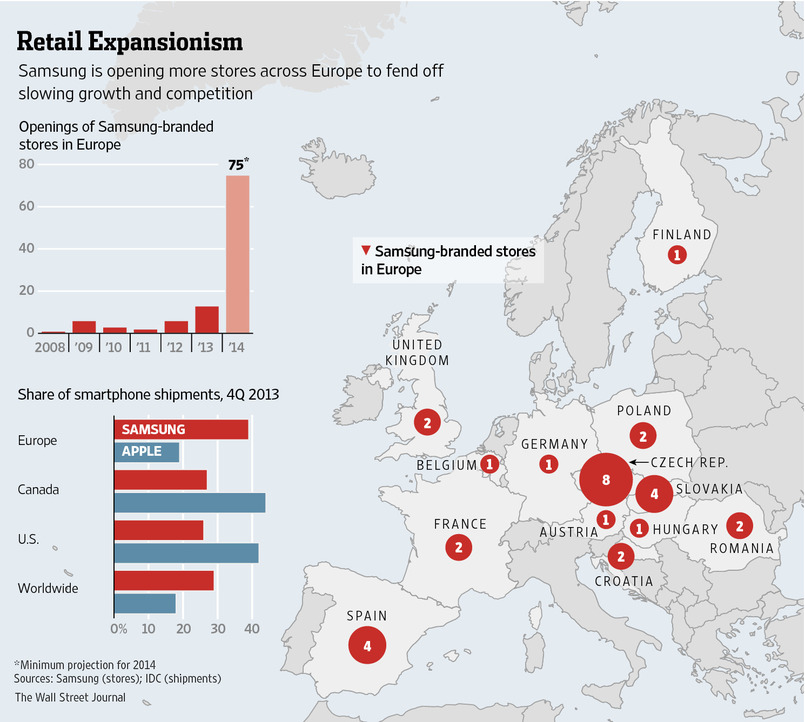
The South Korean technology giant plans to triple its footprint of 31 stores in Europe in the coming months, and will open 90 kiosks within big box retail chains Best Buy Inc.BBY +0.08% and Future Shops in Canada by the spring, executives told The Wall Street Journal. In the U.S., Samsung has joined with Best Buy to set up 1,400 prominently displayed “store-in-store” kiosks, complete with Samsung-trained staff. At one new shop near the Guggenheim museum in Bilbao, Spain, enamel-white tables are festooned with the company’s latest gadgets, from TVs and smartphones to its Galaxy Gear smartwatch.
Samsung’s retail push comes amid increasing pressure in the smartphone market from a wave of new handset makers that sell lower-priced phones based on Google Inc.GOOG +0.36% ‘s Android operating system. In the fourth quarter, the company’s profit growth slowed sharply due to stiff competition in the mobile market, where it derives the majority of its profits.
Samsung doesn’t disclose smartphone shipments, but analysts estimated the company sold anywhere between 85 million and 87 million smartphones in the fourth quarter, giving it almost a third of the global smartphone market share. But in the U.S. and Canada, Samsung still lags Apple AAPL +0.94% in smartphone sales.
Apple had 42% of the U.S. smartphone market in the fourth quarter, according to research firm IDC, while Samsung had 26%. In Canada, Apple had 44% of the market compared with Samsung’s 27%. In Europe, Samsung’s smartphone market share was 39% in the fourth quarter, compared with Apple’s 19%.
In the past, Samsung relied primarily on shelf space in carrier shops for its sales. But as it feels the pinch from competitors, the company, which also makes memory chips, flat-screen televisions and displays, is looking to carve out a stronger retail identity not tied to any one carrier or retailer.
In some ways, Samsung is taking a page from Apple’s playbook. Apple gained a reputation as a premium brand through its 420 global retail stores, which it designs and runs itself. Apple’s stores drew total revenue of $7 billion in the fiscal first quarter ended Dec. 28 and generated average revenue of $16.7 million per store. It had 21,000 weekly visitors, on average, to each store.
But unlike Apple, Samsung doesn’t own the vast majority of its stores, nor profit directly from them. Instead, the company says it leaves management of its shops to outside companies, overseeing them to make sure the stores have a consistent feel. Apple, by contrast, is deeply involved in managing its stores—from interior design to on-site technical help.
In December, Samsung hired Tim Gudgel away from Apple, where he played a key role in designing Apple’s retail stores. Mr. Gudgel, who is now Samsung’s vice president and general manager of retail sales in the U.S., declined to be interviewed for this article. Samsung doesn’t disclose the number of its stores globally, but overall retail sales accounted for about a quarter of its third-quarter revenue of 59 trillion won ($55 billion).
The retail expansion in Europe and North America come as Samsung has over the years succeeded in elevating its brand image through its retail stores across Asia. In Seoul alone, there are more than 100 Samsung stores. Samsung brand shops are also found across mainland China, Taiwan and Hong Kong. After first experimenting with “store-in-store” kiosks within retail outlets, the company is now opening more stores with its own logo, where consumers can try out its smartphones, tablets and cameras.
“It is a good showcase for their product, and a place to get technical help,” says 69-year-old Hubert Candeliez, who was among a dozen or so customers browsing and getting help from staff in blue polo shirts on a recent afternoon in Samsung’s Paris shop in the ritzy neighborhood of Madeleine. “But it isn’t a place to buy something that you can do anywhere,” the former textile-business owner said.
In Europe, Samsung-branded stores have been slowly opening since 2008 in cities including Frankfurt and London. But openings are now set to accelerate rapidly with at least 75 additional openings planned for the coming months, Samsung said.
The stores are helping to generate buzz. Last fall, the Paris shop was mobbed by a few hundred customers for the launch of the company’s large-screen smartphone, the Galaxy Note 3.
Last week, Samsung opened a new retail store in one of the largest malls in North America, in Edmonton, Canada. That follows the opening of its second shop outside Vancouver earlier this month. To coincide with the Winter Olympics, the Edmonton store opening featured a hockey tournament and a ribbon-cutting ceremony hosted by a former member of the Canadian Olympic hockey team.
“The markets where Samsung is really buying up more shelf space, Apple is particularly strong, so I don’t think that is a coincidence,” says Kevin Restivo, an analyst at market research firm IDC. “Canada is a smaller market, one where you can experiment a bit more, with an eye on the U.S.”
The first Canada store opened in 2012 after a Samsung kiosk set up during the Winter Olympics in 2010 generated considerable interest, according to company executives. And while sales from carrier stores make up the bulk of the company’s phone sales, results from the Vancouver store have “exceeded our expectations for a stand-alone store from a sales and profitability standpoint,” says James Politeski, the president of Samsung Canada. He declined to give specific figures.
Samsung Canada stores are operated by GLENTEL Inc., GLN.T -1.12% a Canadian retail company that also operates stores in the U.S. and Australia.
 About bambooinnovator
 Bamboo Innovator