‘Brands must personify themselves’; In the past, we used to focus on how brands came to life through identity, which is relatively simple. Now, we have brands having conversations with people across digital media, so the brand actually has a voice
February 27, 2014 Leave a comment
2014-02-23 14:15
‘Brands must personify themselves’
By Kim Bo-eun
Korean companies do not dare to voice out opinions on social or political issues for fear of offending the government, businesses or customers.
However, branding consultancy Interbrand’s chief marketing officer (CMO) says more global brands are developing human personalities that voice their stance on various issues, and these personalities can help brands stand out and succeed.
“At its simplest form, a powerful brand feels like it’s a person coming to life. And brands are increasingly finding opportunities to personify themselves,” Interbrand CMO Graham Hales told The Korea Times’ Business Focus in an interview.
He cited Google’s gay pride message on the opening day of the Sochi Winter Olympics as an example. The rainbow-colored Google logo with illustrations of winter sports athletes appeared on the Google search page in the U.S. and Russia on Feb. 6. Below the search field was a quote from the Olympic charter that partially read: “The practice of sport is a human right. Every individual must have the possibility of practicing sport, without discrimination of any kind.”
“In the past, we used to focus on how brands came to life through identity, which is relatively simple. Now, we have brands having conversations with people across digital media, so the brand actually has a voice,” said Hales.
Developing corporate personality
Consumer goods company Procter & Gamble (P&G) successfully established itself as a family-friendly brand during the 2012 London Summer Olympics, and once again during this year’s Sochi Winter Olympics through its “Thank You, Mom” campaign. The series of commercials focus on the mothers’ love and support behind athletes’ success and has created a loving, supportive personality for the brand.
“I think it’s an interesting example of a brand that used to be seen as a corporate brand with quite a long distance from customers. People would want to go and work at P&G, but we didn’t pick up a bottle of detergent and say ‘I’m going to buy this because it’s a P&G one,’” said Hales.
“P&G has recognized that there are opportunities for brands that were once more corporate to assume a larger role.”
It’s not easy to create a likable brand personality that will win the hearts of the majority, but it’s even harder to develop a very distinct brand personality that takes a stance on specific social and political issues.
Like Google, U.S. telecommunications giant AT&T spoke against discrimination against homosexuality. However, while Google’s approach was a degree more subtle, using its logo and a quote to convey its opinion, AT&T issued a clear public statement against Russia’s anti-gay law through the company’s official blog. The Russian law bans pro-homosexual propaganda that could be accessible to minors.
“Russia’s law is harmful to LGBT (lesbian, gay, bisexual and transgender) individuals and families, and it’s harmful to a diverse society,” the statement read.
AT&T became the first major Olympic sponsor to condemn an Olympic host country’s law. Other major sponsors such as Coca Cola and McDonald’s took a less direct approach by issuing general statements against discrimination or in support of LGBT rights.
While developing distinct brand characters can be beneficial, issuing statements on sensitive issues can become tricky due to potential negative business implications. However, Hales said, doing so would be less challenging if the brand clearly knows its customers.
“If your brand is clear and you know your customers well, you know how to navigate the issues and can declare the brand’s opinion with conviction and confidence. Conversely, if a brand isn’t clear and doesn’t know its customers, the situation becomes fraught and high risk,” he said.
“Brands need to see this as an opportunity rather than a challenge. It offers brands the potential to deepen their relationship with their audiences, but it does require the brand to have clarity and confidence in its communications.”
Social media and the mobile web are creating a new dimension of communication for brands. Not only do statements and videos go viral in a matter of seconds, they elicit instant feedback and start dialogue with and among consumers, which has far-reaching impacts for brands.
“Companies need to recognize their role as more rounded citizens. In the past, brands may have operated in more linear ways, but every touch point of a brand has a role to play in delivering the brand, and social media now means brands can be more conversant than ever before,” said Hales.
Brand identity is about a brand’s direction, purpose and meaning, but brand personality is more about its emotional characteristics. The latter differentiates companies with similar brand identities and explains why consumers like certain brands even if there appears to be no physical difference from other brands.
“Brands will try and show personality as they come to market so that you get a sense of what they are like and whether they are the sort of organizations you want to do business with. The more human organizations can feel, the easier it would be for us to empathize with them.”
Personification is what makes a brand strong. Strong brands create significant value for organizations, and that’s why strong brands are the best performing brands, according to Hales.
“The brands on Interbrand’s Best Global Brands outperform those on other stock market indices because they are stronger brands,” he said. “These are businesses that create superior returns for their organizations with low risks attached to them.”
Global sports events as brand platforms
With state leaders, businesses and civic groups participating in discussions on Russia’s anti-gay law, the Sochi Olympics has demonstrated how global sports events now represent much more than nations and athletes and thus, have become platforms that present important opportunities for brands.
“There are a lot of voices going into what was once regarded as sporting occasions,” said Hales. “Sochi is something of a landmark.”
The upcoming FIFA World Cup in Brazil and Incheon Asian Games in Korea are similarly bound to serve as important platforms for dialogue. Animal rights groups have already started movements even with more than six months left until the Asian Games.Koreandogs.org has submitted a petition to boycott the Asian Games over Koreans’ consumption of dog meat.
“When it comes to sponsorship opportunities, brands not only need to understand how their target market responds to those games, the efficiency attached to the sponsorship and the basic math side, but also see how they can use it to bring their brand personality to life,” he said.
The Asian Games, in particular, will enable Korean brands to get closer to their supporters because of the proximity of the brands to the participating countries.
For the Olympics or the World Cup, sponsorships tend to become thematic because brands support sports all over the world, but when it comes down to the local level, it is easier for brands to get home nation support, Hales said.
“As part of a fan base, you’ve got to put yourself in the heads of the fans. Brands have to demonstrate that they’re true supporters as opposed to just existing corporations. This will trigger a lot more emotion than just doing things in a predictable or gray fashion,” he added.
“The braver you can be with your sponsorships, the more powerful they can become.”
Growing importance of brands in Korea
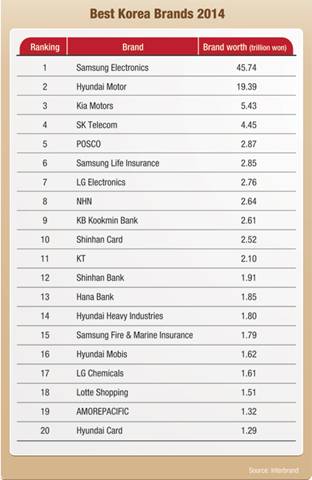
The number of Best Korea Brands has grown to 50 this year from 30 a year earlier, when the index for Korea was launched. According to Interbrand’s announcement Thursday, the top 50 brands’ value amounts to 116.9 trillion won. Hales said the fact that more businesses are qualifying for the ranking demonstrates they are taking brands more seriously.
“I have a lot of respect for Korean companies — they have grown incredibly quickly within a tough global environment. Korean businesses are household names around the world and are recognized for providing excellent quality products,” he said.
Samsung Electronics topped the list for the second consecutive year, with a brand value worth 45.7 trillion won, a 23 percent growth from 2013. Following was Hyundai Motor and Kia Motors, with each achieving 23 percent and 18 percent in growth. The top three brands were on Interbrand’s top 100 Best Global Brands for 2012 and 2013. Samsung ranked 8th in 2013 and its vision for 2020 is to make it in the top 5.
“Samsung has a very strong sense of understanding about what Samsung is and what it should be progressing into in the future. It’s a significant achievement for the company to be publicly stating its ambition in six years time,” Hales said.
 About bambooinnovator
 Bamboo Innovator