Looking both ways: Governments’ relationship with the tech sector is hideously complicated
February 27, 2014 Leave a comment
Looking both ways: Governments’ relationship with the tech sector is hideously complicated
Feb 22nd 2014 | From the print edition
IF THERE IS an industry that exemplifies the virtues of the private sector, it is technology. In the past 30 years a wave of innovations has transformed the lives of consumers in the developed world, allowing people to engage in a huge range of activities by using devices they can hold in their hand.
Governments’ role in pushing forward technological progress has been widely underestimated, as Mariana Mazzucato shows in her book, “The Entrepreneurial State”. The first computers were developed by governments, as were jet engines, nuclear power and lasers. The internet grew out of ARPANET, a project nurtured by America’s Defence Department. It took government-launched satellites to enable global positioning systems to work. Touchscreen technology was invented by academics with the help of government funding. Even the algorithm that made Google so successful was created with the aid of a grant from America’s National Science Foundation.
The state is very good at funding basic scientific research and at helping fledgling companies, many of which are too small, or still too far from profitability, to attract the interest of the venture-capital industry. A report by the President’s Council of Advisers on Science and Technology commented that “industry generally invests only in developing cost-competitive products in the three-to-five-year time frame.”
Most people accept that the private sector is best placed to turn that basic research into commercial products. But government interaction with the technology sector does not stop there.
A digital Domesday book
The internet has created the greatest treasure trove of personal data ever assembled—a Domesday book for the 21st century. Most consumers, initially reluctant to hand over data to buy goods online, have long since got used to the idea. People happily publish their likes and dislikes, their pictures and the names and contact details of their best friends on social media. Such data are invaluable for companies that want to target their marketing more closely. Thanks to technology, companies can even find out where people are at any particular moment.
But that raises serious questions. Who should be responsible for the data’s security? And should there be limits on how they can be used? Governments have been alert to this problem from the earliest days of the internet, but recent European draft legislation looks far too heavy-handed. Every business covered by the rules will have to appoint a data-protection officer at an estimated cost of €80,000 a year, according to the European Small Business Alliance. Businesses with fewer than 5,000 data points are exempt, but even a small outfit with a mailing list of customers could easily exceed that.
Germany has 16 Länder, each with its own data-protection commissioner who can interpret the rules in his own way. In Bavaria websites must allow users to remain anonymous. That is a problem for Facebook users, because the networking site insists that customers use their own names.
Governments play a triple role in all this. They represent consumer rights, but they also expect the corporate sector to provide a raft of data when they have security concerns, and in addition they track e-mail and phone conversations directly. Such data can be helpful to monitor terrorists and tax cheats, but in the hands of an unscrupulous government they can be used to keep an eye on dissidents as well. And if a government is careless, those data can be pre-empted by fraudsters and other undesirables. This debate has been fuelled by the revelations of Edward Snowden, a former National Security Agency contractor who leaked details of American surveillance operations to the media.
If the state has proved less than trustworthy, private companies are not perfect either. Some have lost large amounts of customers’ data, either by accident or because they have been hacked. The records of more than 100m customers each were stolen from Sony and Target. But Luc Delany, a former Facebook employee who now works as a consultant, points out that companies have a strong incentive to get it right. If people lose trust in a business, the brand will suffer. Companies are walking a fine line, trying to meet the authorities’ requests for information but being open about it (see chart 4). Apple, for one, revealed last year that it had received requests for information from 31 governments. The vast majority came from America’s.
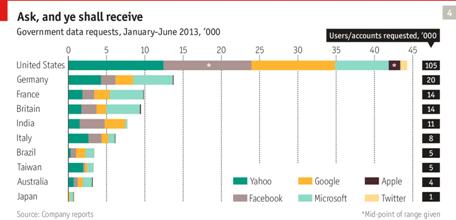
As the internet penetrates ever deeper into people’s lives, such issues will become increasingly important, raising a raft of questions. Should service providers be responsible for offensive messages posted on platforms such as Twitter? What can be done about child abuse online, given that many of the sites concerned are based offshore? If internet companies help authorities in the West track down dangerous individuals, will that encourage authoritarian regimes elsewhere to demand access to their critics’ personal details?
The internet may be the ultimate instance of globalisation. Its flexibility makes it very difficult to monitor, with new sites springing up all the time. And as a weapon it can be used by anyone, from protesters who want to undermine governments to disgruntled customers who want to give companies a bad name.
In many such instances governments may want to intervene and companies could find themselves on the defensive. It is an area where a number of different principles—free speech, the right to privacy, the freedom to innovate—collide. The trade-off among these principles will have to be negotiated within each country and by each individual, but in an interconnected world there may be no satisfactory answer.
 About bambooinnovator
 Bamboo Innovator