Taiwan independence group topples Sun Yat-sen statue
February 27, 2014 Leave a comment
Taiwan independence group topples Sun Yat-sen statue
Sunday, February 23, 2014 – 20:54
AFP
TAIPEI – A radical Taiwanese independence group said on Sunday they had pulled down a statue of the founding father of the nationalist republic who fled from the Chinese mainland to the island more than six decades ago.
The event, which was condemned by politicians and supporters of the ruling nationalist Kuomintang (KMT) party, illustrates how hostility towards Beijing still runs deep within some Taiwanese circles, despite years of improving ties between the two former foes.
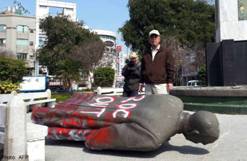
The bronze statue of Dr Sun Yat-sen had stood for over half a century at a park in the southern city of Tainan, until it was pulled down in a surprise raid on Saturday.
Dozens of independence activists launched a surprise attack, using a rope to topple the 600-kg statue which was splashed with red paint and covered in protest signs reading: “ROC out, KMT down”.
The Republic of China (ROC), the official title of Taiwan, was founded by Dr Sun in the Chinese mainland in 1911. Chinese nationalist forces later fled to the island in 1949 at the end of a civil war with Mao Zedong’s Communists.
The park has long been a flashpoint between nationalist groups and supporters of the Kuomintang party, who view Dr Sun and fellow nationalist leader Chiang Kai-shek with reverence but are loathed by radical independence groups.
“This action is to show our support of the victims of the February 28 Incident,” said Tsai Ting-kui, head of the radical Alliance for Referendum to Safeguard Taiwan.
Mr Tsai was referring to a tragedy that took place in 1947, when riots erupted across the island after a KMT inspector beat a female vendor in Taipei for selling untaxed cigarettes.
Thousands were killed in the February 28 massacre which remained taboo for decades under the late nationalist KMT leader Chiang Kai-shek’s rule. He died in 1975 after governing the island for 26 years and February 28 was later made an official holiday.
In 1998 the park gained another statue of Tang Teh-chang, one of thousands of people killed by Chinese nationalist troops in a 1947 massacre. It was also renamed after Tang.
Since then the Sun statue, like many statues of Chiang, has become the target of attacks by independence groups. Last year it survived an attempt by the Tainan city government to remove it when dozens of Kuomintang supporters guarded it around the clock for weeks.
Ties between Taiwan and China have improved markedly since 2008 after Ma Ying-jeou of the China-friendly Kuomintang party came to power on platform of beefing up trade and tourism links. He was re-elected in 2012.
China has emerged as the leading trade partner of the export-reliant island, absorbing more than 40 per cent of the goods it sold abroad.
But despite the fast thawing tensions, various surveys show that a great majority of people in Taiwan have said “no” to Beijing’s offer of the island be reunited with the Chinese mainland.
Taiwan became a fully-fledged democracy in 1996 after the first direct presidential election.
 About bambooinnovator
 Bamboo Innovator