Kim Yuna and the Korean art of suffering; How Kim Yuna’s Olympic loss weighs on the heart of a nation.
March 1, 2014 Leave a comment
Kim Yuna and the Korean art of suffering
How Kim Yuna’s Olympic loss weighs on the heart of a nation.
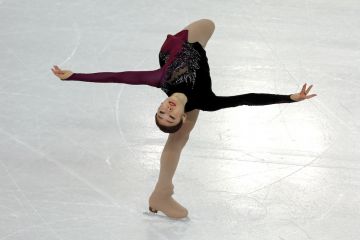
South Korea’s Kim Yuna performs in the Women’s Figure Skating Free Program at the Iceberg Skating Palace during the Sochi Winter Olympics on February 20, 2014. (Adrian Dennis/AFP/Getty Images)
SEOUL, South Korea — Call it the gasp heard round the world.
Olympic fans were aghast when Russia’s Adelina Sotnikova took the figure skating gold medal over South Korean uber-star Kim Yuna. You could almost imagine the collective shock measuring on the Richter scale.
To virtually everyone who wasn’t Russian or a figure skating judge, the Korean heartthrob’s flawless performance clearly outshined that of her Russian rival, who at one point even stumbled. On Saturday, the International Olympic Committee said it received a protest letter from South Korea, and some 2 million people have signed an online petition objecting to the result.
But the outpouring of global emotion pales compared to what South Koreans are enduring.
Back home, a throng of Korean writers have proclaimed that Kim Yuna’s tears have triggered a kind of collective national mourning called “Han.”
Han is a feeling of unresolved sorrow, torment and resignation in the face of injustice. It is culturally unique, unfathomable to outsiders, some Koreans say, although a few scholars believe it has Indian or East Asian roots.
So powerful is this force that medical anthropologists have noted it can be accompanied by dizziness and a weight in the gut. The affliction can be brought about by the death of a loved one or a terrible divorce.
Kim Yuna “is essentially the nation’s daughter,” explains Daniel Tudor, author of Korea: The Impossible Country. “If people think she has been cheated or bullied, then the whole nation has been cheated or bullied.”
“Korea is changing, but there are still plenty of people who feel this way,” he said. “There will be a sense among such people that this is just another example of Korea being pushed around by bigger powers, and in that way, I suppose we can relate it to Han.”
“One of the chief sources of Han is being mistreated by the powerful,” he said.
With its kitschy gadgets and K-pop dance moves, South Korea doesn’t seem from afar like a place where people would wallow in sadness. But Han has strong roots here, helping Koreans make sense of a history of war and suffering at the hands of larger powers, writes Michael Breen in his book The Koreans: Who They Are, What They Want, Where Their Future Lies.
“The sadness gets so bad in your life that, if you die with too much Han, we believe you will become a ghost,” said Lee Hee-kyeong, a psychiatrist in Gyeonggi province. “This is different from Western psychiatry but it is not entirely unique to Korea. Here, the suffering becomes a part of you, a part of your blood, and there is a big emphasis on the sadness more than Western countries.”
Koreans have endured their share of sorrow. Early in the 20th century, their mountainous peninsula was poor and war-tattered, under vicious Japanese occupation. Beginning in the 1940s came a Cold War division into the communist North and dictatorial South and, starting in 1950, the devastation ofthe Korean War. Even South Korea’s swift industrial build-up in the 1960s and ’70s carried enormous social costs, adding to a sense of helplessness for some.
The cries and wails of traditional Korean music carry the sounds of Han, as do shamanistic rituals called Musok that are still popular today. Still, Han wasn’t identified as a national characteristic until the 1970s, a result of the traumas of the previous century, writes Breen.
Even in the US, Korean American communities have occasionally embraced Han. During the 1992 Los Angeles race riots, Korean migrants felt Han when their family-run shops were burned to the ground and their voices were sidelined to those of whites and blacks, part of the infamous event known to Koreans as “sa-i-gu,” writes the literary scholar Elaine Kim of the University of California at Berkeley.
But any sense of Han, even this one, cannot be avenged, but only overcome with finding joy in the sorrow and embracing it. In an article called “The way to resolve Yuna’s Han,” one Korean writer opines that resolving the emotional knot of Han surrounding Yuna’s loss will require taking on the sadness and becoming content afterward.
Winter Olympics 2014: Yuna Kim hints at retirement after shock defeat to Russian Adelina Sotnikova
Controversy in Sochi as South Korean superstar Yuna Kim is denied ice skating gold by 17-year-old Russian Adelina Sotnikova
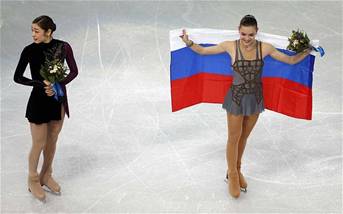
Robbed? a bemused Yuna Kim with gold medal winner Adelina Sotnikova Photo: GETTY IMAGES
By Ian Chadband, in Sochi
11:54PM GMT 20 Feb 2014
The cries of scandal were ringing round Sochi after another ice skating judging controversy caused more than a million people to complain online about a dubious ‘home town’ decision which had left Russia rejoicing.
Adelina Sotnikova became the darling of all Russia after defeating the overwhelming favourite, Yuna Kim, and becoming the first female figure skater ever to land individual gold for her country.
Yet with the vast majority of the world believing that reigning champion Kim must have been victorious for her beautiful, flawless performance, the South Korean’s compatriots were in particular uproar about a decision they felt had been engineered to favour the Russians.
More than a million people have signed an online petition demanding an inquiry into Kim’s loss while some of the sport’s luminaries, headed by double champion Katarina Witt, expressed their astonishment.
“I am stunned by this result, I don’t understand the scoring,” Witt said on German TV as Kim failed to join her and Sonja Henie as the only female skaters to defend successfully their title. “I’m trying to figure it out, OK? I thought Yuna outskated her,” was the verdict of Canadian four-times world champion Kurt Browning.
Yet the hosts, still lauding their surprise 17-year-old victor Sotnikova as a “super sensation”, were adamant that this was not a judging scandal engineered to please the hosts nor one influenced by the partisan crowd at the Iceberg Skating Palace.
And they were backed by the International Olympic Committee, whose spokesman Mark Adams reported that no official complaint had come from the South Korean federation about the marking, which ended with a 5.48-point gap separating the two.
More ammunition to those claiming foul came with the fact that one of the nine judges was the Ukrainian Yuri Balkov, who was suspended for a year after being involved in a fixing scandal at the ice dancing at the 1998 Nagano Olympics, while another, Alla Shekhovtseva, is married to Russian federation general director Valentin Piseyev.
Her colleagues rallied round Shekhovtseva, with Russian coach Eteri Tutberidze insisting at a press conference here: “She has been an international judge for many years and there have never been any allegations. For me Adelina was the champion.”
Sotnikova’s supporters felt her free programme contained more difficult technical elements and she completed seven triple jumps to Kim’s six. Yet her presentation was widely considered not to be in the same league as the 23-year-old Kim, who suggested afterwards that this may have been her last competition.
Kim sidestepped the controversy, saying: “There is nothing that will change with my words.”
A new judging system was brought in after the 2002 Salt Lake City Games when a French judge, under pressure from her own federation, was accused of inflating the scores in the figure skating pairs finals to stop the Canadian pair winning. Judges were given anonymity but that has caused new problems. “They need to get rid of the anonymous judging. People need to be held accountable,” said American skater Ashley Wagner.
Sochi 2014: 1.5m sign petition calling for inquiry into figure skating gold
• South Koreans angered by decision in favour of Russian
• Adelina Sotnikova won surprise gold ahead of Yuna Kim
Justin McCurry in Tokyo
The Guardian, Friday 21 February 2014 15.45 GMT
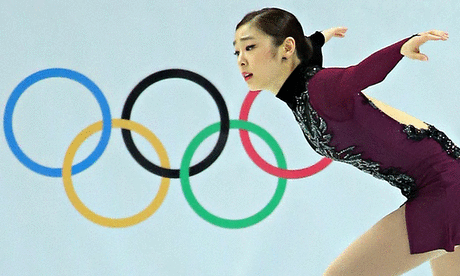
South Korean figure skater Yuna Kim missed out on gold, but more than 1.5m people want the judging to be reviewed. Photograph: Yonhap/EPA
At the end of a flawless performance, it seemed that nothing could come between Yuna Kim and her bid to become only the third woman to win back-to-back Olympic gold medals in figure skating.
But Kim, the undisputed darling of South Korean sport, and the millions of her compatriots who had stayed up into to the early hours to watch her decisive long programme at the Sochi Winter Olympics on Thursday, had not reckoned with the sport’s opaque and controversial scoring system.
When the scores had been tallied, the 23-year-old overwhelming favourite had to settle for a silver medal, losing out by 5.48 points to the unfancied Russia Adeline Sotnikova, who won her country’s first women’s Olympic figure skating gold.
South Korean skating fans immediately cried foul play. “Queen Yuna,” they said, had been denied the gold that was rightfully hers by questionable judging and the looming presence of the Russian leader, Vladimir Putin.
As of Friday, more than 1.5 million of them had signed an online petitiondemanding an inquiry into Kim’s shock defeat. The petition could end up breaking change.org records – previous most-signed campaigns have included Sybrina Fulton and Tracy Martin’s successful attempt to bring the man who shot their son, Trayvon Martin, to court (2.3m signatures), and a protest against YouTube and Google (4.3m).
The Dong-a Ilbo newspaper said Kim had been denied the chance to join Germany’s Katarina Witt and Norway’s Sonja Henie as the only women to win successive Olympic figure skating golds by partisan judging and an “extra judge” in the form of Putin. Kim had been up against “the home turf score plus Putin’s score”, the South Korean newspaper said.
While delirious Russian fans celebrated Sotnikova’s surprise victory inside the Iceberg Skating Palace, doubts were quickly raised about the impartiality of at least two of the nine judges that had sent her into first place.
The Ukrainian judge Yuri Balkov was suspended for a year when he was caught on tape trying to fix the 1998 Olympic ice dancing competition in Nagano, Japan, while others pointed out that judge Alla Shekhovtseva is the wife of Valentin Piseev, the general director of the Russian skating federation.
Carolina Kostner, who won bronze, had cause to feel more aggrieved than Kim, who attempted only six triple jumps compared to her and Sotnikova’s seven. The Italian, however, received 7.34 points fewer than the Russian, despite pulling off every one of her 11 jumps to the evocative musical backdrop of Ravel’s Bolero.
Skaters-turned-TV pundits poring over the judging details struggled to comprehend how Sotnikova had pulled off the upset and generated the first major sporting scandal of the Sochi Games.
“I am stunned by this result, I don’t understand the scoring,” Witt, who won gold in 1984 and 1988, said during her commentary for German TV.
As it was, Sotnikova racked up 149.95 points in the free skate, a dramatic improvement on her previous best of 131.63, recorded last month.
South Korean journalists dispensed with any pretence of objectivity. “Why did you invite all of us if you were going to have Putin’s little sports meeting?” Bae Sung-jae, a commentator for broadcaster SBS, said on Twitter.
Much of the criticism surrounds the scoring system, which replaced the familiar 6.0 tallies after a vote-trading scandal at the Salt Lake City Games in 2002. It is meant to be more rigorous: each jump or spin has a base value, and the judges assign further grades for executions and other elements such as choreography. That may undermine the calls for an inquiry by Kim’s fans – some commentators said that while her routine was smoother, Sotnikova’s was technically more demanding.
But the system is also more opaque: the scoring is anonymous and it is harder to discern national bias. One of Kim’s competitors said the time had come to ditch the system by which individual judges give their scores anonymously.
“People don’t want to watch a sport where you see people fall down and somehow score above someone who goes clean,” said the US skater Ashley Wagner, who finished seventh. “It’s confusing, and we need to make it clear for people. People need to be held accountable. They need to get rid of the anonymous judging. There are many changes that need to come to this sport if we want a fan base, because you can’t depend on this sport to always be there when you need it.”
In the South Korean capital, Seoul, fans expressed a mixture of anger at the result and praise for Kim, whose performance in Sochi marked her retirement from competitive skating.
“Yuna was still so beautiful,” 32-year-old Young-min told Reuters. Another fan, Kim Byoung-in, said: “She is and will be our gold medallist forever, and we will be rooting for her next phase of life.”
South Korean TV attempted to ease Kim’s pain, playing endless reruns of her valedictory performance in Sochi and footage from her 17-year career, beginning with her first tentative slides across the ice as a six-year-old. By Friday, “Thank you, Yuna” was the most popular search term on the country’ biggest internet portals, Naver and Daum.
Kim attempted to rise above the controversy. “The scores are given by the judges so I’m not in the right position to comment and there is nothing that will change with my words,” she said. “The most important thing for me was to take part in these Games.”
Rage among South Korean skating fans may not be enough to force an official inquiry, though. The International Olympic Committee said on Friday that it would not investigate Sotnikova’s win unless a formal complaint was lodged.
“I am unaware, in fact I am certain, there hasn’t been any complaint,” said the IOC’s communications director, Mark Adams. “If it does, the first step for it would be to go through [the International Skating Union]. If there isn’t a credible complaint then we wouldn’t take it any further.”
Olympics: South Korean fury at Kim Yu-na’s defeat
POSTED: 21 Feb 2014 15:18
For millions of South Koreans who stayed up into the early hours of Friday morning to watch their idol Kim Yu-na try to defend her Olympic figure-skating title, there was heartbreak and anger over her eventual silver finish.
SEOUL: For millions of South Koreans who stayed up into the early hours of Friday morning to watch their idol Kim Yu-na try to defend her Olympic figure-skating title, there was heartbreak and anger over her eventual silver finish.
Within hours of the result, the website of the popular online campaigning forum, Change.org, crashed as hundreds of thousands logged on to sign a petition calling for a review of the judges’ scores.
The biggest name in South Korean sports, Kim has a fanatical following in her home country, and there was huge expectation that she would secure back-to-back golds going into Thursday’s long programme in Sochi with a narrow lead over her rivals.
Her performance seemed flawless, but Russia’s Adelina Sotnikova scored higher technical marks to take first place on the medal podium.
Kim skated last, shortly before 4:00am Korean time, and Korean TV commentators voiced surprise, verging on shock at the final result, with suggestions that the judges may have been swayed by the partisan Russian crowd.
“It will be interesting to see whether Sotnikova can ever obtain such a high score again down the road,” said former skater – and a former Kim Yu-na coach – Byeon Seong-jin, commentating on the KBS channel.
“Today, Yu-na did not lose but Russia won,” Byeon said.
A petition to challenge the result was set up immediately at Change.org and the website was swamped within hours.
“The petition gained 700,000-plus signatures in just six hours and is sending traffic to our site at five times the highest previously-recorded rate,” Change.org spokeswoman Charlotte Hill told AFP.
“Approximately 90 percent of the traffic is coming from South Korea,” Hill said, adding that the San Francisco-based company had a “team of engineers” working to keep the server up and running.
The final came too late for Korean newspapers’ Friday print editions, but their websites were flooded with angry comments by ordinary South Koreans who felt that “Queen Yu-na” as Kim is known, had been robbed of the title.
“Kim Yu-na sheds tears at Russian bullying,” ran a headline on the online edition of the JoongAng Ilbo newspaper.
“It was an unfair result … Home advantage was to be expected, but we did not expect it to be displayed in such a way,” the daily said.
An editorial by South Korea’s Yonhap news agency noted that “many foreign media” had questioned the judges’ decision.
“It is regrettable that the Olympics which must put the highest priority on fairness was marred by such a controversial judgement,” it said.
The Sports Chosun website ran a balanced report of the competition, but the hundreds of comments it attracted were far from neutral.
“Congratulations Russia! You’ve become the most rotten Olympics in history. Must be proud of that,” wrote one disenchanted Kim fan.
“Sochi is just a shorter term for pick-pocket,” wrote another.
Korean Twitter users voiced similar sentiments, although many also sent words of consolation to Kim and thanked her for everything she had achieved for her country.
“I made my conclusion” tweeted @Kjsultra in Korean. “Sotnikova’s gold medal is given by Russia and Yuna Kim’s medal is given by the rest of the world.”
South Korean President Park Geun-hye sent a personal message to Kim, who confirmed on Friday that she was retiring from competition as she had said she would.
“Your beautiful performance at the Games will be remembered forever – not only in the mind of Koreans but the whole world,” Park said in her message, which made no comment on the judges’ decision.
 About bambooinnovator
 Bamboo Innovator