Like Columbus, It Floated Here: The answer of how the useful plants got to the Americas has stumped scientists, until now. Using a relatively new type of genetic analysis, researchers found that bottle gourds floated to the Americas from Africa
March 1, 2014 Leave a comment
Like Columbus, It Floated Here
By RACHEL NUWERFEB. 24, 2014
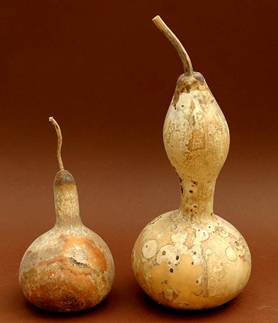
Using a relatively new type of genetic analysis, researchers found that bottle gourds floated to the Americas from Africa. CreditCaraMaria
By the time Columbus arrived in the New World in 1492, bottle gourds had already conquered much of the globe. After evolving in Africa, one species,Lagenaria siceraria, made a break for East Asia around 11,000 years ago and eventually took up residence in Polynesia, China, Peru and beyond, earning the title of most widely distributed pre-Columbian domesticated plant.
The gourds have been supremely useful, too — not so much for nutrition (they taste bitter) but, when dried, as containers, medical and musical instruments, even decorative birdhouses. Despite their ubiquity, though, they have their secrets.
Archaeological evidence shows that ancient peoples living in Florida and Mexico began using them at least 10,000 years ago. Yet how they got to the Americas remained unknown.
Now scientists think they have an answer — and in the process may have resolved puzzling inconsistencies in earlier research.
Previously, researchers speculated that the gourds floated here from Africa, although they had no way to prove it. In 2005, a team of scientists challenged that notion. They analyzed short fragments of DNA taken from living and archaeological bottle gourds and found that ancient North American specimens shared more in common with Asian than with African gourds, so perhaps the colonizers who crossed the Bering land bridge more than 10,000 years ago took gourd seeds with them.
But that did not explain how the bottle gourd, a plant that prefers tropical climates, could have survived such harsh winters. Moreover, ancient American seeds more closely resemble the fatter, oddly shaped African seeds than the thinner, more symmetrical Asian ones.
Now, it seems, those questions have finally been answered. The founding bottle gourds did not come from Asia after all, but instead traveled to the Americas directly from Africa, a new study in Proceedings of the National Academy of Sciences reports.
To arrive at this conclusion, researchers used a relatively new method of genetic analysis called high-throughput sequencing. “The technology has come an incredibly long way since the 2005 study, so now we can look at this question in a lot more detail,” said the lead author, Logan Kistler, a postdoctoral fellow in anthropological genomics at Penn State.
To recreate the plant’s family tree, the researchers isolated DNA taken from modern bottle gourds around the world and ancient ones found at nine archaeological sites throughout the Americas. The pre-Columbian artifacts from the New World, they found, were linked directly to African relatives. This means the gourds floated to the Americas on their own.
To double-check this conclusion, the team created a computer model of Atlantic Ocean currents. Simulations confirmed that a bottle gourd traveling from West Africa could make it to North or South America in nine months, on average. Once there, given the right conditions, the seeds could very likely take root. (A 1954 study found that bottle gourds could spend up to a year floating in saltwater without losing fertility.) The diversity of New World gourd populations suggests that there were several successful oceanic crossings throughout history.
Some mysteries remain, however. Scientists are not sure how the gourds managed to spread from New World shores across entire continents, or why wild bottle gourds no longer grow in the Americas. Dr. Kistler and his colleagues hypothesize that large animals might have spread the gourds’ seeds, and when those animals later went extinct, the wild bottle gourds did the same.
Changing climate could also have played a role. “The study is another step forward, but we are still far from understanding what really happened,” saidHanno Schäfer, a botanist at the Technical University of Munich who was not involved in the work. Further detailed studies “will probably be the only way to really answer the question without the need of storytelling,” he said.
Analyzing bottle gourds from archaeological sites elsewhere in the world could help fill in those details, as could examining genetic material found in the cells’ nuclei.
“At this point, I think we can say we’re confident that bottle gourds did travel from Africa, but that certainly isn’t the end of the story for the species,” Dr. Kistler said. “There’s always more to learn.”
 About bambooinnovator
 Bamboo Innovator