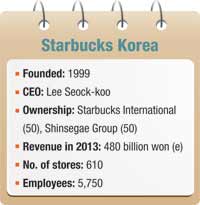
Starbuck Korea 2013 revenue is estimated at 480 billion won ($453 million), up from 391 billion won in 2012
March 1, 2014 Leave a comment
2014-02-23 13:14
What’s secret of success? – ‘It’s more than beans’
By Lee Hyo-sik
Chung Ha-yeon, 26, is a self-proclaimed Starbucks fanatic. Not a single day goes by without Chung sipping a cup of fresh brew from the world’s largest coffee franchise.
“On the way to my office every morning, I always get Americano from a nearby Starbucks. I love the aroma of freshly brewed coffee in the morning,” Chung said. “On top of regular coffee products, I often enjoy Starbucks’ seasonal specialties all year around. I just tried the franchise’s latest ‘cherry blossom latte’ and ‘cherry blossom white chocolate.’ I just loved them.”
The officer worker in Seoul said besides its high-quality coffee, she loves Starbucks merchandise such as mugs, tumblers and planners for their sleek designs and usability.
“I think people love Starbucks because it offers what consumers want and holds promotions that catch their attention all year round,” she said. “For example, many people, including myself, went to Starbucks more often than usual from November through December last year to get the 2014 planner for free. The planner is a must-have-item for many women for its classy design and user-friendly features.” The coffee franchise gives the planner free of charge to those who have over 20 drinks in the final two months of each year.
Chung’s friend, Park Hyun-jung, also makes frequent trips to Starbucks, particularly to work on a project or read books there. “I like Starbucks because all of its branches offer pretty much consistent taste, unlike other franchises. In addition, I like their interior design, which is chic and at the same time cozy. Starbucks is the perfect place for me to chat with friends or work on something over a cup of great-tasting coffee.”
Chung and Park are some of the loyal customers turning Starbucks Coffee Korea, a 50-50 joint venture between Seattle-based Starbucks International and Shinsegae Group, into the nation’s most successful coffee brand. It opened 11 new stores so far in 2014, pushing up the number of Starbucks franchises in the country to 610.
The figure is smaller in comparison to those of home-grown franchises Caffe Bene and Ediya, which operate over 900 stores and over 1,000 stores, respectively. But Starbucks generates the largest sale; its 2013 revenue is estimated at 480 billion won ($453 million), up from 391 billion won in 2012. Caffe Bene’s sales reached only 210 billion won in 2012, while Ediya’s hit only 42 billion won the same year.
Starbucks directly operates all its stores by hiring nearly 6,000 baristas and other staff across the country, In contrast, Caffe Bene, Ediya and other coffee franchise stores are individually owned and operated, that is, the companies let individual owners open the store under their brands in return for royalties.
Starbucks’ direct management helps ensure consistency in the quality of the coffee across its stores and implement its marketing strategy more effectively, according to Lee Seock-koo, CEO of Starbucks Coffee Korea.
In an interview with The Korea Times’ Business Focus, Lee said the world’s largest coffee chain will further strengthen its status as a market leader in 2014, which marks its 15th anniversary in Korea.
“Starbucks Korea has been growing at an explosive pace since it opened its doors in July 27, 1999. We will celebrate the 15th anniversary in large scale this summer,” Lee said. “Starbucks couldn’t be where it is now without customers and local communities. We are planning an array of promotional events to thank our loyal customers. We will also introduce new community services to give back to society more.”
Leader in mobile marketing
The CEO said on top of marketing a variety of innovative, high-quality products, Starbucks will introduce new services using the latest mobile technologies in 2014 to further enhance customer experience.
“In the Asia-Pacific region, Korea is considered a mature market along with Japan. But Korea differs from Japan in that it is often used as a test market for Starbucks’ new services based on mobile technologies, because it is the world’s most wired country with the highest smartphone penetration rate,” Lee said. “On many occasions, the Seattle headquarters first tested new mobile-based customer services in Korea before introducing them to other markets. The headquarters is also interested in what Starbucks Korea sells and how it promotes them.”
The CEO said the company plans to implement a new ordering system in the first half of this year, which will enable those holding a “My Starbucks Reward Card” to order and pick up coffee without having to wait at the stores.
“Under the envisioned system, customers holding our membership card, who account for 40 percent of the total number of store visitors, can order and pay using their smartphones, making it unnecessary for them to wait in line to order and get their drinks. They can come and pick up what they ordered immediately from an express counter,” Lee said. “We will provide more convenient services and create a more user-friendly and comfortable store environment to boost customer satisfaction.”
Besides its proactive application of mobile technologies, the CEO said Starbucks Korea has been adding the “fun” element to its products and services, which he mentions is one of the firm’s success factors.
“Most coffee franchises in Korea use vibrating buzzers to let customers know when their drinks are ready. But we don’t because we think it takes away the interaction between our employees and customers. We call out what customers ordered or the customers’ nicknames if they registered one in our membership program,” he said.
Under the “call my name” system, Starbucks cardholders can register any nicknames they want to be called when their drinks are ready.
“Some wanted to be called princess or names of famous actors and actresses for fun. Starbucks Korea was the first to launch such service worldwide in January this year and will do so in other countries soon,” Lee said. “The service has been an enormous hit in Korea. This shows that people want to interact with others in an analogue manner in the increasingly digitalized world. This is a good example of Starbucks adding the fun factor to its services.”
In January alone, 250,000 membership cardholders registered nicknames. More than 70,000 people signed up for membership only to register their nicknames.
The CEO also said Starbucks Coffee Korea has introduced unique designs for each store in accordance with the region’s characteristics. “Starbucks worldwide does have a universal store design. But Starbucks Korea has added something more to it. For instance, our stores nearby historical sites have features that reflect historical and cultural heritages in the area. This way, our store mingles better with the communities.”
The firm’s drive-through stores are also different from those of their counterparts in other countries, according to Lee, who said customers can order face to face with employees through a monitor. “In other countries, customers order through a microphone at the drive-through stores. But in Korea, they see the faces of our employees on the screen while placing an order. This provides a more personal touch and makes customers feel that they are better treated. Starbucks in the U.S. and other countries has benchmarked our system and will soon launch it.”
In August 2012, the company opened its first drive-through store in the ancient city of Gyeongju, North Gyeongsang Province, to better serve tourists visiting the ancient capital of the Silla Kingdom. Starbucks currently operates six drive-through shops nationwide.
Plenty of room for growth
Citing its high-quality coffee varieties and customer-friendly, innovative mobile services, Lee said Starbucks Coffee Korea will continue to grow at an explosive pace in the coming years, dismissing concerns that the country’s coffee franchise industry may have reached a saturation point.
“I think there is still plenty room for Starbucks to grow in Korea. In 2014, the industry is expected to expand at least 20 percent from a year earlier, following the 27 percent growth in 2013. Starbucks will continue to outperform the overall market,” he said. “The coffee franchise industry has largely been unaffected by sluggish economic conditions over the past few years because many people see having a cup of coffee as a small luxury in an increasingly harsh reality. They are willing to spend a couple of dollars on coffee, regardless of changes in their income.”
According to AC Nielsen, the industry is projected to increase at a double digit rate through 2020.
The CEO also said coffee franchises will grow at the expense of instant coffee makers, saying more people prefer freshly-brewed coffee over instant coffee in line with rising incomes. “In addition, Korean consumers have been increasingly shunning away from soda, fruit-based juice and other beverages. Instead, they have begun drinking more coffee.”
A coffee shop has become a popular social venue for people to interact with friends and family members over a cup of coffee, he said, adding that coffee drinkers can read books, surf the Internet, study or work there. “For these reasons, I think the coffee franchise industry will continue to grow at a sustainable pace for many years.”
Lee said Starbucks will open more stores through 2020 mostly in prime locations in Seoul and other large cities. “We will not compete with coffee shops in small neighborhoods. We would like to grow together with our smaller counterparts. Starbucks will also try to source more ingredients from local producers to provide our customers fresh and tasty products.”
 About bambooinnovator
 Bamboo Innovator