Chewing Gum Makers Cater to Chinese Tastes
March 2, 2014 Leave a comment
Chewing Gum Makers Cater to Chinese Tastes
Product Is Growing at Double-Digit Rates in the Country
KATHY CHU and LAURIE BURKITT
Feb. 25, 2014 11:36 p.m. ET
As China’s slowing economy dents sales growth of everything from personal computers to Oreo cookies, some companies are finding growth in a surprising place: chewing gum.
Gum is growing at double-digit rates in China, igniting a turf battle for China’s chewers. Snack food maker Mondelez International Inc. MDLZ -1.31% entered the fray in 2012 with a sugar-free brand and a high-profile campaign with a Taiwanese celebrity. Meanwhile, market leaders William Wrigley Jr., a division of Mars Inc., and Korea’s Orion Group have expanded distribution and offered flavors such as grapefruit, cucumber and tea to encourage China’s swelling middle class to chew more.
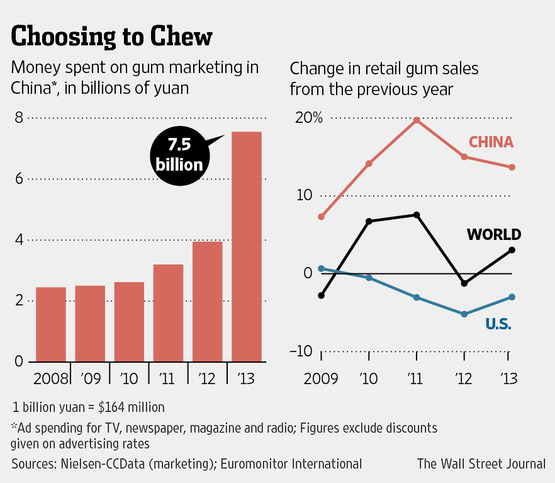
Rising disposable incomes in China are increasingly making gum a mainstay in the pockets of young adults, the key gum-chewing segment. But companies’ aggressive marketing of gum as a way to improve oral health, increase concentration and lower stress levels is also winning over consumers. In the last two years, ad spending on chewing gum has more than doubled to 7.55 billion yuan ($1.24 billion), before factoring in discounts given on advertising rates, according to Nielsen-CCData.
Qu Zhu, 30 years old, a Beijing investment banker, typically buys a 40-piece container of chewing gum each month. “Chinese food has so much garlic,” he said. “I need to freshen my breath after eating.”
In a TV commercial in China for Extra gum, a man eating crispy fried noodles at a restaurant complains to the female chef that it could break his teeth. She tells him his teeth aren’t good, and offers him a pack of Extra, which Wrigley promotes as “caring about teeth, caring even more about you.”
While nearly all sales of packaged food have been affected by China’s weakening economy, gum is still seeing “dynamic growth” due to manufacturer promotions and rising consumer demand, according to Euromonitor analyst Vera Wang Wei.
Gum sales grew nearly 14% in China last year to $2.8 billion, nearly double the level of 2009. Still, annual growth has moderated since a recent 2011 peak of 20%.
Even as China’s economy slows, “my expectation is that gum will be quite resilient,” said Torsten Stocker, a partner at A.T. Kearney, a consulting firm.
Gum isn’t popular with everyone. Zhang Lu, a 22-year-old student in Beijing, said she’s afraid that chewing gum will build up her jaw muscles and make her face look fat. “You know Chinese girls care about their shapes,” she said.
Michael Yeung, president of Wrigley Asia Pacific, said “there’s no science” behind this concern.
A rapidly expanding market for chewing gum in China comes even as the treat’s sales have weakened or even declined in mature Western markets, despite the introduction of newfangled products such as caffeinated gum.
The double-digit growth in China “is one of the reasons we launched there,” Mondelez Chief Executive Irene Rosenfeld told analysts in November.
Mondelez, after launching its Stride brand in China in the third quarter of 2012, hired Taiwanese celebrity Ke Zhen Dong as its spokesman and sponsored the popular Chinese talent show “Super Boy.” Mondelez also installed over 100,000 checkout counter displays for the gum in 10 months.
For the maker of Oreos, gum has been a “phenomenal success,” generating about $100 million in annual sales, said Ms. Rosenfeld.
Confectionery company Orion said it posted sales of more than 1 trillion won ($932 million) for the first time in China in 2012—and continued its strong growth last year—on the back of its top-selling product there: Xylitol chewing gum.
Orion, which also sells potato-flavored treat Yegam and Choco Pie snacks in China, first entered the market in 2003 and has been growing at a 30% annual rate in the country, it said in its 2012 annual report.
Because gum consumption is still low in China compared with other countries, companies see “large potential” for growth, said Cherry Dai, a project manager at SmithStreet, a consulting firm. “Girls want to eat gum to stay slim,” said Ms. Dai.
Last year, the average Chinese consumer chewed $1.80 worth of gum. By comparison, Britons chewed more than four times this amount, Americans more than six times and Japanese 6.5 times, according to Euromonitor.
The biggest challenge, gum makers say, is to convert more consumers, especially those in lower-tier cities, into habitual gum chewers.
“Gum is an impulse-purchase item, and if you don’t see it, you don’t buy it,” said Mr. Yeung of Wrigley, which now sells gum in more than 2.1 million stores in China, up from 1.8 million in 2008. “By making it more available in cities, it will help us grow in economically challenging times.”
 About bambooinnovator
 Bamboo Innovator