Land Investors Brace for Slowdown; Hillwood, Other Developers Are Selling Huge Tracts
March 2, 2014 Leave a comment
Land Investors Brace for Slowdown
Hillwood, Other Developers Are Selling Huge Tracts
KRIS HUDSON
Updated Feb. 25, 2014 7:20 p.m. ET
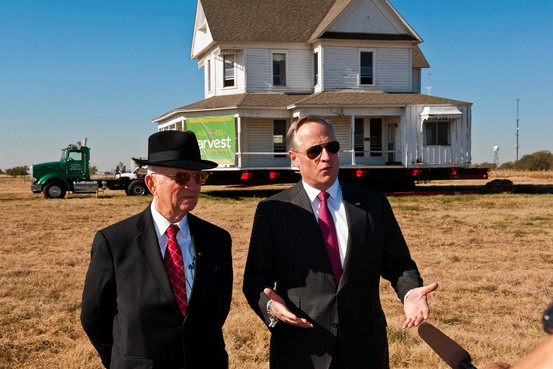
H. Ross Perot Jr., right, and his father at the groundbreaking of the Harvest project near Fort Worth. Hillwood Development
Texas developer H. Ross Perot Jr. and a few other big land investors are taking some chips off the table, betting that the swift increase in prices on residential land in recent years will abate in 2014.
Many economists predict home prices this year will increase by roughly half of their percentage gain in 2013, when they rose by an average of 11.3%, according to the S&P/Case-Shiller national index of home prices. The direction of home prices heavily influences what home builders will pay for land.
“Unless home prices go higher, I don’t see land [prices] going much higher,” says Mr. Perot, whose Hillwood Development Co. owns 9,400 residential acres in seven states. His father founded Electronic Data Systems and was a presidential candidate in 1992 and 1996. “Land’s about as expensive as it can be.”
Hillwood sold 13 residential tracts totaling 4,300 acres in the past year for $125 million, nearly double the amount it had invested in them. Hillwood also bought two tracts last year totaling 1,800 acres, but 2013 was the first year in the past 10 that Hillwood was a net land seller.
It is unusual for Hillwood to sell huge tracts of raw land. Typically, the company develops tracts into dozens or hundreds of home lots—with electricity, roads and other infrastructure—and sells them piecemeal to multiple home builders.

Another Texas land investor, Stratford Land Co., intends to complete sales of at least $400 million of land early this year after selling $100 million of land last year and $150 million in 2012. To sell, Stratford looks to double the money it spent on the land. It still holds about $1 billion of assets.
“We want to take some chips off the table,” Stratford founder and CEO Phillip Wiggins said in an interview. “It seems like we’ve timed this very well. But we have the rest of the portfolio to play a little long on, because we think there’s still some wind behind our sails for a few years.”
Investment-management firm Paulson & Co. since 2009 has amassed more than 20 residential projects spanning 30,000 lots in distressed markets. Last year, Paulson for the first time since then sold tracts in a few markets, though it intends to also keep buying and holding land in markets where it thinks prices still have room to rise.
“As a result, we have been measured in our sales activity over the past year,” says Michael Barr, portfolio manager for the Paulson Real Estate Funds.
Starwood Land Ventures LLC, an arm of investor Barry Sternlicht‘s Starwood Capital Group, since 2007 has amassed a portfolio spanning roughly 17,000 lots, buying mostly at the market’s nadir in 2009 and 2010. Last year, Starwood Land posted its largest year of land sales, divesting tracts totaling 2,300 lots for $150 million. Meanwhile, it bought one tract of 675 lots for $25 million.
“The market was right and the prices were very good—in some cases above what they were in the peak years,” says Mike Moser, Starwood Land’s co-CEO. “So, it’s time to start harvesting.”
Demand has been hot for residential land because home builders have been trying to ramp up their production as the housing market has recovered. Last year, builders started construction of an estimated 618,300 single-family homes, up 15.5% from 2012, but still roughly half of historical averages, according to the U.S. Census Bureau. The National Association of Home Builders predicts builders will start construction of 822,000 single-family homes this year.
Lot prices in 2013 increased more than 20% on average nationally from 2012 levels, according to housing-research and analysis firm Zelman & Associates. In red-hot California, lot prices increased in Modesto by 73% in the past year, according to land brokerage Land Advisors Organization.
But the land market lost momentum late last year as home buyers began to balk at rising prices and higher interest rates. That weakening of demand tempered home builders’ appetite for top-dollar land.
A look at the sequential, quarter-to-quarter change in land prices underscores the cooling of the market. According to Zelman’s monthly surveys of builders, brokers and developers in 55 major markets, prices of finished lots receded from their biggest recent gain—6.8% in the first quarter of 2013 from the previous quarter—to a more tepid 2.9% gain in last year’s fourth quarter.
Some economists and market observers now predict smaller price gains—and, in some cases, flat prices—for land in 2014. “We expect the pace of acceleration to ease,” Zelman analyst Ryan McKeveny said.
Many of the investors that sold land in the past year will remain in the business. Mr. Perot’s Hillwood intends to develop another 1,600 lots this year, mostly in Texas. That includes its 1,000-acre Harvest project north of Fort Worth, which includes a working farm, a community garden, a man-made lake, an activities coordinator and automation systems in every home.
“We’re sellers at the right price at the right time and the right circumstance,” says Fred Balda, president of Hillwood’s residential-development division. “We were fortunate to have that [scenario] the last couple of years. But we’re not vacating our core business.”
 About bambooinnovator
 Bamboo Innovator