NASA Scientists Discover 715 New Planets; Data From Kepler Space Telescope Suggests 4 Alien Worlds Have Potential for Life
March 2, 2014 Leave a comment
NASA Scientists Discover 715 New Planets
Data From Kepler Space Telescope Suggests 4 Alien Worlds Have Potential for Life
LEE HOTZ
Feb. 26, 2014 3:57 p.m. ET
NASA’s Kepler mission scientists announces the discovery of 715 new planets around distant stars, including four alien worlds roughly the size of Earth that might be might be potentially suitable for life. Robert Lee Hotz reports on the News Hub. Photo: NASA.
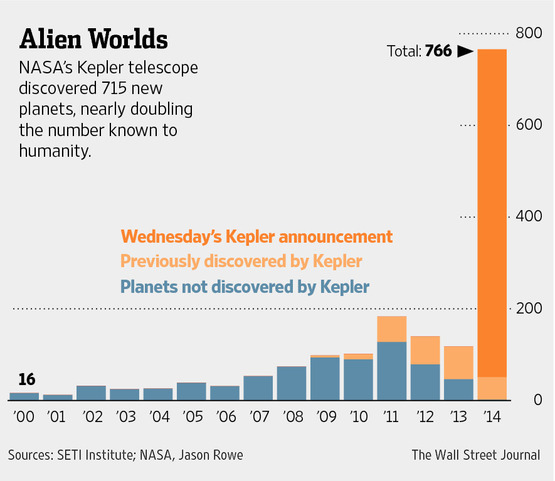
NASA scientists announced Wednesday the discovery of 715 new planets around distant stars, including four alien worlds roughly the size of Earth that might be the proper temperature for liquid water to form and, therefore, potentially suitable for life.
The discovery, based on two years of data collection on 150,000 or so stars by the agency’s orbiting Kepler space telescope, brings the confirmed count of planets outside our solar system to nearly 1,700.
“We have almost doubled the number of planets known to humanity,” said planetary scientist Jack Lissauer at NASA’s Ames Research Center in Mountain View, Calif., who is a science co-investigator on the $600 million Kepler space telescope mission.
The team of three dozen astronomers, data analysts and planetary scientists detailed their findings in two research papers submitted to the Astrophysical Journal and discussed their findings Wednesday at a news conference held by NASA.
The data were collected before the Kepler telescope malfunctioned last year, leaving it unable to track stars precisely enough to continue the planet-hunting mission for which it was launched in 2009. The Kepler scientists are now seeking funding from NASA to operate the telescope for another two years in a reduced role, to study how planets form around stars.
Meanwhile, the researchers continue to pore through data collected while it was still working properly, which document several thousand candidates in the expectation they will be able to confirm the existence of several hundred more planets in orbit around other stars.
Almost all of the newly verified exoplanets—as the alien worlds are called because they are outside our solar system—are smaller than Neptune, a gas giant at the outer reaches of the solar system that is almost four times the size of Earth. The worlds are clustered around just 305 stars in solar systems that, like our own, contain multiple planets, the scientists said.
The researchers said that four of these newly confirmed planets are less than 2.5 times the size of Earth, which means the force of gravity there would be relatively comfortable for creatures like humans, and orbit in the so-called habitable zone around their stars—the distance at which the surface temperature of an orbiting planet may be right for liquid water. It wouldn’t be so hot that it would boil and dissipate into space or so cold that it would freeze solid.
One of those new planets, called Kepler-296f, is twice the size of Earth and orbits a star half the size and only 5% as bright as our sun, said Jason Rowe, a research scientist at the SETI Institute and a member of the Kepler science group. Details of the others—designated Kepler 174d, Kepler 298d and Kepler 309c—weren’t publicly available Wednesday. The total, though, “increases the number of Earth-sized planets by 400%,” he said.
Taken together, the new Kepler discoveries confirm that “small planets are extremely common in our galaxy,” said planetary physicist Sara Seager at the Massachusetts Institute of Technology, who wasn’t involved in the discoveries. “I am extremely excited about this.”
 About bambooinnovator
 Bamboo Innovator