Bamboo Innovator Weekly Insight – The KS Way to Scale Up a Compounder: The Case of WhatsApp, Phison and Naver
March 4, 2014 Leave a comment
| Dear Friends and All,
The KS Way to Scale Up a Compounder: The Case of WhatsApp, Phison and Naver
“I want to do one thing, and do it well.. On the internet there is a lot of flash and fad. What we are trying to build here is a long-term persistent sustainability.. The simplicity and utility of our product is really what drives us. We won’t stop until every single person on the planet has an affordable and reliable way to communicate with their friends and loved ones.. People starting companies for a quick sale are a disgrace to the Valley. If you run a startup and your goal is to get on techcrunch, you are doing it wrong. Next person to call me an entrepreneur is getting punched in the face by my bodyguard. Seriously. ” – Jan Koum, WhatsApp founder
“We are our own worst enemy. We have to be patient and concentrate on the things we are doing.. The first question I asked them was, why do they want to create their own startups and be an entrepreneur. About 70% of them immediately replied me that they want to be rich. If that is the case, then I believe that 99% of them will fail.” – KS Pua, CEO of Taiwan-listed Phison Electronics
How can 55 full-time employees (32 engineers) handle more than 19 billion messages and simultaneous connections per day (50 billion across seven platforms), equivalent to the total worldwide volume of SMS text messages, with speed, reliability and few technical errors (99.9% uptime)? Disruptions under load – whether coming from hardware failures (servers, network gear), software breakdowns or management misadventures in serving the growing user population base – has prevented the scalability of business model as the business grows bigger. The value destruction risk that comes from limitations in scaling up the core business inevitably diverts the attention of entrepreneurs to seek alternative growth paths, often self-dealing ones, resulting in fads and fashion in the business and tech world with no genuine compounders to last the distance in a bubbly valuation playground.
The contrarian anti-advertising, anti-data-harvesting model and Erlang language platform has resulted in WhatsApp to remain devoted to a clean, lightning fast communications factory that works flawlessly in providing a low-latency, reliable, and resilient service against disruptions under load. As WhatsApp founder Jan Koum explains the importance of focus of “No Ads! No Games, No Gimmicks!”: “At every company that sells ads, a significant portion of their engineering team spends their day tuning data mining, writing better code to collect all your personal data, upgrading the servers that hold all the data and making sure it’s all being logged and collated and sliced and packaged and shipped out… And at the end of the day the result of it all is a slightly different advertising banner in your browser or on your mobile screen. In other words, avoiding ads allowed the company to focus on making a messaging product that just works well.” Thus, while everyone rushed to promote ads, games and bells-and-whistle-attention, the quiet and simple-yet-profound “Koum System” (KS) has resulted in high stickiness amongst its 450 million monthly user base (70% are active daily, an engagement even higher than Facebook’s 61%) and enabled WhatsApp to scale up to become a compounder that was acquired by Facebook for $19 billion ($4 billion cash, $15 billion Facebook stock) despite registering $20 million in sales from a subscription-based model of $1 annual fees after one year of free usage. The deal for the five year old startup was signed on Feb 19, just a few days before Feb 24, the anniversary day when WhatsApp was founded in 2009. While it is debatable whether WhatsApp’s wide-moat justifies a $19 billion price tag, we believe that there are even more important lessons for value investors in analyzing the “Koum System” (KS) business model so as to identify emerging compounders before the valuation goes off-the-scale.
KS also stands for Knowledge System, that critical intangible wisdom embedded in the Bamboo business model that enabled the company to work with the times, anticipate twists and turns, unclutter the mind from constant emergencies to see further into the future and to resist the baits that people dangle in front of you. Often times, value investors are simply hurried investors in reacting to events that have happened despite their claims of patience, as they apply the quant screens as a first-order tool to identify undervalued investment opportunities without evaluating the KS element in the wide-moat of the business model. Hurriers will often mistake surface phenomena for a real trend, seeing only what they want to see. How much better to see what is really happening, even if it makes our task harder.
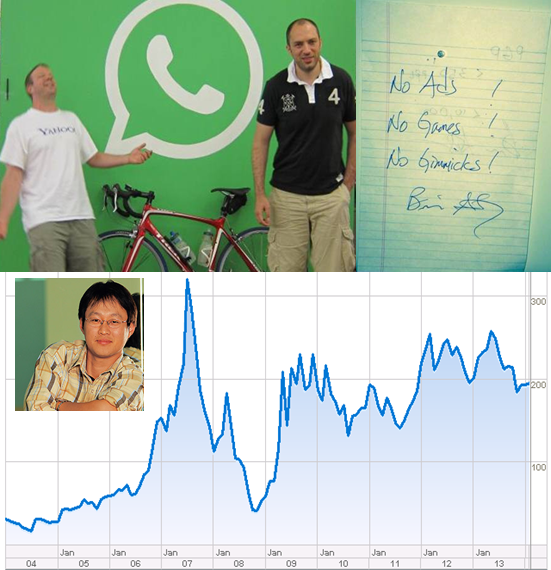
WhatsApp founders Brian Acton (top left) and Jan Koum (right); Bottom: KS Pua, CEO ofPhison (8299 TT) – Stock Price Performance, 2004-2014
Identifying compounders using the KS way has been partly inspired by a trip to Taiwan in early 2006 to visit several companies out of the over 1,500 companies, one of which was Phison Electronics (8299 TT, MV $1.1bn). The fabless IC designer is up over 7-fold since its listing in 2004 to a market value of $1.1 billion, generating $1.09bn in sales and $89m in profits; it is also up over 3-fold since early 2006 after our visit while the TaiEx index is up around less than 30% over the same period.
KS (Khein-Seng Pua, 40) is also the name of the co-founder and CEO of Phison. Established in Nov 2000 and listed in 2004, Phison is an abbreviation of “Five Persons”, referring to the number of co-founders (two Malaysians and three Taiwanese), all engineers (CK Awyong, Samuel Wu, Jackie Hsu and JY Yang). The company’s Chinese name 群聯 means “a group of people united together” and this collaborative spirit that emphasizes pooling the collective wisdom became one of Phison’s most important corporate values. As KS reflected, “It’s amazing how great may be your success if you work hard and seek original ways to clear obstacles consistently.” Phison is the world leader in USB flash memory controllers and related NAND flash applications which are used in products such as SSD (solid state drives), eMMC (embedded multimedia card) and security products. Many have claimed to be the first to invent the USB drive. The “paper” concept of USB flash drive by IBM dates back to 1997. In 1999, M-Systems from Israel filed a patent followed by Netac from China and Trek (TREK SP, MV $46m) from Singapore. In 2000, Phison was the first to introduce the USB drive system on chip (SoC) which uses a single chip. KS was 27 then. KS added, “At the time, no one believed in us so we had to do everything ourselves – from developing the technology, the chips to the product itself.” Phison launched Pen Drive in June 2001 and broke even by August of the same year.Phison is a now public company with Toshiba, SanDisk (after purchasing M-Systems), Kingston, and Hynix acting as shareholders. Noticeably, the market value of Singapore’s Trek’s is over 20 times smaller than Phison despite both starting out as pioneers in the USB flash phenomenon.
KS shared that his maxim in life is to do things correctly everyday and to be patient so as to grow better. “We are our own worst enemy. We have to be patient and concentrate on the things we are doing.” With its focus on the SoC controller technology platform…
<Article snipped>
Like Koum who had to move to US from then-communist Ukraine when he was 16 in 1992 with his mother and grandmother, taking advantage of a relaxed emigration policy for Jews, KS was forced to leave his hometown Sekinchan in Selangor, Malaysia due to the Bumiputera policy for Taiwan at 19 to further his studies at National Chiao Tung University located in Hsinchu, a well-known science park. Both Koum and KS had invaluable mentors in their career and entrepreneurial path. Koum had Brian Acton (Yahoo’s employee #44) whom he met at Yahoo where he took a part-time job while still a student at San Jose State University and learning technical skills from second-hand textbooks and living on food stamps. Two weeks into his job at Yahoo, one of the company’s servers broke. Yahoo cofounder David Filo called his mobile for help. “I’m in class,” Koum answered discreetly. “What the fuck are you doing in class?” Filo said. “Get your ass into the office.” Filo had a small team of server engineers and needed all the help he could get. Koum dropped out: “I hated school anyway”. Later on in his own entrepreneurial venture after incorporating WhatsApp in California on Feb 24, 2009, early WhatsApp kept crashing or getting stuck and mostly local Russian friends downloaded the app. Koum grudgingly admitted he should probably fold up and start looking for a job. His mentor Acton balked: “You’d be an idiot to quit now. Give it a few more months.” Luck intervened and the first tipping point help came from Apple when it launched push notifications in June 2009, letting developers ping users when they weren’t using an app. Koum updated WhatsApp so that each time you changed your status — “Can’t talk, I’m at the gym” — it would ping everyone in your network. Koum released WhatsApp 2.0 with a messaging component and watched his active users suddenly swell to 250,000 and WhatsApp never looked back. Both Koum and Acton were working for free for the first few years. In the same way Koum had Action, KS had his academic mentor Professor Wu Bing-fei who introduced him to a job at Feiya Technology (which has since become Silicon Motion Technology) after he graduated with a master’s degree in electrical and control engineering. KS had met his second mentor Kiyoshi Kobayashi, president of Toshiba’s Semiconductor and Storage Products Company, one year after he established Phison. KS effused, “In the past ten years, whenever I have a difficult decision to make or simply needed guidance, I will seek out his opinion. He will then carefully analyze the problem at hand and yet, at the end of the day, he allows me to make my own decision.”
Both WhatsApp and Phison had experienced tipping point events that resulted in the business to take off and scale up exponentially…
<Article snipped>
To read the exclusive article in full to find out more about the story of KS Pua of Phison, why the word KS has resulted in Korea’s NAVER to compound 70-fold in ten years to over $20 billion and the wisdom of the KS way in identifying emerging compounders before valuations becomes elevated exponentially, please visit:
|
| The Moat Report Asia |
|
“In business, I look for economic castles protected by unbreachable ‘moats’.” – Warren Buffett
The Moat Report Asia is a research service focused exclusively on competitively advantaged, attractively priced public companies in Asia. Together with our European partners BeyondProxyand The Manual of Ideas, the idea-oriented acclaimed monthly research publication for institutional and private investors, we scour Asia to produce The Moat Report Asia, a monthly in-depth presentation report highlighting an undervalued wide-moat business in Asia with an innovative and resilient business model to compound value in uncertain times.
Learn more about membership benefits here: http://www.moatreport.com/subscription/
https://www.moatreport.com/individual-subscription/?s2-ssl=yes
Our latest monthly issue for the month of February investigates an emerging Asian Walgreens which is a top 3 community pharmacy operator in its home market. Walgreens is a classic neglected American compounder up over 272-fold to $54 billion from under $200m as it quietly consolidates the market. Over the decade, we observed that it is difficult to scale services-based businesses without an entrepreneurial mindset, committment and execution and the bold and unique management system of the company since 2000 allowed the pharmacists to be part-owner of the business which will lead to increased level of commitment and an owner’s mindset in growing the business for the long-term in the community. The firm has strong cash generation ability due to its negative cash conversion cycle (CCC) in the business model to help the business stay resilient during difficult times and to fund capex needs internally without straining the business model scalability as the network expands. The centralized logistics system provide regular deliveries to all of its community pharmacies enables the outlets to maximize retail space without the need to have space to keep stocks. This also enables the community pharmacies to optimize retail space to carry a wide range of products which is important as consumers increasingly have top-of-mind recall for the company as the destination to go to for their healthcare needs. Like Walgreens, the company believed in the power of embedding technology into the business model to better compete and its financial and warehousing/inventory management systems are integrated with its in-house POS (point-of-sale) system which is linked among all its community pharmacies and head office via virtual private network. The company is founded by five college friends who were somewhat frustrated that their pharmacy degrees were underappreciated and under-rewarded as compared to their medical degree counterparts even though they had studied hard for 4-5 years and had in-depth medical knowledge. They were eager to prove themselves that they are as capable, if not more so. This restless spirit to prove their capabilities resulted in them coming together to be entrepreneurs and they wish to provide the platform for similar restless pharmacists to apply their hard-earned knowledge acquired in the university. We find that this common purpose and camaraderie spirit is rare in Asian companies and makes the company unique to scale up sustainably. The company is currently trading at a EV/EBIT of 13.9x and EB/EBITDA 12.6%. In the next two to three years as the company expands its network of outlets, operating cashflow (CFO) could increase 50-60% and a re-rerating could result in a doubling in market value.
Our past monthly issues examine:
The Moat Report Asia Members’ Forum has been getting penetrating quality dialogues from our existing institutional subscribers from North America, Europe, the Oceania and Asia,including professional value investors with over $20 billion in asset under management in equities, secretive Singapore-based billionaire entrepreneur who’s a super value investor and successful European multi-billion family offices. Questions range from:
Do find out more in how you can benefit from authentic and candid on-the-ground insights that sell-side analysts and brokers, with their inherent conflict-of-interests, inevitable focus on conventional stock coverage and different clientele priorities, are unwilling or unable to share. Think of this as pressing the Bloomberg “Help Help” button to navigate the Asian capital jungle. Institutional subscribers also get access to the Bamboo Innovator Index of 200+ companies and Watchlist of 500+ companies in Asia and the Database has eliminated companies with a higher probability of accounting frauds and misgovernance as well as the alluring value traps.
|
 About bambooinnovator
 Bamboo Innovator