Brazil Drought Jolts Commodities’ Prices; Coffee, Sugar and Soybeans See Sharp Increases
March 8, 2014 Leave a comment
Brazil Drought Jolts Commodities’ Prices
Coffee, Sugar and Soybeans See Sharp Increases
ALEXANDRA WEXLER, JEFFREY T. LEWIS and LESLIE JOSEPHS
Updated March 4, 2014 7:27 p.m. ET
SÃO PAULO, Brazil—Brazil’s worst drought in decades is decimating crops but breathing new life into battered commodity markets.
It hardly has rained in some of the South American country’s top farming regions since the start of the year, a period when precipitation is usually the heaviest. Traders, analysts and government forecasters who were calling for record harvests in coffee, sugar and soybeans as recently as December are cutting production estimates, triggering a spike in futures prices that may translate into higher costs for consumers later in the year.
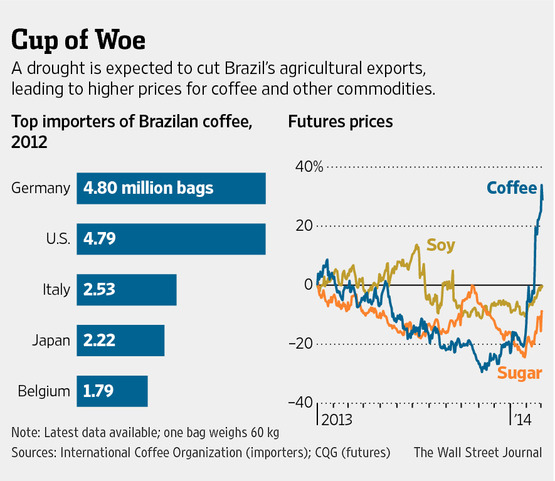
Futures prices for the arabica coffee variety are up 67% since the start of the year. Raw-sugar prices have risen 8%. Soybeans, which have been affected by drought in some areas and too much rain in others, also are up 8%.
The withered coffee trees and parched sugar-cane fields stand in contrast to the bumper crops that have weighed on commodities in recent years. Soaring prices in markets in which Brazil is a key supplier show how quickly global commodity markets can swing from concerns about oversupply to fears of a shortage. The situation in Brazil also could presage a period of price volatility following an era of relatively low and stable prices on many raw materials that benefited companies and individual consumers, analysts say.
Brazil is the world’s biggest grower and exporter of coffee and sugar. For soybeans, it was expected this year to surpass the U.S. as the top producer for the first time, though that is now unlikely because of the weather, analysts say.

“So far this year, the weather [in Brazil] has been the largest surprise for [commodity] markets across the world,” said Adam Sarhan, chief executive at Sarhan Capital, a New York advisory firm.
“When you have a major external effect, especially a drought that you can’t quantify, that throws the entire supply-and-demand equation” out of whack, he said.
The big gains in coffee, sugar and soybeans have helped propel the S&P GSCI commodity index 3.8% this year. The S&P 500 stock index is up 1.4%.
“The weather is creating a lot of interest in some of these markets, and it’s creating a lot of opportunities” for investors, said Jack Scoville, vice president at Price Futures Group in Chicago.
Supply concerns in commodity markets haven’t been isolated to Brazil’s agricultural sector. U.S. supplies of natural gas, which is used to heat and generate electricity, have been stretched by a harsh winter and gas prices are up 10% this year.
Investors pulled $24 million from agricultural-commodity funds in February, though that was down from an average monthly outflow of $97 million last year, according to EPFR Global.
Even after this year’s gains, prices for most commodities are well off the peaks hit in recent years. Sugar prices were twice as high three years ago, while soybean prices would need to rise another 25% to match their summer 2012 levels. Growers outside Brazil are predicting healthy crops in both markets, which could offset reduced production from the drought.
Some analysts say prices have risen too much and that it is too soon to know the drought’s effect on Brazil’s crops.
“Short term, it looks overblown,” said Robbert van Batenburg, director of market strategy at brokerage Newedge. “I could see some form of pause in the massive upswing in the near term.”
Still, Brazil’s bad weather has put an end to forecasts of several more years of record output and global surpluses in the coffee and sugar markets. Brazil is the source of about one-third of the world’s annual coffee crop, more than one-fifth of the sugar output, and about one-third of soybean output.
Now, some analysts are lowering their expectations. Copersucar SA, Brazil’s biggest sugar exporter, said last month that Brazil’s main sugar-cane-growing region will produce 32 million metric tons of the sweetener, 8.6% less than it previously expected.
Also in February, agricultural consulting firm Safras & Mercado cut its estimate of Brazil’s soybean production to 86.1 million metric tons, down 6.2% from a month earlier.
Commodity-trading firms and Wall Street analysts had projected that the current season’s soybean output in Brazil would be larger than the U.S. crop for the first time. Now, many market experts think that isn’t likely. The extreme weather could also sap the potential of the upcoming crops.
“You have to worry—is it too dry to plant corn and cotton and the next crop of soybeans?” said Kona Haque, commodities strategist at Macquarie Bank in London. “Arguably it is, and that’s brewing further concerns for later in the year.”
Prices for arabica coffee, which is prized for its mild flavor and typically used in gourmet blends, have been the most affected by the drought, because Brazil grows more than half the world’s supply. In February, prices jumped 44%, the biggest monthly increase in almost two decades.
In mid-January, when the severity of Brazil’s dry spell became apparent, Jonathan Camarda, executive wealth manager at Camarda Wealth Advisory Group, bought shares of the iPath Pure Beta Coffee ETN, an investment product that tracks coffee prices.
Some experts say the drought in Brazil is likely to have ripple effects beyond the commodity markets directly affected. Ethanol refiners, which turn sugar cane into fuel, are predicting higher prices later this year, while chicken farmers say they will need to pass along rising grain costs to consumers.
“The drought isn’t a direct threat to chickens. The main issue for us is the cost of feed,” said Francisco Turra, president of the Brazilian Poultry Association. “Higher costs means higher prices.
 About bambooinnovator
 Bamboo Innovator