CEOs Scramble to Sell Themselves When Looking for a New Job
March 8, 2014 Leave a comment
CEOs Scramble to Sell Themselves When Looking for a New Job
RACHEL FEINTZEIG
March 4, 2014 7:41 p.m. ET
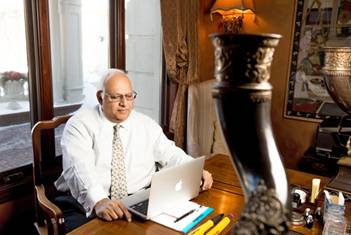
Ravi Saligram, formerly CEO of OfficeMax, at the desk in his home office in Naperville, Ill., last month. Rob Hart for The Wall Street Journal
When Ravi Saligram ran OfficeMax Inc., he revamped the Fortune FT.T -2.78% 500 retailer’s digital strategy and engineered a merger with its chief rival before leaving last November after three years at the helm.
Now on the hunt for a new job as a chief executive, the 57-year-old Mr. Saligram has traded the corner office for his home office in Naperville, Ill. Without an executive assistant for the first time in more than a decade, his hours are suddenly his own. Recently, he debated whether to join LinkedIn.
Former CEOs get plenty of help when they’re looking for new work, from face time with recruiters and high-priced career coaching to advice from fellow executives, who are often just a phone call away.
But interviews with chief executives and recruiters indicate that, in many ways, the miseries of everyone’s job hunt are theirs, too: They spend hours online researching potential employers and searching for leads, or carefully striking the right tone in emails to contacts and former colleagues. They also play a waiting game that some recruiters and executive coaches say has gotten longer and more intense as companies cast a wider, international net for talent and seek chiefs with highly specific skill sets.
Chief executives enjoy a low unemployment rate—1.6% in 2013, compared with 6.6% for all workers, according to the Bureau of Labor Statistics—but job openings at that level have been scarce for several years. The number of S&P 500 companies appointing new leaders reached a nine-year low in 2012, when only 37 companies appointed new chiefs, according to search firm Spencer Stuart. Fifty-three companies named new CEOs in 2013, but 72% were internal moves, according to Spencer Stuart.
That has left some former executives with their pick of next jobs, but “the rest are scrambling,” says Gail Meneley, who provides outplacement services for executives. “It’s like musical chairs.”
Her clients, usually executives who were pushed out of their companies, are now taking posts at smaller firms or settling for lower pay, she says. (Compensation is still healthy, though. The median pay for mid-sized company chiefs was $4.7 million in 2012, according to Equilar Inc., which tracks executive pay.)
Before starting their search, many executives who step off the treadmill choose to take some time off.
David Kirchhoff, who spent nearly seven years in the top post at Weight Watchers International Inc. WTW -2.32% before leaving last August, took six months to travel. He tried bullfighting in Spain and surfing in Australia, and he biked his way through New Zealand. Now back home in Darien, Conn., the 47-year-old Mr. Kirchhoff has been meeting with private-equity firms and venture investors, but he says he’s willing to wait for something “amazing.”
Running a company leaves little time for self-reflection. Jane Stevenson, an executive recruiter and coach with Korn Ferry, recommends that chief executives take at least three weeks off before officially putting themselves on the market, in part to recast their identity away from work.
After announcing her departure as Lululemon Athletica Inc.’s CEO last June, Christine Day says she didn’t plan to start working again until 2015. “Financially, I don’t have to work,” says Ms. Day, but she notes that she’s not the kind of person who can stay idle for long. Companies kept calling, and in January she accepted the top job at Luvo Inc., a maker of healthy frozen meals. She will start full-time in September.
Landing a new CEO role usually takes 10 to 12 months, Ms. Meneley says. Former chiefs can’t stay out of the game too long, however: After more than a year out of the corner office, candidates get stale, search experts say.
One former Fortune 1,000 CEO in her 60s has spent several years attempting a corner-office comeback. Fired in 2008, she expected another top executive job but had to sit on the sidelines waiting out a two-year-long noncompete agreement. By the time she was able to hit the job market, the trail had gone cold. She didn’t get an interview, much less an offer.
“My entire career, I had always been the one who was so actively pursued,” she says, and she now feels “lulled” into semiretirement, serving on a corporate board. She says she wishes she had been more aggressive in pursuing opportunities when she could.
The circumstances of a CEO’s exit matter, but search professionals differ on how much.
“If someone did a flat-out bad job, people are not going to be beating a path to their door to get them to take on another business,” says John Wood, a vice chairman with executive-search firm Heidrick & Struggles International Inc. HSII +4.79%
Kim Van Der Zon, a senior partner with executive search firm Egon Zehnder International Inc., says corporate boards tend to be forgiving toward executives pushed out during a merger. “There’s always going to be a loser, so to speak, But that doesn’t mean they’re viewed as a loser in the market.”
Mr. Saligram, who ran a staff of 28,000 at OfficeMax before its merger with Office DepotInc., ODP +2.46% spends about six to eight hours a day on his job search. Selling himself doesn’t come easily, but he has pushed himself to stay connected and says he’s “quite confident” about his search. The stress of the merger—and the job—behind him, he’s working out at his home gym, tracking his elliptical workouts on a whiteboard and taking time to read mysteries by Brad Meltzer and Jeffrey Archer.
Asked to describe his next employer, he envisions a mid-sized company in growth mode, perhaps something in retail, consumer products, business-to-business services or technology. After taking on a turnaround assignment at OfficeMax, “something with some tail wind” would be nice, he says.
“I’m very clear that it’s not over for me, that I want to run another company,” he says. “You know that it’s going to take time. Your rational side tells you all of that, but still it’s not easy.”
 About bambooinnovator
 Bamboo Innovator