At China’s NPC, Proposed Changes Include Bank Deposit Insurance; Policies in Premier Li’s Annual Report Would Inject More Risk Into Financial System
March 9, 2014 Leave a comment
At China’s NPC, Proposed Changes Include Bank Deposit Insurance
Policies in Premier Li’s Annual Report Would Inject More Risk Into Financial System
BOB DAVIS
Updated March 5, 2014 11:12 a.m. ET

BEIJING—China’s leaders promised policies that would inject more risk into a financial system grown used to bailouts and other government support as Beijing sought to push ahead an overhaul agenda without hurting the economy.
The proposals were included in an annual work report by Premier Li Keqiang to the country’s rubber-stamp legislature that is China’s version of the U.S.’s State of the Union Address, though one that is rarely interrupted by applause and almost never by catcalls.
The Chinese government maintained the country’s growth target at 7.5% for the coming year. But as City University of Hong Kong professor Joseph Cheng tells Deborah Kan, concerns over steady growth are mounting.
The proposed financial makeover includes bank deposit insurance, allowing local governments to issue bonds and permitting the yuan to fluctuate in trading more widely. They were among the more far-reaching policies in a program put before the National People’s Congress that offered few bold steps.
Bank insurance was the most significant financial proposal, UBS China economist Tao Wang said. “It should lay the groundwork to accelerate interest rate liberalization and also make explicit that there are risks in the financial system,” she said. The changes would help banks price their loans according to the riskiness of the borrower rather than their political clout, economists argue, and make more capital available to private companies.
Mr. Li set China’s growth target at “about 7.5%,” the same as last year. That suggests the leadership is worried at least as much about keeping growth from slowing and deepening unemployment, , as it is in pushing difficult and controversial changes that might bolster the country’s long-term prospects. Last year, China’s GDP grew at 7.7%.
There was little in the report, for instance, to indicate that China would slow a buildup in credit that rivals the U.S., Europe, Japan and South Korea before those economies crashed. Slowing credit creation is bound to slow growth, too.
Société Générale analyst Wei Yao called the effort to balance growth and reform “mission impossible.” But Xiang Dong, a senior researcher for the State Council, the government’s executive body, gave Beijing some wiggle room in meeting the growth target. “Whether [growth is] 7.3% or 7.7%, it’s still about 7.5%,” he said at a news conference.
Mr. Li’s congress address was the government’s best opportunity to lay out its goals for this year following the leadership’s endorsement late last year of wide-ranging economic-overhaul priorities for the next decade.
Some of the most specific pledges came in the financial sector. In a section labeled “major tasks for 2014,” Mr. Li said China would set up a bank deposit-insurance system, a proposal that China’s leaders have debated for 20 years. The issue has been so fraught because many Chinese investors figure that deposits in all financial institutions are implicitly guaranteed by the government.
It is far from clear how investors would react to the change. While Mr. Li also said that the government is promoting privately owned banks as a way to funnel money to small and medium-size companies, some argue that depositors will avoid those banks even if there is deposit insurance. That is because they may figure the government will still fully back China’s largest state-owned banks, whatever the policy changes.
Central bank officials have said they are ready to institute deposit insurance. But some banks are still fighting a plan to require them to pay into a fund to pay off depositors in failed banks. Yan Bingzhu, chairman of Bank of Beijing Co.601169.SH -0.96% , a midsize state-owned firm, wrote in a proposal to the government that there is still “disagreement” over the mechanism of deposit insurance in China.
The government report also said that China would ease its control over the exchange rate of the country’s currency—the yuan—and “expand its floating range.” Currently, the central bank sets the daily trading rate for the yuan, which is permitted to rise or fall 1% from that rate. Over the past few weeks, the People’s Bank of China has intervened to weaken the yuan, creating losses for traders who have bet on the yuan’s steady rise. Individuals familiar with the central bank’s thinking say these moves are a prelude to widening the band, probably doubling the range.
In another substantial change, Mr. Li said China would expand the number of cities that could issue bonds. Currently, most cities are barred by the central government from raising debt directly and instead have set up special-purpose companies, which borrow to finance real estate and infrastructure projects. In December, China’s national audit office said that local government debt, including debt incurred by local state owned companies on behalf of the local government, had soared 67% to 17.9 trillion yuan ($2.95 trillion) midyear 2013 since the last tally at the end of 2010, when it was 10.7 trillion.
A separate finance ministry report said that new local-government borrowing could be used to roll over such debt. While that could add even more to China’s growing debt load, the ministry said it would strengthen oversight of local financing to prevent abuse.
Mr. Li’s report didn’t touch on one of the most pressing financial issues before China: whether to allow corporate and local government bonds to default as a way to signal that investors shouldn’t expect government bailouts as has happened in the past. Many economists have argued such a stand is necessary to slow the run-up in credit growth.
While Mr. Li was speaking, the government was faced with whether to step in and repay investors in a Chinese solar company, Shanghai Chaori Solar Energy Science & Technology Co. 002506.SZ +3.19% , which has said it won’t be able to repay on Friday about 89.8 million yuan ($14.7 million) interest on a one billion yuan bond issued two years ago. If it occurs, the default could be the first ever in China’s $1.5 trillion publicly traded corporate-bond market.
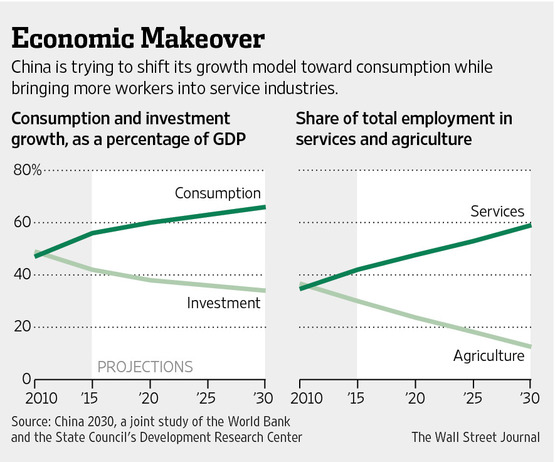
Mr. Li said the government would focus its energies on areas where “the public call for reform is strongest” and where “there is extensive public consensus.” For instance, he trumpeted a reduction in the red tape that hinders private business and incentives for private companies to invest in large state-owned companies. The latter would give state firms a new source of capital without having to give up corporate control. He also discussed China’s smog problem and said China would start reducing particulate matter in the air—although without setting a specific target.
 About bambooinnovator
 Bamboo Innovator