Buddhist Monks Join Protests in Thailand

Buddhist Monks Join Protests in Thailand

JAMES HOOKWAY And WILAWAN WATCHARASAKWET

March 5, 2014 7:12 p.m. ET

image001-11

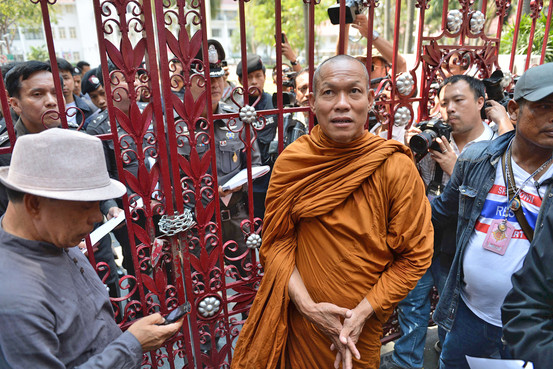
Thai Buddhist monk and antigovernment protest leader Luang Pu Buddha Issara at a rally in Bangkok on Tuesday. Agence France-Presse/Getty Images

BANGKOK— Luang Pu Buddha Issara doesn’t fit the usual picture of a Buddhist monk.

Sure, his hair is shorn and he wears the clergy’s distinctive saffron robes. But Phra Buddha Issara (Phra is a religious title) is also a leader of the street protests seeking to oust Prime Minister Yingluck Shinawatra

.

His high-profile activism reflects how in Thailand, as well as some other predominantly Buddhist parts of Asia, the faith is taking on an increasingly political form.

Phra Buddha Issara is often seen prowling the perimeter of his protest camp with a walkie-talkie, accompanied by tough-looking bodyguards. Last week he led a picket against a pro-government television station to persuade it to lend more favorable coverage to protesters; station executives quickly complied.

A few days earlier, he launched a boycott campaign against businesses linked to the prime minister’s family, including one of Asia’s most profitable cellular phone networks. He and his followers also marched to a hotel owned by the Shinawatra clan to demand compensation for reservations that hotel managers had abruptly canceled; the monk pocketed the equivalent of $3,700.

The losses on the Thai stock market were much heavier: In just a few days, firms perceived to be linked to the Shinawatras lost a combined $2 billion of their market value.

Traditionally, Buddhist monks have seldom intervened in secular affairs. The religion emphasizes rising above the world of desire and suffering, with soft chanting and quiet meditation, and generally lacks the confrontational zeal that helped propel the spread of Christianity and Islam. There is no tradition of jihad or crusade in Buddhism.

But decades of economic mismanagement in Myanmar led some Buddhist monks to take a stand against that country’s former military leaders in the so-called Saffron Revolution in 2007. After the arrival of a quasi-civilian government in 2011, some militant Buddhists began violently opposing what they see as the spread of foreign beliefs, especially Islam.

In Sri Lanka, the end of the civil war in 2009 has given fresh impetus to Sinhalese Buddhist nationalists to push back against what they perceive as the influence of Christianity and Islam among the minority ethnic-Tamil population.

Buddhism is also tied up in Tibetan ideas of nationhood and the Dalai Lama continues to play a prominent role internationally, as China’s outrage over President Barack Obama‘s meeting with the exiled dissident last month showed.

In Thailand, one of the spiritual centers of Buddhism, factional rivalries within the faith are amplifying a political battle that has claimed 22 lives since early November.

Broadly put, the contest is between a new wave of populist politicians such as Ms. Yingluck and her elder brother, former Prime Minister Thaksin Shinawatra, and the royalist old guard, which has customarily held veto power over the actions of elected leaders.

Additional spice is provided by the uncertainty over who or what will fill the gap left when the reign of the ailing, 86-year-old King Bhumibol Adulyadej ends.

The competing factions have used monks to add a measure of spiritual legitimacy to their cause, and Phra Buddha Issara is just one of several taking sides.

In 2010, hundreds of clerics quietly lent their support to pro-Shinawatra “Red Shirt” protesters, dozens of whom were shot dead by security forces in Bangkok while pushing for new elections.

A dozen senior monks were placed on the then-government’s security watch list. Some, including monks who, like many of the Red Shirts, come from the northeast of the country, joined protests as a kind of human shield to deter action from security forces.

“Monastic politics in Thailand are a mirror image of the country’s secular politics, characterized by deep divisions and uncertainties about the future,” academic and author Duncan McCargo wrote in a study about the growing politicization of Buddhist monks here.

Phra Buddha Issara, 46 years old, is one of staunchest opponents of the Red Shirt movement.

In an interview at his heavily fortified protest camp on the northern outskirts of Bangkok, he called democracy a “poison fruit,” and said Buddhists should stand firm to rein in the influence of populist leaders such as Ms. Yingluck and Mr. Thaksin.

The Buddhist clergy, or shagha, was largely sidelined from political life after the end of the absolute monarchy in 1932, and since then, too many monks have been free riders, he said, content to let secular leaders run Thailand.

Some Buddhist organizations have tried to put the brakes on Phra Buddha Issara’s activism, warning him that he is violating clerical rules by taking such a public, political stance in a country where monks aren’t even allowed to vote.

The country’s highest Buddhist authority, the Supreme Sangha Council, though, has been rudderless since the death of its supreme patriarch at the age of 100 in October. It could be months before a new leader is chosen.

That leaves plenty of time for Phra Buddha Issara and other activist monks to reshape the role that monks play in Thailand’s increasingly bloody politics.

Unknown's avatarAbout bambooinnovator
Kee Koon Boon (“KB”) is the co-founder and director of HERO Investment Management which provides specialized fund management and investment advisory services to the ARCHEA Asia HERO Innovators Fund (www.heroinnovator.com), the only Asian SMID-cap tech-focused fund in the industry. KB is an internationally featured investor rooted in the principles of value investing for over a decade as a fund manager and analyst in the Asian capital markets who started his career at a boutique hedge fund in Singapore where he was with the firm since 2002 and was also part of the core investment committee in significantly outperforming the index in the 10-year-plus-old flagship Asian fund. He was also the portfolio manager for Asia-Pacific equities at Korea’s largest mutual fund company. Prior to setting up the H.E.R.O. Innovators Fund, KB was the Chief Investment Officer & CEO of a Singapore Registered Fund Management Company (RFMC) where he is responsible for listed Asian equity investments. KB had taught accounting at the Singapore Management University (SMU) as a faculty member and also pioneered the 15-week course on Accounting Fraud in Asia as an official module at SMU. KB remains grateful and honored to be invited by Singapore’s financial regulator Monetary Authority of Singapore (MAS) to present to their top management team about implementing a world’s first fact-based forward-looking fraud detection framework to bring about benefits for the capital markets in Singapore and for the public and investment community. KB also served the community in sharing his insights in writing articles about value investing and corporate governance in the media that include Business Times, Straits Times, Jakarta Post, Manual of Ideas, Investopedia, TedXWallStreet. He had also presented in top investment, banking and finance conferences in America, Italy, Sydney, Cape Town, HK, China. He has trained CEOs, entrepreneurs, CFOs, management executives in business strategy & business model innovation in Singapore, HK and China.
Leave a comment