Italian finance: Time to modernise; ‘Stress tests’ will count for little until the vast network of local banks is overhauled and governance reformed
March 9, 2014 1 Comment
March 4, 2014 6:57 pm
Italian finance: Time to modernise
By Rachel Sanderson
‘Stress tests’ will count for little until the vast network of local banks is overhauled and governance reformed
As the tourist season was heating up last summer in the southern Italian region of Puglia, officials from the Bank of Italy seized control of a small co-operative bank in Alberobello, the sun-baked town known for its whitewashed trulli houses.
Inspectors had been poring over the books at Banca di Credito Cooperativo di Alberobello as part of the preparations for this year’s “stress tests” of European banks. But this routine exam turned up “serious breaches” of anti-money laundering rules at the bank. Prosecutors later alleged that a longstanding board member was funnelling money for the local mafia.
The case of tiny Banca Alberobello may be an isolated and extreme example but it highlights growing concern about governance and lending standards in hundreds of small banks in Italy.
As the European Central Bank prepares to conduct stress tests and asset quality reviews of hundreds of banks across the eurozone, there is particular worry among some European regulators about Italy’s banks.
These concerns have led the Bank of Italy to conduct its own intensive examinations across the nation, such as the one at Banca Alberobello, ahead of the ECB tests. From Banca di Sicilia in the deep south to Banco di Trento e Bolzano, in the German-speaking northeast, the Bank of Italy is staging its toughest examination of the nation’s banks in history.
Italian banks came out among the weakest in the EU’s stress tests in 2011. Its worst performing was Monte dei Paschi di Siena, Italy’s third-largest bank by assets that has since been the subject of its third state bailout in four years, as well as a scandal about the alleged use of hidden derivatives to hide losses.
Italian officials say the country cannot afford another failure as it struggles to emerge from a crippling two-year recession. The Bank of Italy is urging some of the nation’s largest lenders to raise capital in the markets to build a buffer against potential loan defaults and bolster investor confidence. It is also pressing weaker midsized banks to merge to create stronger balance sheets while seizing control of vulnerable smaller banks, such as that in Alberobello.
Despite the public clean-up, industry insiders say the Italian banking system will not be truly reformed until regulators tackle the system’s centuries-old culture of campanilismo – a system in which local communities protect their own.
Campanilisimo has left Italy with too many lenders to serve an economy that has generated little growth over the past decade, bankers argue. The result is a banking sector plagued by weak profitability – and weak banks cannot provide the lending needed to stimulate the economy.
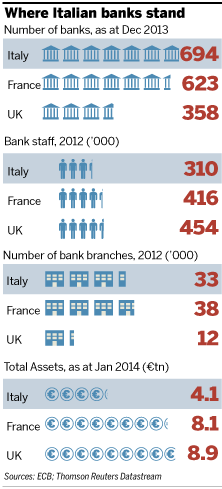
“The cap hikes will go well,” says a large foreign investor. “There is a lot of money looking for cheap assets. If you compare [Italian banks] with the book value of Spanish banks you are going to make money. But it doesn’t address the structural issues. Italy is overbanked and profitability is poor.”
Italy has almost 700 banks, employing 310,000 people in 33,000 branches. The banks’ total assets are €3.5tn, worth 225 per cent of gross domestic product.
Up until 2010, Italy’s banks were held up as an exemplar of the advantages of conservative banking. They withstood the financial crisis better than their European and US peers due to an aversion to risky derivative products and high savings rates among Italians.
Their ties to their local communities – sometimes dating back hundreds of years – strengthened this conservatism. Even its largest banks by assets, UniCredit and Intesa Sanpaolo, which are in reality an amalgamation of dozens of smaller banks, largely remain rooted in their local towns.
But as the European debt crisis hit in 2011 and the Italian economy fell into recession, the Italian banks’ focus on lending to local small and midsized businesses was no longer a source of strength.
Weakness in Italy’s real economy and the link between the financial sector and the sovereign remain crucial risks to the banking system, the International Monetary Fund has warned. Non-performing loans rose to a record €155bn at the end of last year, according to ABI, the Italian banking association.
“Weak profitability and deteriorating loan quality are the most pressing vulnerabilities affecting Italian banks,” the IMF said.
Today five of Italy’s 15 largest banks are already lined up for a capital increase for an aggregate amount of about €7bn in the coming weeks. These are Monte dei Paschi di Siena; Banca Popolare di Milano and Banco Popolare, the fifth and sixth-largest by assets; Carige, the main bank in the port city of Genoa; and Popolare di Vicenza in the northeast.
The number of Italian banks coming to market to raise funds is not expected to stop there. Goldman Sachs estimates that the aggregate shortfall for the Italian banking sector stands at a midpoint of €17bn. The worst-case scenario puts the shortfall at €23bn.
“We will see others” raising funds in the public markets, says a senior Italian investment banker who has many of Italy’s largest banks as clients. “Whereas everyone was very confident, that swagger has now gone. No one is safe any more,” he says.
Even UniCredit and Intesa Sanpaolo, which are considered safely within the ECB rules, are still seeing many of their loans to small and midsized companies turn sour as economic growth stalls. Both are taking steps to sell these loans to clean up their balance sheets.
Alberto Nagel, chief executive of Mediobanca, the Milanese bank, has said he is looking at doing the same to clean up the bad loan exposure held by smaller banks.
The pressure of the stress tests is even showing signs of prompting long-awaited consolidation among some of Italy’s smaller regional, co-operative popolari banks.
UBI and Banco Popolare of Verona, BPM and Banca Popolare dell’Emilia Romagna, Credito Valtellinese and Banca Popolare di Sondrio are all considered possible tie-ups, according to senior bankers with direct knowledge of discussions.
The Bank of Italy has brought 13 smaller banks under its direct control, including Alberobello. Alberto Gallo, senior credit analyst at RBS, believes that in Europe, “Italian mid-tier banks need to reform the most, not just in raising capital but also in consolidating, reducing costs and increasing efficiency”.
The pressure being imposed by the Bank of Italy has irked some bank chief executives. “The Bank of Italy is making up in a year for 20 years of not doing its job properly,” says the chief executive of a large Italian bank.
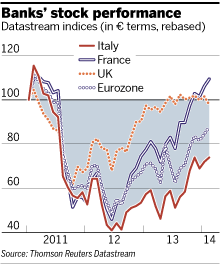
But investors and analysts say the timing of the capital raising is good. Foreign interest in Italy, particularly from the US, has picked up because valuations are still low compared with Greek and Spanish banks. Italian banks have lost 20 per cent of their value since January 2011. EU banks on average are down only 5 per cent.
For Antonio Patuelli, chairman of the ever-bullish Italian banking association, a year from now Italy’s banking system will have been vindicated.
“Those banks that cannot go it alone will need to do capital hikes, sell things, undertake mergers. But the stress tests are going to be a positive surprise. After all these years people are going to realise that Italy is not the sick man of Europe,” he says.
. . .
Yet even if the stress tests go as well as Mr Patuelli predicts, many in the industry say the Bank of Italy will still need to tackle the most vexing issue in Italian banking: the governance structures of community banks.
Co-operatives and banks under significant influence of banking foundations – not-for-profit organisations made up of local community leaders that still hold majority stakes in most Italian banks – fared noticeably worse in the last stress tests.
Senior European officials argue that Italy should follow the example of Spain, where 45 banks were turned into about 10 through a series of mergers. But local ties in Italy make that difficult.
One senior bank executive describes the banking system as “the glue that holds Italy together”. He describes a complex network in which banking shareholders and foundations are woven into politics and the Italian economy, while unions hold seats on the boards of the banks through foundations.
“We need a solvent to wash it away,” he says.
The Bank of Italy is making up in a year for the 20 years of not doing its job properly
Mr Patuelli, a former government undersecretary who chairs a bank in the seaside town of Ravenna, rejects the idea that community ties have ossified Italy’s banks – or even that politics plays any role in the industry.
“Foundations are long-term institutional investors that are vital in a country like Italy where there is a lack of capital and institutional investors, such as foreign pension funds,” he says.
. . .
The example of Banca Popolare di Milano provides a salutary lesson for investors about the difficulties of investing in the Italian system.
Andrea Bonomi, the Italian-American founder and senior principal at investment firm Investindustrial, took a gamble on investing in BPM in October 2011. Mr Bonomi, who made a successful investment in Ducati, the Italian motorcycle maker, sensed a good opportunity if the local bank of Italy’s richest city could clean up its balance sheet and governance.
This overhaul appeared to be under way when Mr Bonomi made his investment. Its former management had resigned after the Bank of Italy raised concerns about the bank’s century-old governance structure that gave each shareholder one vote. This gave a hard core of unionists rooted in the local community effective control of the bank.
Massimo Ponzellini, its former chairman, was placed under house arrest in May 2012 after being accused of false accounting and paying kickbacks to local politicians. He has denied the charges.
Yet in spite of the scandal and pressure from regulators, BPM’s unionist core remains intent on retaining control. Mr Bonomi sold his entire 8.6 per cent stake in January after he was blocked by other board members from introducing governance changes that would have diluted the union’s power. Mr Bonomi made a small profit but not as much as he had hoped. Still, Citigroup estimates earnings will rise if corporate governance improves at the bank, as executives have promised.
When asked by the Financial Times a few weeks before his stake sale whether he would make the investment again, a weary Mr Bonomi said: “Probably not”.
Mr Gallo at RBS admits that “reform is not simple in Italy, with intricate cross-shareholdings and shared directorships complicating efforts.” He adds: “However, reform and recapitalisation of the banks is critical to get credit flowing to the real economy again.”
——————————————-
Loans: State debt pile scuppers ‘bad bank’ idea
Non-performing loans have become the bugbear of the Italian banking system. A non-performing loan, or NPL, refers to a loan that is in default or is close to being in default. Many loans become non-performing after being in default for 90 days, although this depends on the contract terms.
NPLs held on Italian banking books were worth €150bn at the end of November, up by a fifth compared with a year before, according to the Italian banking association. With Italy’s economy showing only weak and uncertain growth, NPLs will mount for the foreseeable future, says the Bank of Italy.
In response, the Italian banking system is seeking to clean up its books in several ways.
The Bank of Italy is guiding banks towards making “lots of provisions” in the coming quarters and officials admit it will take many years before NPLs have worked their way through the banks’ balance sheets.
Italian banks are individually also seeking to sell their NPLs to foreign buyers, such as US distressed debt funds including KKR. Some midsized banks are in talks to merge as they try to gain economies of scale to offset their weak loan books.
But these attempts have run into a significant obstacle: bankers say a big gap has opened up between market value and the book value of NPLs during Italy’s crippling two-year recession.
At one midsized bank external valuations are coming in at 10 cents for NPLs priced at book value by the banks at 40 cents in the euro, according to industry sources.
Many bankers privately admit that the best way for Italian banks to get rid of their NPLs would be for the Italian state to set up a “bad bank”, such as that created in Spain.
But the double weaknesses of the Italian economy and the Italian state’s still growing debt pile make that an impossibility, they say.
Italian officials have been opposed to the idea of a state-sponsored solution, concerned about its impact on Italy’s €2tn of national debt.
Francesco Daveri, an economist at Parma University, says: “If a bad bank is set up now with many firms still going bankrupt and many loans going into arrears, public finance costs would be very high.”
 About bambooinnovator
 Bamboo Innovator
I read the article: March 4, 20 1 4 6: 57 pm
Italian finance : Time to modernise
By Rachel Sanderson
I want to extend a heartfelt thanks to the Financial Times correspondent, Rachel Sanderson, for the further notoriety given to Puglia and to the witewashed trulli houses of the town Alberobello, a UNESCO world heritage site.
I also want to say however, that I do not share what represented by Rachel Sanderson and generalized about the poor state of health of Italian banks and specifically of small cooperative banks, citing as negative and representative examples, the great Monte dei Paschi Siena and the small (certainly not among the Bcc) Banca di Credito Cooperativo di Alberobello, the whose capital strength is absolutely out of the question.
It’s sure that the capital strength of the Banca di Credito Cooperativo di Alberobello remains valid even in the presence of negative events that have led the Bank of Italy to propose and obtain from the Minister of Economy and Finance the emission of the decree of extraordinary administration.
To verify such a truth was enough to take a look at balance sheets, published on the website of the said Bcc, but probably, Rachel Sanderson did not do that.
The Core Tier 1 (indicator of capital strength of banks) of the Banca di Credito Cooperativo di Alberobello at 31 December 2012 was equal to 20.26%, compared with a minimum 8% required by the regulations ECB (Common Equity Tier 1 ratio).
I think that is exactly the case that Rachel Sanderson, in another article, much more weighted, provides not only to revise her negative representation of the cooperative banks, which are also very common in other major European countries, but even more, she corrects the erroneous opinion expressed on the Banca di Credito Cooperativo di Alberobello, wrongly considered not solid and not able to “provide the necessary credit to stimulate the economy.”