Giant batteries: The missing piece of the renewable-power jigsaw may now have been found in the form of a new type of flow battery

Going with the flow

Giant batteries: The missing piece of the renewable-power jigsaw may now have been found in the form of a new type of flow battery

Mar 8th 2014 | From the print edition

image001-30

THERE is nothing so expensive, some cynics suspect, as free fuel. It is not that turning wind and sunlight into electricity is itself that costly, provided you pick the right places to do it. But it is not reliable. The wind does not always blow, and even in the most cloud-free desert night falls with monotonous regularity. Political commitments to use large quantities of renewables, such as several European countries have made (see article), thus risk the lights going out. The search therefore has been on for a cheap way to store energy transduced from sun and wind when it is plentiful, so that it can be used when it is not. Read more of this post

Let the sun shine: The future is bright for solar power, even as subsidies are withdrawn

Let the sun shine: The future is bright for solar power, even as subsidies are withdrawn

Mar 8th 2014 | IVANPAH VALLEY, CALIFORNIA, AND LEXINGTON, NORTH CAROLINA | From the print edition

FORTY-FIVE minutes west of Las Vegas, dejected sinners may encounter a sight to lift their sunken hearts: a sea of 347,000 mirrors, reflecting the rays of the desert sun on to boilers mounted on three 460-foot towers. The Ivanpah solar-thermal plant (pictured), which opened in mid-February, is the largest of its kind in the world. Fully ramped up, it will deliver around 377 megawatts (MW) of power to 140,000 homes in southern California. Its backers compare it to the nearby Hoover Dam; an astronaut claims to have spotted it from the international space station. It is a striking sight, even if the heat from its heliostats has roasted dozens of unfortunate birds alive. Read more of this post

Angela Belcher is a materials scientist who makes things with viruses. She is now using them to attack cancer

Brain scan: The DNA of materials

Angela Belcher is a materials scientist who makes things with viruses. She is now using them to attack cancer

Mar 8th 2014 | From the print edition

“IT’S getting a little challenging,” says Angela Belcher. “I feel I am having to make choices now, which I never really wanted to.” But there are only so many hours in the day and she already combines multiple academic disciplines into a repertoire of research that spans an ambition to drive an electric car powered by a virus battery to building better touch-screens for digital devices and lately to giving surgeons new tools to detect and potentially treat minute traces of cancer. Read more of this post

China’s restless West: The burden of empire; After a brutal attack in China, the Communist Party needs to change its policies towards minorities

China’s restless West: The burden of empire; After a brutal attack in China, the Communist Party needs to change its policies towards minorities

Mar 8th 2014 | From the print edition

image001-10

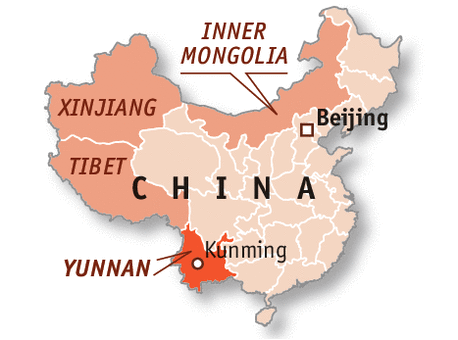
A GROUP of knife-wielding assailants, apparently Muslims from western China, caused mayhem and murder on March 1st in the south-western Chinese city of Kunming, stabbing 29 people to death at the railway station and injuring 140 others. The attack has shocked China. The crime against innocents is monstrous and unjustifiable, and has been rightly condemned by the Chinese government and by America. But as well as rounding up the culprits, the Communist Party must face up to an uncomfortable truth. Its policy for integrating the country’s restless western regions—a policy that mixes repression, development and Han-Chinese migration—is failing to persuade non-Han groups of the merits of Chinese rule. Read more of this post

Business in emerging markets: Submerging hopes; The boom in emerging-market investment by rich-world firms has led to plenty of disappointment

Business in emerging markets: Submerging hopes; The boom in emerging-market investment by rich-world firms has led to plenty of disappointment

Mar 8th 2014 | From the print edition

image001-29

IN 2007 UniCredit, an Italian bank, fought off ferocious competition from other Western lenders to buy Ukraine’s fourth-largest bank from an oligarch for a queasy $2 billion. This week, amid talk of war and default, UniCredit limited withdrawals from its ATMs in Ukraine. At the same time, the shares of firms that are big in Russia, such as Carlsberg and Renault, fell. Read more of this post

Autism: Women have fewer cognitive disorders than men do because their bodies are better at ignoring the mutations which cause them

Autism: Women have fewer cognitive disorders than men do because their bodies are better at ignoring the mutations which cause them

Mar 1st 2014 | From the print edition

AUTISM is a strange condition. Sometimes its symptoms of “social blindness” (an inability to read or comprehend the emotions of others) occur alone. This is dubbed high-functioning autism, or Asperger’s syndrome. Though their fellow men and women may regard them as a bit odd, high-functioning autists are often successful (sometimes very successful) members of society. On other occasions, though, autism manifests as part of a range of cognitive problems. Then, the condition is debilitating. What is common to those on all parts of the so-called autistic spectrum is that they are more often men than women—so much more often that one school of thought suggests autism is an extreme manifestation of what it means, mentally, to be male. Boys are four times more likely to be diagnosed with autism than girls are. For high-functioning autism, the ratio is seven to one. Read more of this post

The search for a cure for AIDS: If it ain’t broke.then break it

The search for a cure for AIDS: If it ain’t broke…then break it

Mar 8th 2014 | From the print edition

GENE therapy usually works by repairing a broken gene or creating a new one where none previously existed. Breaking a working gene to effect a cure is a novel approach. That, though, is what Carl June of the University of Pennsylvania and his colleagues are trying to do. As they explain in the New England Journal of Medicine, by damaging a gene called CCR5 they hope to treat—and possibly cure—infection with HIV, the virus that causes AIDS. Read more of this post

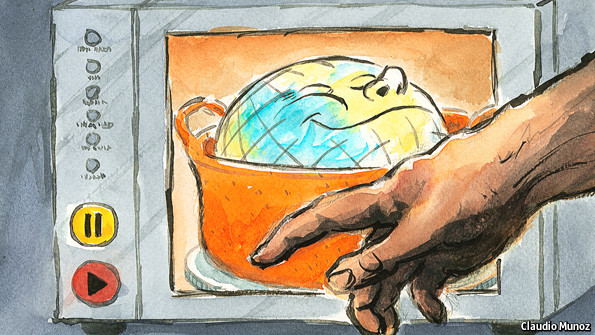
Global warming: Who pressed the pause button? The slowdown in rising temperatures over the past 15 years goes from being unexplained to overexplained

Global warming: Who pressed the pause button? The slowdown in rising temperatures over the past 15 years goes from being unexplained to overexplained

Mar 8th 2014 | From the print edition

image001-28 image002-10 ]

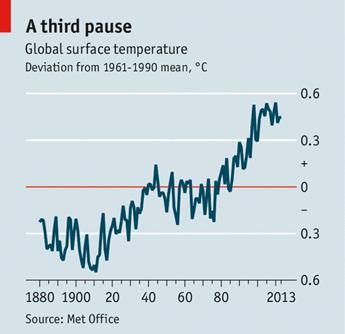
BETWEEN 1998 and 2013, the Earth’s surface temperature rose at a rate of 0.04°C a decade, far slower than the 0.18°C increase in the 1990s. Meanwhile, emissions of carbon dioxide (which would be expected to push temperatures up) rose uninterruptedly. This pause in warming has raised doubts in the public mind about climate change. A few sceptics say flatly that global warming has stopped. Others argue that scientists’ understanding of the climate is so flawed that their judgments about it cannot be accepted with any confidence. A convincing explanation of the pause therefore matters both to a proper understanding of the climate and to the credibility of climate science—and papers published over the past few weeks do their best to provide one. Indeed, they do almost too good a job. If all were correct, the pause would now be explained twice over. Read more of this post

Religion and advertising: Competing to be the real thing

Religion and advertising: Competing to be the real thing

Mar 8th 2014, 12:01 by B.C.

image001-26

TWO recent bits of news will be of interest to people who worry about the offence which advertising and other marketing tools can cause to religious believers. As it happens, both items concern Christians in Britain, but one could find many similar stories from other countries and faiths. The Advertising Standards Authority (ASA), a self-regulatory body,rejected a complaint from 30 people who said they were upset by a Christmas commercial for KFC, a fast-food chain. The ad poked lightish fun at some secular aspects of the winter-holiday celebration (like shoppers squabbling over an item they both wanted) and showed carol singers trying to soften the heart of a Scrooge-like figure with what they self-mockingly called “stupid songs”. It was the latter two words which offended some; but as the ASA noted, the singers were just making a point about their grumpy listener’s state of mind. Read more of this post

French telecoms wars: Gloves off; Since the beginning of 2012, when a new competitor, Iliad Group’s Free, crashed in with super-low prices and soon snatched more than 10% of the market, revenues of the three incumbent operators tumbled

French telecoms wars: Gloves off

Mar 8th 2014, 11:38 by M.S. | PARIS

ANY ordinary person who has spent some time in France will have been puzzled by the unpredictable internet and mobile connections in a country where services are by and large among the world’s best. It is not only in remote rural regions that you have to run up a hill waving your mobile to send a text. The Left Bank in Paris can also feel like the Pyrenees. This may now change, thanks to a gloves-off battle for the country’s second-biggest telecoms operator. Read more of this post

High-speed rail link to connect provincial capitals in China

High-speed rail link to connect provincial capitals in China

Staff Reporter

2014-03-09

China is building a high-speed rail link to connect almost every provincial capital in the country and shrink the travel time between them to less than eight hours, said Wang Mengshu, deputy chief engineer of state-owned China Railway Group Limited. Read more of this post

Like the world fairs of old, Silicon Valley runs on booms, busts, and showboating impresarios. That’s a good thing

Like the world fairs of old, Silicon Valley runs on booms, busts, and showboating impresarios. That’s a good thing

by Venkatesh Rao 3,500 words

Venkatesh Rao is a Seattle-based writer and consultant. He is the author of Tempo (2011), a book on decision-making, and blogs at ribbonfarm.

A few times a month, I walk from my apartment in the rapidly gentrifying Lower Queen Anne part of Seattle towards one of the cafés in the booming South Lake Union neighbourhood. A good deal of the real estate along my route is controlled by Microsoft’s co-founder Paul Allen, and much of the demand is driven by Amazon’s inexorable rise. Read more of this post

How to be Happier and More Productive by Avoiding ‘Decision Fatigue’

How to be Happier and More Productive by Avoiding ‘Decision Fatigue’

Posted on Tuesday, May 7th, 2013

Written by Brian Bailey

image001-24 image002-8

Let’s say it’s your birthday.

First, happy birthday! We got you a cake.

We’ll come back to the cake in a moment. Read more of this post

Think you’re a thought leader? You’re probably wrong. but here are 3 ways to become one

Think you’re a thought leader? You’re probably wrong… but here are 3 ways to become one

Cheryl Kim, Special to Financial Post | March 7, 2014 | Last Updated:Mar 7 11:57 AM ET
Thought leadership. A term bandied about daily by public relations people trying to build the reputation of their CEO. But most people talking about thought leadership have no clue what it means. And most content labelled as “thought leadership” is actually missing the elements of both “thought” and “leadership”. Read more of this post

Fastenal’s CEO Sweats the Small Stuff: Will Oberton climbed Fastenal’s ranks by sticking with basics and solving problems creatively. Even Warren Buffett is impressed

SATURDAY, MARCH 8, 2014

Fastenal’s CEO Sweats the Small Stuff

By DYAN MACHAN | MORE ARTICLES BY AUTHOR

Will Oberton climbed Fastenal’s ranks by sticking with basics and solving problems creatively. Even Warren Buffett is impressed. Read more of this post

Study Gives Hope of Altering Genes to Repel H.I.V.

Study Gives Hope of Altering Genes to Repel H.I.V.

By DENISE GRADYMARCH 5, 2014

image001-19

Jay Johnson of Philadelphia took part in research involving gene editing, which zeros in on a particular gene and disables it.  Read more of this post

Evan Williams, the billionaire co-founder of Twitter, is trying to rethink online writing at his new start-up, Medium

MARCH 8, 2014, 2:00 PM  Comment

With Medium, Evan Williams Is Tackling the Future of Writing Online

By CLAIRE CAIN MILLER

image001-18Peter DaSilva for The New York TimesEvan Williams, the billionaire co-founder of Twitter, is trying to rethink online writing at his new start-up, Medium.

As a founder of both Blogger and Twitter, Evan Williams helped change the way people write online. Now, with his latest start-up,Medium, he is trying to figure out how we will write in the future. Read more of this post

Counting our blessings: We should learn to be thankful for the many good things in life that we often take for granted

Updated: Sunday March 9, 2014 MYT 7:21:10 AM

Counting our blessings

BY SOO EWE JIN

We should learn to be thankful for the many good things in life that we often take for granted.

THERE are some realities in life that we sometimes find difficult to embrace. Read more of this post

China Online Funds Pressure Deposit Ceiling, Ex-PBOC Vice Governor; Banks Want to Clamp Down on Money-Market Funds

China Online Funds Pressure Deposit Ceiling, Ex-PBOC Vice Governor

Banks Want to Clamp Down on Money-Market Funds

March 8, 2014 4:03 a.m. ET

BEIJING—Online money-market funds are putting pressure on the central bank’s ceiling on bank deposit rates, but regulators welcome the development, a former vice governor of the People’s Bank of China said Saturday. Read more of this post