Indonesian middle class spending offsets falling commodity prices
March 14, 2014 Leave a comment
March 12, 2014 5:23 am
Indonesian middle class spending offsets falling commodity prices
By Ben Bland in Balikpapan
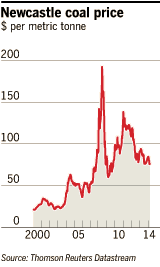
Balikpapan on the island of Kalimantan should by rights be feeling the chill winds of China’s economic slowdown. As Indonesia’s coal capital it has – like other major commodity producing nations from Australia to Brazil – seen prices of key exports tumble over the last couple of years.
Yet, as testified by sales of plush apartments on the seafront, rising middle class incomes are fuelling a resurgent local economy, as in other second-tier cities such as Banjarmasin, Makassar and Medan.
Thus even as the price of the coal filling the barges in front of her office has fallen by as much as a third in the last two years, property developer Nina Ristina believes there are still plenty of wealthy buyers for the apartments she is selling.
“Sales only began in July but we’ve already sold 500 out of 1,100 apartments,” says Ms Ristina, a manager for the Borneo Bay Residences, as she markets a show apartment fitted with a smartphone-compatible remote-controlled lighting system.
“Most of the buyers are local residents and about 30 per cent are involved in the coal industry.” That is no surprise: Indonesia is the world’s largest exporter of coal for power stations and China its biggest customer.
She says that while property price growth in the capital, Jakarta, has started to slow, Balikpapan is still booming, with high demand for new housing, retail space and apartments in the city’s first “super block”, which will incorporate a shopping mall, hotel and apartments when it opens in 2017.
Two-bedroom, 55 square-metre apartments in the Borneo Bay Residences are on offer at Rp1.4bn ($123,000) and prices are rising at around 5 per cent every three months. The development will eventually be connected to Balikpapan’s new Rp1.8tn airport by a coastal highway built on reclaimed land.
Although investors in Balikpapan remain optimistic, economic growth across Indonesia eased to the slowest annual pace since 2009 last year, at 5.8 per cent.
With shipments of coal, palm oil and other natural resources accounting for around 60 per cent of exports in southeast Asia’s biggest economy, the slump in global commodity prices has pushed Indonesia’s current account into deficit at a time when investors remain nervous about emerging markets.
The decline in commodity prices has continued apace, with iron ore prices suffering one of their steepest declines on record on Monday because of fresh concerns about slowing demand from China.
Buddhika Piyasena, an energy analyst at debt rating agency Fitch in Singapore, says that some small Indonesian coal miners with a high cost base will be forced to shut down because of the fall in prices.
But the large players like Adaro Energy, Bumi Resources and Indo Tambangraya Megah have defied market expectations by cutting costs and increasing production to make up for the drop in average selling prices.
“The industry is more resilient than we thought,” says Mr Piyasena. “It’s surprising how much operators have been able to cut costs and improve competitiveness.”
But while demand from China for coal is still growing in absolute terms, Beijing is seeking to increase its use of renewable energy and reduce the need for imported coal by better connecting remote inland mines with power plants near the main population centres.
“It’s not a very rosy picture,” says Mr Piyasena, who expects coal prices to remain “flattish” over the next two to three years.
That is not good news for the recently-minted mining tycoons of Balikpapan and other coal producing areas in Indonesia.
However, analysts believe that strong domestic demand in secondary cities like Balikpapan, with more than 500,000 people, will continue to be the backbone of the economy as the middle class grows rapidly.
Boston Consulting Group predicts that the consuming class will double from 74m to 140m people by 2020, defining this grouping as households spending more than Rp2m ($164) a month.
“We are not only dependent on coal,” says Dosi Samon, who runs a construction and building supplies company based in Samarinda, the provincial capital of East Kalimantan, which is being connected to Balikpapan by a 100km toll road. “The Indonesian economy is driven by our basic needs, which are still increasing.”
Chrisna Endrawijaya, the 27-year-old editor of the Kaltim Post, the province’s best-selling newspaper, agrees that East Kalimantan is proving remarkably resilient.
“People say the media is a dying industry in America but we are making good money here,” he says. “Advertising demand is still very strong, driven by property, motorbikes and cars.”
 About bambooinnovator
 Bamboo Innovator